
Items related to Project Risk Management: A Proactive Approach (Project...
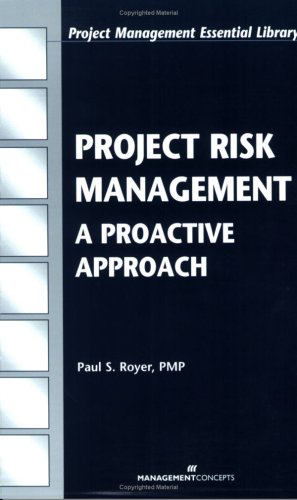
Synopsis
You don't need sophisticated statistical analysis or software to improve the probability of project success. This book offers a proactive project management process for managing project risk from project initiation through planning, execution, control and closure. In addition, you'll apply a new technique for program risk auditing that lets you explore risk in multiple related projects. You'll learn how to uncover hidden risk during the planning phase and how to track and manage it throughout the project. You'll also learn to enhance project value by building a risk management repository to support ongoing knowledge transfer.
"synopsis" may belong to another edition of this title.
About the Author
Paul Royer, PMP, is the founder of Proactive Risk Management, an informa-
tion technology and management consulting firm in Olympia, Washington, specializing in project management, risk management, and quality assurance. He has more than 30 years of experience in the information systems indus- try, specifically in health care, government, and consulting. His background includes project management, risk management, quality assurance, systems development, data and process modeling, data warehousing, data administra- tion, training and coaching, methodology development and implementation, business requirement definition, and process improvement. He has a BA in
Computer Science from the University of California at Berkeley.
Excerpt. © Reprinted by permission. All rights reserved.
Project Risk Management
A Proactive Approach
By Paul S. RoyerManagement Concepts Press
Copyright © 2002 Management Concepts, Inc.
All rights reserved.
ISBN: 978-1-56726-139-4All rights reserved.
Contents
Preface,
Acknowledgments,
CHAPTER 1 Risk Management As a Project Management Process,
CHAPTER 2 Initiation: Project Opportunity Assessment,
CHAPTER 3 Risk Management Planning,
CHAPTER 4 Execution: Project Risk Audit,
CHAPTER 5 Controlling: Continuing Risk Management,
CHAPTER 6 Closure: Risk Knowledge Transfer,
CHAPTER 7 Program Risk Audit,
Bibliography,
Risk Management Lexicon,
Index,
CHAPTER 1
Risk Management As a Project Management Process
It must be remembered that there is nothing more difficult to plan, more doubtful of success, nor more dangerous to manage than the creation of a new system. For the initiator has the enmity of all who would profit by the preservation of the old institution and merely the lukewarm defense in those who would gain by the new ones. — Machiavelli
The art of project management consists of many processes. As defined by the Project Management Institute in the PMBOK® Guide, there are five essential project management processes, as shown in Figure 1-1. For reference, we define these processes simply as follows:
• Initiating processes — Obtaining commitment to begin a project
• Planning processes — Establishing a plan to accomplish the business need that the project addresses
• Executing processes — Coordinating the people and other resources assigned to the project
• Controlling processes — Ensuring achievement of project goals through monitoring and measuring progress so that remedial action can take place in a timely fashion
• Closing processes — formalizing completion of the project by acceptance of final deliverables, leading to an orderly project end.
OVERVIEW OF RISK MANAGEMENT PROCESSES
Before discussing how to manage risk, we must agree on a definition for the term. In the context of project management, we define risk as:
The potential events or circumstances that threaten the planned execution of the project.
This definition puts a totally negative context around the word risk. Others, such as the Project Management Institute, include the positive opportunities (impacts) that risks may have on a project. However, in developing a proactive risk management philosophy, it is most important to concentrate on the negative aspects of risk.
Each project management process has a corresponding risk management process, as shown in Figure 1-2. To establish a common reference framework, we define the risk management process simply as follows:
• Initiation: Project opportunity assessment — Examining the high-level requirements of the project opportunity to define risks versus opportunities in order to make a decision to proceed or not to proceed with the endeavor
• Planning: Risk management planning — Identifying risks and developing mitigation strategies and contingency plans to minimize their impact
• Executing: Project risk audit — Auditing the effectiveness of project management processes
• Controlling: Continuing risk management — Monitoring identified project risks to trigger the implementation of risk mitigation strategies and contingency plans; identifying new risks
&#
"About this title" may belong to another edition of this title.
Search results for Project Risk Management: A Proactive Approach (Project...

Stock Image
Project Risk Management: A Proactive Approach (Project Management Essential Library)
Seller: Orion Tech, Kingwood, TX, U.S.A.
Seller rating 5 out of 5 stars

paperback. Condition: Good. Seller Inventory # 1567261396-3-37755893
Stock Image
Project Risk Management: A Proactive Approach (Project Management Essential Library)
Published by
Management Concepts (edition ), 2001
ISBN 10: 1567261396
ISBN 13: 9781567261394
Used
Paperback
Seller: BooksRun, Philadelphia, PA, U.S.A.
Seller rating 5 out of 5 stars
Paperback. Condition: Fair. The item might be beaten up but readable. May contain markings or highlighting, as well as stains, bent corners, or any other major defect, but the text is not obscured in any way. Seller Inventory # 1567261396-7-1
Stock Image
Project Risk Management: A Proactive Approach (Project Management Essential Library)
Seller: ThriftBooks-Reno, Reno, NV, U.S.A.
Seller rating 5 out of 5 stars
Paperback. Condition: Very Good. No Jacket. May have limited writing in cover pages. Pages are unmarked. ~ ThriftBooks: Read More, Spend Less. Seller Inventory # G1567261396I4N00
Stock Image
Project Risk Management: A Proactive Approach (Project Management Essential Library)
Seller: ThriftBooks-Dallas, Dallas, TX, U.S.A.
Seller rating 5 out of 5 stars
Paperback. Condition: Very Good. No Jacket. May have limited writing in cover pages. Pages are unmarked. ~ ThriftBooks: Read More, Spend Less. Seller Inventory # G1567261396I4N00
Stock Image
Project Risk Management: A Proactive Approach (Project Management Essential Library)
Seller: ThriftBooks-Atlanta, AUSTELL, GA, U.S.A.
Seller rating 5 out of 5 stars
Paperback. Condition: Very Good. No Jacket. May have limited writing in cover pages. Pages are unmarked. ~ ThriftBooks: Read More, Spend Less. Seller Inventory # G1567261396I4N00
Seller Image
Project Risk Management: A Proactive Approach (Project Management Essential Library)
Seller: clickgoodwillbooks, Indianapolis, IN, U.S.A.
Seller rating 4 out of 5 stars

Condition: acceptable. Used - Acceptable: All pages and the cover are intact, but shrink wrap, dust covers, or boxed set case may be missing. Pages may include limited notes, highlighting, or minor water damage but the text is readable. Item may be missing bundled media. Seller Inventory # 3O6WBH001L48_ns
Stock Image
Project Risk Management : A Proactive Approach
Published by
Berrett-Koehler Publishers, Incorporated, 2001
ISBN 10: 1567261396
ISBN 13: 9781567261394
Used
Softcover
Seller: Better World Books, Mishawaka, IN, U.S.A.
Seller rating 5 out of 5 stars
Condition: Good. Pages intact with minimal writing/highlighting. The binding may be loose and creased. Dust jackets/supplements are not included. Stock photo provided. Product includes identifying sticker. Better World Books: Buy Books. Do Good. Seller Inventory # 2694596-6
Stock Image
Project Risk Management: A Proactive Approach (Project Management Essential Library)
Seller: HPB-Emerald, Dallas, TX, U.S.A.
Seller rating 5 out of 5 stars
paperback. Condition: Very Good. Connecting readers with great books since 1972! Used books may not include companion materials, and may have some shelf wear or limited writing. We ship orders daily and Customer Service is our top priority! Seller Inventory # S_470589325
Stock Image
Project Risk Management: A Proactive Approach (Project Management Essential Library)
Seller: HPB-Diamond, Dallas, TX, U.S.A.
Seller rating 5 out of 5 stars
Paperback. Condition: Very Good. Connecting readers with great books since 1972! Used books may not include companion materials, and may have some shelf wear or limited writing. We ship orders daily and Customer Service is our top priority! Seller Inventory # S_485905624
Stock Image
Project Risk Management: A Proactive Approach (Project Management Essential Library)
Seller: suffolkbooks, Center moriches, NY, U.S.A.
Seller rating 5 out of 5 stars
paperback. Condition: Very Good. Fast Shipping - Safe and Secure 7 days a week! Seller Inventory # mon0000001213