
Synopsis
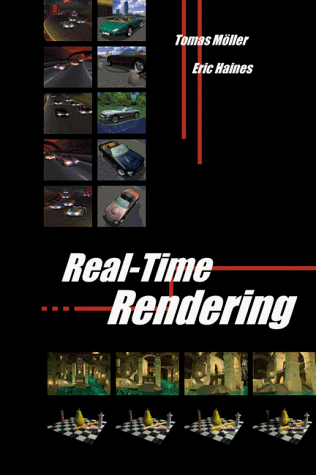
Realistically animated 3D computer graphics rendered in real time is a goal of the computer animation industry. Tomas Mˆller and Eric Haines provide a text that covers the development of real-time rendering for use in computer games, computer-animated movies, advertising, and other applications. The authors have written the book that they wish they had when they started out. Focusing on the entire graphics pipeline, this book covers optimization, visual appearance, speed-up techniques, and collision detection. The authors present new techniques and time-tested algorithms. Entire sections are devoted to special effects, polygon tessellation, and model simplification. A large section on hardware ends the book. Copious references, mathematical appendices, reading recommendations, and a dedicated web site for additional resources make this book an indispensable guide to this rapidly evolving field.The Graphics Rendering Pipeline; Transforms; Visual Appearance; Texturing; Special Effects; Speed-Up Techniques; Pipeline Optimization; Polygonal Techniques; Intersection Test Methods; Collision Detection; Graphics Hardware; The Future; Some Linear Algebra; Trigonometry
Second Edition now available.
"synopsis" may belong to another edition of this title.
About the Author
Tomas Möller received his PhD in computer graphics from Chalmers University of Technology in 1998. He has also worked 4 years in the computer graphics industry on the development of rendering software.
Eric Haines has worked in the field of computer graphics for over 15 years. During this time he has developed rendering software for Autodesk, Hewlett-Packard, Spatial, and 3D/EYE. He has contributed to a number of books on rendering, has taught courses at SIGGRAPH, and is an editor for the "journal of graphics tools," among other activities.
From the Back Cover
Rendering realistic 3D images in a fraction of a second is an important goal in today's computer graphics industry. With the timely publication of "Real-Time Rendering," authors Tomas Möller and Eric Haines present algorithms of lasting value, for use in computer-aided design, simulation, virtual reality worlds, and games. Focusing on the graphics pipeline, the book has chapters on transforms, optimization, visual appearance, polygon manipulation, collision detection, and special effects. Also included are a wide range of texture algorithms, intersection methods, and speed-up techniques. The book concludes with a section on hardware, including case studies of various graphics systems. Appendices on linear algebra and trigonometry give concise summaries for these fields. Copious references, reading recommendations, and a dedicated web site for additional resources make this book an indispensable guide in this rapidly evolving field.
Excerpt. © Reprinted by permission. All rights reserved.
From Chapter 1: What follows is a brief overview of the chapters ahead.
Chapter 2, The Graphics Rendering Pipeline. This chapter deals with the heart of real-time rendering, the mechanism that takes a scene description and converts it into something we can see.
Chapter 3, Transforms. The basic tools to manipulate position, scaling, orientation, etc, of objects and the viewer are transforms.
Chapter 4, Visual Appearance. This chapter covers the definition of materials and lights and their use in achieving a realistic surface appearance. Also covered are other appearance-related topics, such as providing higher image quality through antialiasing and gamma correction.
Chapter 5, Texturing. One of the most powerful hardware-accelerated tools for real-time rendering is the ability to display data such as images on surfaces. This chapter discusses the mechanics of this technique, called texturing, and presents a wide variety of methods for applying it.
Chapter 6, Special Effects. There is more to rendering than creating surfaces, materials, and textures. This chapter presents techniques and tricks beyond the basics.
Chapter 7, Speed-Up Techniques. After you make it go, make it go fast. Various forms of culling, model representation, and geometry consolidation are covered here.
Chapter 8, Pipeline Optimization. Once an application is running and uses efficient algorithms, it can be made even faster using various optimization techniques. Finding the bottleneck and deciding what to do about it are the topics covered here.
Chapter 9, Polygonal Techniques. Geometric data comes from a wide range of sources, and sometimes requires modification in order to be rendered rapidly and well. This chapter discusses polygonal data and ways to clean it up and simplify it.
Chapter 10, Intersection Test Methods. Intersection testing is important for rendering, user interaction, and collision detection. In-depth coverage is provided here for a wide range of the most efficient algorithms for common geometric intersection tests.
Chapter 11, Collision Detection. Finding out whether two objects touch each other is a key element of many real-time applications. This chapter presents some efficient algorithms in this rapidly evolving field.
Chapter 12, Graphics Hardware. While graphics-hardware-accelerated algorithms have been discussed in the previous chapters, this chapter focuses on components such as color depth, frame buffers, and basic architecture types. Case studies of a few representative graphics accelerators are provided.
Chapter 13, The Future. Take a guess (we do).
We have included appendices on linear algebra and trigonometry.
"About this title" may belong to another edition of this title.
Search results for Real-Time Rendering

Stock Image
Real-Time Rendering
Seller: World of Books (was SecondSale), Montgomery, IL, U.S.A.
Seller rating 5 out of 5 stars

Condition: Good. Item in good condition. Textbooks may not include supplemental items i.e. CDs, access codes etc. Seller Inventory # 00097847002
Stock Image
Real-Time Rendering
Seller: ThriftBooks-Dallas, Dallas, TX, U.S.A.
Seller rating 5 out of 5 stars
Hardcover. Condition: Good. No Jacket. Pages can have notes/highlighting. Spine may show signs of wear. ~ ThriftBooks: Read More, Spend Less. Seller Inventory # G1568811012I3N00
Stock Image
Real-Time Rendering
Seller: ThriftBooks-Atlanta, AUSTELL, GA, U.S.A.
Seller rating 5 out of 5 stars
Hardcover. Condition: Good. No Jacket. Pages can have notes/highlighting. Spine may show signs of wear. ~ ThriftBooks: Read More, Spend Less. Seller Inventory # G1568811012I3N00
Stock Image
Real-Time Rendering
Seller: ThriftBooks-Dallas, Dallas, TX, U.S.A.
Seller rating 5 out of 5 stars
Hardcover. Condition: Fair. No Jacket. Readable copy. Pages may have considerable notes/highlighting. ~ ThriftBooks: Read More, Spend Less. Seller Inventory # G1568811012I5N00
Stock Image
Real-Time Rendering
Seller: HPB Inc., Dallas, TX, U.S.A.
Seller rating 5 out of 5 stars
hardcover. Condition: Very Good. Connecting readers with great books since 1972! Used books may not include companion materials, and may have some shelf wear or limited writing. We ship orders daily and Customer Service is our top priority! Seller Inventory # S_473493355
Stock Image
Real-Time Rendering
Seller: WorldofBooks, Goring-By-Sea, WS, United Kingdom
Seller rating 5 out of 5 stars
Hardback. Condition: Very Good. The book has been read, but is in excellent condition. Pages are intact and not marred by notes or highlighting. The spine remains undamaged. Seller Inventory # GOR003081078
Buy Used
US$ 9.52
US$ 7.54 shipping
Ships from United Kingdom to U.S.A.
Ships from United Kingdom to U.S.A.
Quantity: 1 available
Seller Image
Real-Time Rendering
Seller: WeBuyBooks, Rossendale, LANCS, United Kingdom
Seller rating 5 out of 5 stars
Condition: Good. Most items will be dispatched the same or the next working day. A copy that has been read but remains in clean condition. All of the pages are intact and the cover is intact and the spine may show signs of wear. The book may have minor markings which are not specifically mentioned. Seller Inventory # rev8950380433
Buy Used
US$ 15.64
US$ 8.37 shipping
Ships from United Kingdom to U.S.A.
Ships from United Kingdom to U.S.A.
Quantity: 1 available
Stock Image
Real-Time Rendering
Published by
Natick, MA, U.S.A.: A K Peters, Limited, 1999, 1999
ISBN 10: 1568811012
ISBN 13: 9781568811017
Used
Hardcover
Seller: The Warm Springs Book Company, Fremont, CA, U.S.A.
Seller rating 4 out of 5 stars

Hardcover. Dust Jacket Included. Hardback, 2nd printing, Very Good Plus to Fine Minus/no DJ (as issued); light light shelf wear and rubbing to glossy pictorial boards, illustrated with a color photosection, 8vo., 482 pages., 0.0 0.0 0.0. Seller Inventory # 12116
Stock Image
Real-Time Rendering
Seller: SHIMEDIA, Brooklyn, NY, U.S.A.
Seller rating 5 out of 5 stars
Condition: New. Satisfaction Guaranteed or your money back. Seller Inventory # 1568811012
Seller Image
Real-time rendering
Published by
A K Peters, Estados Unidos, 1999
ISBN 10: 1568811012
ISBN 13: 9781568811017
Used
Hardcover
Seller: LIBRERÍA SOLÓN, Madrid, M, Spain
Seller rating 5 out of 5 stars
Tapa Dura. Condition: Muy bien. Tapa dura. Profusamente ilustrado.9781568811017. A K Peters. Estados Unidos. 1999. 24x16 centímetros. 482 páginas. Tapa dura. Estado=Muy bien. Inglés. Seller Inventory # 45353
Buy Used
US$ 23.97
US$ 46.54 shipping
Ships from Spain to U.S.A.
Ships from Spain to U.S.A.
Quantity: 1 available