
Items related to Telecommuting Success: A Practical Guide for Staying...
Telecommuting Success: A Practical Guide for Staying in the Loop While Working Away from the Office - Softcover
Synopsis
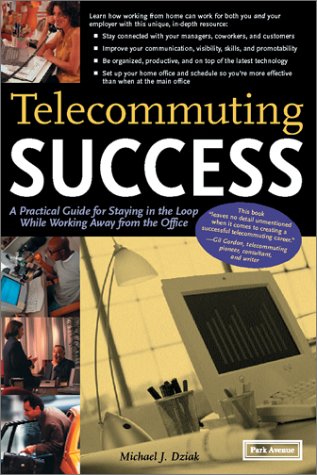
This book “goes beyond the basics and…leaves no detail unmentioned when it comes to creating a successful telecommuting career,” says Gil Gordon, telecommuting pioneer and consultant, in this book's foreword.
Regular telecommuting is becoming a way of life for many employees. If you’re not careful, however, telecommuting can leave you out of touch with your workplace and manager. This book recognizes telecommuting’s pitfalls and shows you how to avoid them. It advocates that you become not just a good telecommuter, but a power telecommuter who accomplishes more, communicates better, and stays effective and visible when virtual.
Get expert guidance on all issues that telecommuters face. Here is a partial list of the many topics covered:
--Avoid the top 10 telecommuting traps
--Disarm telecommuting skeptics, including your boss and coworkers
--Master technology without becoming a technology geek
--What every home office needs—and doesn’t need
--10 time management tips you can use today
--Train yourself and your coworkers, boss, spouse, kids, pets, and neighbors
--Develop your telecommuting credibility
--Stay part of the team when working away
--Do’s and don’ts for effective communication with technology tools
--10 ways to stay on the corporate radar screen
--Earn superior performance reviews
--Signs that it’s time to visit the home office more often
--Career path strategies that work for telecommuters
--Tips for finding a telecommuting job
--Worksheets for scheduling and reporting your work, organizing your home office, and assessing your accomplishments
--Insight from industry pros on maintaining virtual relationships and handling the finer points of telecommuting
--Web resources for home office products and services, telecommuting associations, and additional information
“This book’s strength is in the countless tips, tricks, warnings, suggestions, and shortcuts that collectively mean the difference between being a telecommuter and thriving as a telecommuter,” writes Gil Gordon in the foreword.
Telecommuting Success is ideal for those who are currently telecommuting--or would like to. It also helps managers see the telecommuting employee's point of view.
"synopsis" may belong to another edition of this title.
About the Author
Michael J. Dziak is president of InteleWorks, Inc., a 10-year-old consulting firm that helps employers implement successful telework programs. He has written telework training manuals and numerous articles and has been interviewed by USA Today, the Wall Street Journal, Entrepreneur magazine, and other publications. Dziak speaks regularly on telecommuting and is active with several organizations that advocate telecommuting’s benefits, including the International Telework Association & Council. He received this nonprofit organization’s Johnny Appleseed Award for his work in promoting telework.
Excerpt. © Reprinted by permission. All rights reserved.
Excerpt from Chapter 1:
Why the Boss Is Nervous About Telecommuting
Here are the primary reasons that telecommuting is resisted by management and what you can do about them.
I can t tell if you re working if I can t see you: Before computers, a manager could take a quick glance at a worker s desk and tell if at least some work was being done. Nonwork activities were pretty obvious and hard to hide. Many desk jobs became the paper extension of a countable-task factory environment (processing claims and sales orders, for example, where output could be quantified). The prevailing philosophy was (and unfortunately still is in many cases) that if you were at your desk or at a meeting under the observation of others, you must be working. If you weren t around, you must be goofing off. Today, it s difficult to distinguish work from leisure just by looking. If managers have not updated their skills, then telecommuting is perceived as a threat to their ability to manage. Antidote: Keep good records of your telecommuting days, time, and work activity. Go out of your way to tell your manager exactly what you accomplish during each telecommuting event. See Ch! apters 2 and 6 for more on this.
I won t be able to call a meeting: In my company s client survey work, this response is consistently among the top three management concerns. Uninitiated managers imagine that telecommuting will empty their workgroup, leaving them with no one to call to a meeting. Antidote: Short of simply reducing the number of meetings, your options are limited. If impromptu meetings are important to your manager, you will need to remain reachable and sometimes even have to drive to the office to attend them. Except under extreme circumstances, meetings can be effectively attended by speakerphone or teleconference. It will be up to you to make the technical arrangements and establish a comfort zone to assure this method works. If workgroup representation at meetings remains an issue, you may have to coordinate with your coworkers to limit the number of telecommuters who are out at any given time.
There s no budget for equipment and services: This is a common concern of skeptical managers looking for a reason to avoid telecommuting employees. Although proper telecommuting requires connectivity, it can be done on a low budget. Antidote: Individuals interested (and qualified) in telecommuting should be prepared to make a personal investment in proper equipment and services to get the job done. A solid business case, however, can be made for a substantial corporate telecommuting investment as long as management can quantify the return on investment.
Workers who shouldn t be allowed to telecommute will want to: This excuse is possible evidence of weak management skills. There is little doubt that some employees will look at telecommuting as an opportunity to work less and get away with it. Antidote: One of the first things you should know about telecommuting is that it is not for everyone. Only those who meet strict job, tenure, and performance criteria should be allowed the privilege. If your manager remains nervous about your telecommuting, find out why and do your best to overcome it. Some ideas are offered in Chapters 2 and 5.
"About this title" may belong to another edition of this title.
Search results for Telecommuting Success: A Practical Guide for Staying...

Stock Image
Telecommuting Success : A Practical Guide for Staying in the Loop While Working Away from the Office
Seller: Better World Books, Mishawaka, IN, U.S.A.
Seller rating 5 out of 5 stars

Condition: Very Good. Former library copy. Pages intact with possible writing/highlighting. Binding strong with minor wear. Dust jackets/supplements may not be included. Includes library markings. Stock photo provided. Product includes identifying sticker. Better World Books: Buy Books. Do Good. Seller Inventory # 3750739-6
Stock Image
Telecommuting Success: A Practical Guide for Staying in the Loop While Working Away from the Office
Seller: ThriftBooks-Dallas, Dallas, TX, U.S.A.
Seller rating 5 out of 5 stars
Paperback. Condition: Fair. No Jacket. Readable copy. Pages may have considerable notes/highlighting. ~ ThriftBooks: Read More, Spend Less. Seller Inventory # G1571121099I5N00