
Items related to Contemporary Rhetorical Theory: A Reader
Synopsis
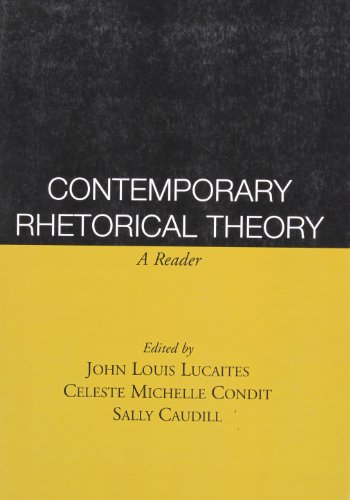
This indispensable text brings together important essays on the themes, issues, and controversies that have shaped the development of rhetorical theory since the late 1960s. An extensive introduction and epilogue by the editors thoughtfully examine the current state of the field and its future directions, focusing in particular on how theorists are negotiating the tensions between modernist and postmodernist considerations. Each of the volume's eight main sections comprises a brief explanatory introduction, four to six essays selected for their enduring significance, and suggestions for further reading. Topics addressed include problems of defining rhetoric, the relationship between rhetoric and epistemology, the rhetorical situation, reason and public morality, the nature of the audience, the role of discourse in social change, rhetoric in the mass media, and challenges to rhetorical theory from the margins. An extensive subject index facilitates comparison of key concepts and principles across all of the essays featured.
"synopsis" may belong to another edition of this title.
About the Author
John Louis Lucaites (PhD, University of Iowa, 1984) is associate professor in the Department of Communication and Culture, adjunct associate professor in American Studies at Indiana University. He is also a Fellow at the Poynter center for the Study of Ethics at Indiana University. He teaches courses in rhetorical theory and the relationship between rhetoric and social theory. His current research focuses on the critique of liberalism and democratic culture. He is the coauthor with Celeste Michelle Condit of Crafting Equality: America's Anglo-African Word (Marie Hochmuth Nichols Award for Outstanding Scholarship, National Communication Association, 1993).
Celeste Michelle Condit (PhD, University of Iowa, 1982) is Professor of Speech Communication at the University of Georgia. She is coediting Women's studies in Communication. Her books include Decoding Abortion Rhetoric: The Communication of Social Change (University of Illinois, 1990) and Crafting Equality: America's Anglo-African Word (University of Chicago, 1993; coauthored with John Louis Lucaites). She was the corecipient of the Marie Hochmuth Nichols Award and the Golden Monograph Award and the recipient of the Dogulas Ehninger Award.
Sally A. Caudill (PhD, University of Georgia, 1998) is a Visiting Assistant Professor in the Department of Communication Studies at Macalester College. She has published several essays on women's roles in reproductive technologies and public speaking. At present, her research interests include multicultural communication and the rhetoric of resistance. She has won numerous teaching awards and served as a student representative to the Women's Caucus of the National Communication Association.
Celeste Michelle Condit (PhD, University of Iowa, 1982) is Professor of Speech Communication at the University of Georgia. She is coediting Women's studies in Communication. Her books include Decoding Abortion Rhetoric: The Communication of Social Change (University of Illinois, 1990) and Crafting Equality: America's Anglo-African Word (University of Chicago, 1993; coauthored with John Louis Lucaites). She was the corecipient of the Marie Hochmuth Nichols Award and the Golden Monograph Award and the recipient of the Dogulas Ehninger Award.
Sally A. Caudill (PhD, University of Georgia, 1998) is a Visiting Assistant Professor in the Department of Communication Studies at Macalester College. She has published several essays on women's roles in reproductive technologies and public speaking. At present, her research interests include multicultural communication and the rhetoric of resistance. She has won numerous teaching awards and served as a student representative to the Women's Caucus of the National Communication Association.
From the Back Cover
Lucaites, Condit, and Caudill have done an exceptional job of mapping out the terrain of issues facing contemporary rhetorical theorists. This volume covers a breadth of perspectives and issues, serving well both as an introduction to contemporary debates and as a launching pad for the next generation of scholarship. With this volume as a sourcebook and guide, I feel optimistic about the future of rhetorical theory (John M. Sloop, PhD, Vanderbilt University).
Excerpt. © Reprinted by permission. All rights reserved.
Introduction I. What Can a "Rhetoric" Be? *Toward a Sophistic Definition of Rhetoric, John Poulakos *Status, Marginality, and Rhetorical Theory, Robert Hariman *The Habitation of Rhetoric, Michael Leff *Text, Context, and the Fragmentation of Contemporary Culture, Michael Calvin McGee *Practicing the Arts of Rhetoric: Tradition and Invention, Thomas Farrell *The Taming of Polos/Polis: Rhetoric as an Achievement Without Woman, Jane Sutton II. Rhetoric and Epistemology *On Viewing Rhetoric as Epistemic, Robert Scott *Knowledge, Consensus, and Rhetorical Theory, Thomas B. Farrell *Some Implications of "Process" or "Intersubjectivity": Postmodern Rhetoric, Barry Brummett *Rhetorical Perspectivism, Richard A. Cherwitz and James W. Hikins *Rhetoric and Its Double: Reflections of the Rhetorical Turn in the Human Sciences, Dilip Parameshwar Gaonkar III. The Character of the Rhetorical Situation *The Rhetorical Situation, Lloyd F. Bitzer *The Myth of the Rhetorical Situation, Richard E. Vatz *Rethinking the Rhetorical Situation from within the Thematic of Differance, Barbara Biesecker IV. Rhetoric, Reason, and Public Morality *The Personal, Technical, and Public Sphere of Argumentation, Thomas G. Goodnight *Narrative as a Human Communication Paradigm, Walter Fisher *Rhetorical Conversation, Time, and Moral Action, Thomas Frentz *Crafting Virtue: The Rhetorical Construction of Public Morality, Celeste Michelle Condit V. The Nature of the Audience *The Second Persona, Edwin Black *In Search of "the People": A Rhetorical Alternative, Michael Calvin McGee *The Third Persona: An Ideological Turn in Rhetorical Theory, Philip Wander VI. The Role of Discourse in Social Change *Requirements, Problems, and Strategies: A Theory of Persuasion for Social Movements, Herbert W. Simons *The Rhetoric of Women's Liberation: An Oxymoron, Karlyn Kohrs Campbell *The Functions of Presidential Campaigning, Bruce Gronbeck *The "Ideograph": A Link Between Rhetoric and Ideology, Michael Calvin McGee *Critical Rhetoric: Theory and Praxis, Raymie E. McKerrow *Rehabilitating Rhetoric: Confronting Blindspots in Discourse and Social Theory, Maurice Charland VII. Rhetoric in the Mass Media *Burke's Representative Anecdote as a Method in Media Criticism, Barry Brummett *The Rhetorical Limits of Polysemy, Celeste Michelle Condit *Reintegrating Ideology and Archetype in Rhetorical Criticism, Janice Hocker Rushing and Thomas S. Frentz VIII. Challenging the Tradition of Rhetorical Theory from the Margins *Cultures of Discourse: Marxism and Rhetorical Theory, James Arnt Aune *An Afrocentric Theory of Communication, Molefi Kete Asante *Disciplining the Feminine, Carole Blair, Julie R. Brown, and Leslie A. Baxter *Postcolonial Interventions in the Rhetorical Canon: An "Other" View, Raka Shome Epilogue
"About this title" may belong to another edition of this title.
Search results for Contemporary Rhetorical Theory: A Reader

Stock Image
Contemporary Rhetorical Theory, First Edition: A Reader
Seller: World of Books (was SecondSale), Montgomery, IL, U.S.A.
Seller rating 5 out of 5 stars

Paperback. Condition: Good. A collection of essays that brings together the themes, issues and controversies that have shaped the development of rhetorical theory since the late 1960s. Seller Inventory # 00102018888
Seller Image
Contemporary Rhetorical Theory: A Reader
Seller: -OnTimeBooks-, Phoenix, AZ, U.S.A.
Seller rating 5 out of 5 stars
Condition: good. A copy that has been read, remains in good condition. All pages are intact, and the cover is intact. The spine and cover show signs of wear. Pages can include notes and highlighting and show signs of wear, and the copy can include "From the library of" labels or previous owner inscriptions. 100% GUARANTEE! Shipped with delivery confirmation, if you're not satisfied with purchase please return item! Ships via media mail. Seller Inventory # OTV.1572304014.G
Stock Image
Contemporary Rhetorical Theory: A Reader
Published by
The Guilford Press, 1998
ISBN 10: 1572304014
ISBN 13: 9781572304017
Used
paperback
First Edition
Seller: The Maryland Book Bank, Baltimore, MD, U.S.A.
Seller rating 5 out of 5 stars
paperback. Condition: Good. First Edition. Corners are slightly bent. Used - Good. Seller Inventory # 4-C-5-1006
Stock Image
Contemporary Rhetorical Theory : A Reader
Published by
Taylor & Francis Group, 1998
ISBN 10: 1572304014
ISBN 13: 9781572304017
Used
Softcover
First Edition
Seller: Better World Books, Mishawaka, IN, U.S.A.
Seller rating 5 out of 5 stars
Condition: Good. 1st Edition. Former library copy. Pages intact with minimal writing/highlighting. The binding may be loose and creased. Dust jackets/supplements are not included. Includes library markings. Stock photo provided. Product includes identifying sticker. Better World Books: Buy Books. Do Good. Seller Inventory # 11863167-6
Stock Image
Contemporary Rhetorical Theory : A Reader
Published by
Taylor & Francis Group, 1998
ISBN 10: 1572304014
ISBN 13: 9781572304017
Used
Softcover
First Edition
Seller: Better World Books, Mishawaka, IN, U.S.A.
Seller rating 5 out of 5 stars
Condition: Good. 1st Edition. Pages intact with minimal writing/highlighting. The binding may be loose and creased. Dust jackets/supplements are not included. Stock photo provided. Product includes identifying sticker. Better World Books: Buy Books. Do Good. Seller Inventory # 8644527-6
Stock Image
Contemporary Rhetorical Theory : A Reader
Published by
Taylor & Francis Group, 1998
ISBN 10: 1572304014
ISBN 13: 9781572304017
Used
Softcover
First Edition
Seller: Better World Books, Mishawaka, IN, U.S.A.
Seller rating 5 out of 5 stars
Condition: Very Good. 1st Edition. Former library copy. Pages intact with possible writing/highlighting. Binding strong with minor wear. Dust jackets/supplements may not be included. Includes library markings. Stock photo provided. Product includes identifying sticker. Better World Books: Buy Books. Do Good. Seller Inventory # GRP70281775
Stock Image
Contemporary Rhetorical Theory, First Edition: A Reader
Seller: World of Books Inc, Montgomery, IL, U.S.A.
Seller rating 4 out of 5 stars

Paperback. Condition: Good. A collection of essays that brings together the themes, issues and controversies that have shaped the development of rhetorical theory since the late 1960s. Seller Inventory # CIN1572304014G
Stock Image
Contemporary Rhetorical Theory: A Reader
Seller: ThriftBooks-Atlanta, AUSTELL, GA, U.S.A.
Seller rating 5 out of 5 stars
Paperback. Condition: Good. No Jacket. Pages can have notes/highlighting. Spine may show signs of wear. ~ ThriftBooks: Read More, Spend Less. Seller Inventory # G1572304014I3N00
Stock Image
Contemporary Rhetorical Theory: A Reader
Seller: HPB-Ruby, Dallas, TX, U.S.A.
Seller rating 5 out of 5 stars
Paperback. Condition: Very Good. Connecting readers with great books since 1972! Used books may not include companion materials, and may have some shelf wear or limited writing. We ship orders daily and Customer Service is our top priority! Seller Inventory # S_487849735
Stock Image
Contemporary Rhetorical Theory : A Reader
Published by
Taylor & Francis Group, 1998
ISBN 10: 1572304014
ISBN 13: 9781572304017
Used
Softcover
First Edition
Seller: Better World Books Ltd, Dunfermline, United Kingdom
Seller rating 5 out of 5 stars
Condition: Very Good. 1st Edition. Former library copy. Pages intact with possible writing/highlighting. Binding strong with minor wear. Dust jackets/supplements may not be included. Includes library markings. Stock photo provided. Product includes identifying sticker. Better World Books: Buy Books. Do Good. Seller Inventory # GRP70281775
Buy Used
US$ 7.32
US$ 6.67 shipping
Ships from United Kingdom to U.S.A.
Ships from United Kingdom to U.S.A.
Quantity: 1 available