Items related to Ashantee
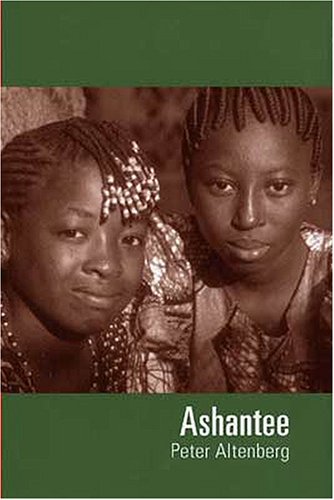

This collection of thirty-eight impressionist episodes describes a white man's friendship with a group of Ashanti tribes people from the Gold Coast of Africa (the former British colony known today as Ghana), who in 1896 were put on display as living objects in a popular ethnographic exhibit in the Vienna Zoological Garden, then still located in Vienna's famous amusement park called Prater. The exhibit caused a veritable "Ashanti fever" as the show attracted five to six thousand visitors per day. Altenberg, barely disguised as Ashantee's autobiographical character Sir Peter, shows a genuine curiosity about the cultural Other and paints a critical picture of his Austrian contemporaries' prejudices, revealed as they were experienced by the Africans.In "Ashantee", beautiful, sensual, childlike, and wholesome African 'paradise people' provide inspiration for the tormented civilised soul of the fin-de-siecle European. Eccentric coffeehouse writer Altenberg is famous for his unique telegram style. Critic Karl Kraus claimed, 'One sentence by Peter Altenberg is equal to an entire Viennese novel'. "Ashantee" introduces the reader to a little-known facet of vibrant Vienna around 1900. Combining cross-cultural sympathy with colonial stereotyping, the book has gained new popularity as current debates about the challenges of cultural coexistence in the global society have renewed interest in the literature about encounters between people of different ethnic and cultural backgrounds. In this edition, Peter Altenberg's literary text is illustrated with reprints of original drawings and photographs of Altenberg and the Ashanti in Vienna.
"synopsis" may belong to another edition of this title.
About the Author:
The poet Peter Altenberg (born Richard Englander, 1859-1919) had a special status in fin-de-siecle Vienna. He did not belong to any particular literary group or movement. He was an outsider, yet praised by almost everybody for his distinct way and for his highly individual style. His friends considered him the greatest Austrian poet of his time. The cabaret performer and important cultural historian Egon Friedell wrote an early book about him with the proud title Ecce Poeta (1912) in which he portrayed Altenberg as the quintessence of poetic spirit. Even Karl Kraus, whose reputation as an uncompromising and incorruptible critic was well established, believed that Altenberg was not only the free-est spirit of his epoch but also the richest poetic talent in modern Germany. 'One sentence of Peter Altenberg makes up for an entire Viennese novel' he claimed in 1913.
"About this title" may belong to another edition of this title.
- PublisherAriadne Pr
- Publication date2007
- ISBN 10 1572411554
- ISBN 13 9781572411555
- BindingPaperback
- Number of pages128
- Rating
Buy New
Learn more about this copy
US$ 18.39
Shipping:
FREE
Within U.S.A.
Top Search Results from the AbeBooks Marketplace
Stock Image
Ashantee
Seller:
Rating

Book Description Condition: New. Book is in NEW condition. 0.45. Seller Inventory # 1572411554-2-1
Buy New
US$ 18.39
Convert currency
Stock Image
Ashantee
Seller:
Rating
Book Description Condition: New. New! This book is in the same immaculate condition as when it was published 0.45. Seller Inventory # 353-1572411554-new
Buy New
US$ 18.39
Convert currency