
Items related to The New Covenant: Commonly Called the New Testament
Synopsis
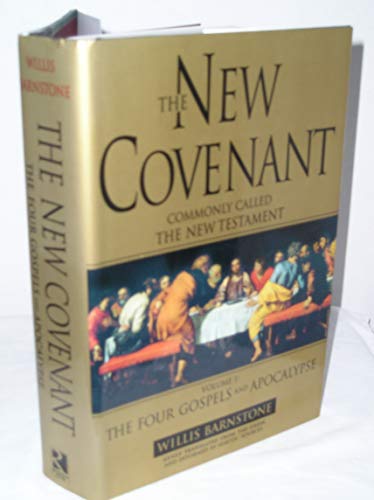
Informed by original Semitic sources, a new literary translation of the Gospels of Matthew, Mark, Luke, and John and of Revelation reexamines Christianity in terms of its Judaic roots, offering new perspective on the Bible and its teachings. 15,000 first printing.
"synopsis" may belong to another edition of this title.
About the Author
Willis Barnstone is a professor of Greek and religious studies at Indiana University, a member of the Jesus seminar, and a poet who has been a Pulitzer Prize finalist.
Reviews
It's difficult to make the case for something new in biblical studies, but Willis Barnstone's The New Covenant, Commonly Called the New Testament: The Four Gospels and the Apocalypse is certainly different. In deciding to provide "a chastely modern, literary version of a major world text," Barnstone restores the probable Hebrew and Aramaic names of all of the major characters. Jesus is Yeshua; his parents Miryam and Yosef take him to Yerushalayim each year for the Seder of the Pesach. Such determination to restore the Semitic origins of the New Testament is refreshing, and Barnstone doubles the fun by following the Gospels not with Acts, as would be traditional, but with the Apocalypse, the Book of Revelation. Here is where Barnstone's literary skill shines most clearly, as he renders the Apocalypse as a great epic poem in loose blank verse. Barnstone's biblical interpretation is heavily influenced by former Episcopal bishop John Shelby Spong, but his literary contribution is quite original. (Riverhead, $35 576p ISBN 1-57322-182-1; Apr.)
Copyright 2002 Cahners Business Information, Inc.
In this ambitious new translation of Scripture, Barnstone restores to the central figure of the New Testament his identity both as a poet and as a Jew. The need for this restoration, prefatory chapters explain, arises out of the reduction of Jesus' words to mere prose in previous translations and of the introduction, very early, of anti-Semitism into the biblical texts. Barnstone's achievement will win plaudits from literary critics and textual scholars: his gifts as a poet confer a graceful elegance on idiomatic directness, while his talents as a scholar open up many historical and linguistic questions. Still, some of the very virtues that will attract scholars will repel ordinary Bible readers. For in making this translation, Barnstone has broken sharply with religious traditions that bring typical readers to the Bible in the first place. A Bible translator who doubts the integrity of the ancient texts, who questions the motives of the early Church compilers, and who refuses to recognize Jesus as divine has already alienated many of his potential readers. And although scholars may accept the linguistic justification for using "Yeshua the Messiah" in place of "Jesus Christ," or for using "The New Covenant" in place of "The New Testament," the typical Christian reader will find such substitutions too disorienting and will seek out other translations. Barnstone laments the general neglect of Richard Lattimore's excellent 1962 translation of the New Testament, but his own translation--for all its considerable strengths--may face a similar fate. Bryce Christensen
Copyright © American Library Association. All rights reserved
An esteemed translator and poet and former professor of Greek at Colgate University, Barnstone believes that in his profession it is crucial to remember Christianity's Jewish roots. His fresh translation of the four Gospels and the Book of Revelation relies on Semitic texts, using Aramaic or Hebrew words for personal and geographical names in place of the more familiar Greek. For example, Jesus becomes Yeshua, and the Lord, Adonai. Wherever he thinks it justified by the nature of the text, he also writes in verse. His translation of the Apocalypse (i.e., the Book of Revelation) is presented in blank verse because Barnstone considers it the epic poem of the New Covenant (or the New Testament). While much of this work is similar to modern translations like the New Revised Standard Version, Barnstone's feel for poetry lends it a unique elegance and power. Furthermore, he provides many helpful footnotes that explain his choices. A 100-page introduction offers insight into the challenges of translation and important background information on the pre-Hellenic world of Judaism from which the New Covenant emerged. Although some of his opinions about the historical Jesus are bound to be challenged, his inclusion of this topic makes the work even more useful. An important addition to any library's collection of Bibles and biblical information. David Bourquin, California State Univ., San Bernardino
Copyright 2002 Cahners Business Information, Inc.
"About this title" may belong to another edition of this title.
Search results for The New Covenant: Commonly Called the New Testament

Stock Image
The New Covenant
Seller: World of Books (was SecondSale), Montgomery, IL, U.S.A.
Seller rating 5 out of 5 stars

Hardback. Condition: Good. Seller Inventory # 00107227111
Stock Image
The New Covenant
Seller: World of Books (was SecondSale), Montgomery, IL, U.S.A.
Seller rating 5 out of 5 stars
Hardback. Condition: Very Good. Seller Inventory # 00109462116
Stock Image
The New Covenant : The Four Gospels and Apocalypse
Published by
Penguin Publishing Group, 2002
ISBN 10: 1573221821
ISBN 13: 9781573221825
Used
Hardcover
Seller: Better World Books, Mishawaka, IN, U.S.A.
Seller rating 5 out of 5 stars
Condition: Very Good. F First Edition. Pages intact with possible writing/highlighting. Binding strong with minor wear. Dust jackets/supplements may not be included. Stock photo provided. Product includes identifying sticker. Better World Books: Buy Books. Do Good. Seller Inventory # 5152141-6
Stock Image
The New Covenant : The Four Gospels and Apocalypse
Published by
Penguin Publishing Group, 2002
ISBN 10: 1573221821
ISBN 13: 9781573221825
Used
Hardcover
Seller: Better World Books, Mishawaka, IN, U.S.A.
Seller rating 5 out of 5 stars
Condition: Very Good. F First Edition. Former library copy. Pages intact with possible writing/highlighting. Binding strong with minor wear. Dust jackets/supplements may not be included. Includes library markings. Stock photo provided. Product includes identifying sticker. Better World Books: Buy Books. Do Good. Seller Inventory # GRP102279910
Stock Image
The New Covenant : The Four Gospels and Apocalypse
Published by
Penguin Publishing Group, 2002
ISBN 10: 1573221821
ISBN 13: 9781573221825
Used
Hardcover
Seller: Better World Books, Mishawaka, IN, U.S.A.
Seller rating 5 out of 5 stars
Condition: Good. F First Edition. Former library copy. Pages intact with minimal writing/highlighting. The binding may be loose and creased. Dust jackets/supplements are not included. Includes library markings. Stock photo provided. Product includes identifying sticker. Better World Books: Buy Books. Do Good. Seller Inventory # 4655016-6
Stock Image
The New Covenant : The Four Gospels and Apocalypse
Published by
Penguin Publishing Group, 2002
ISBN 10: 1573221821
ISBN 13: 9781573221825
Used
Hardcover
Seller: Better World Books, Mishawaka, IN, U.S.A.
Seller rating 5 out of 5 stars
Condition: Good. F First Edition. Pages intact with minimal writing/highlighting. The binding may be loose and creased. Dust jackets/supplements are not included. Stock photo provided. Product includes identifying sticker. Better World Books: Buy Books. Do Good. Seller Inventory # 1459074-6
Stock Image
The New Covenant: Commonly Called the New Testament
Published by
Riverhead Hardcover (edition Book Club Edition), 2002
ISBN 10: 1573221821
ISBN 13: 9781573221825
Used
Hardcover
Seller: BooksRun, Philadelphia, PA, U.S.A.
Seller rating 5 out of 5 stars
Hardcover. Condition: Very Good. Book Club Edition. With dust jacket. It's a well-cared-for item that has seen limited use. The item may show minor signs of wear. All the text is legible, with all pages included. It may have slight markings and/or highlighting. Seller Inventory # 1573221821-11-6-29
Stock Image
The New Covenant
Seller: World of Books Inc, Montgomery, IL, U.S.A.
Seller rating 4 out of 5 stars

Hardback. Condition: Very Good. Seller Inventory # CIN1573221821VG
Stock Image
The New Covenant
Seller: World of Books Inc, Montgomery, IL, U.S.A.
Seller rating 4 out of 5 stars
Hardback. Condition: Good. Seller Inventory # CIN1573221821G
Stock Image
The New Covenant: Commonly Called the New Testament
Seller: ThriftBooks-Dallas, Dallas, TX, U.S.A.
Seller rating 5 out of 5 stars
Hardcover. Condition: Very Good. No Jacket. May have limited writing in cover pages. Pages are unmarked. ~ ThriftBooks: Read More, Spend Less. Seller Inventory # G1573221821I4N00