
Items related to Practice Random Acts of Kindness: Bring More Peace,...
Synopsis
A Course in Compassion
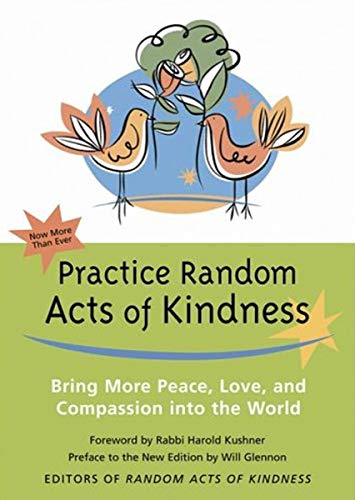
From the creators of the Random Acts of Kindness series comes this practical guide to kindness. Full of inspiring meditations, affirmations, and true stories, this book acts as a guide to creating real change in our world through acts of kindness.
Join the kindness revolution. All over the nation and beyond, people are realizing the power of kindness. With one act, you can change someone’s day―and make the world a better place. It doesn’t take much to offer kind words or deeds to someone, but it can change the whole course of their day. When we participate in random acts of kindness, we join the movement of building a better future. This book by the editors of the Random Acts of Kindness series, with a foreword by Rabbi Harold Kushner, presents readers with a motivational guide to living out kindness each day of our lives.
Inspirational stories and simple suggestions. From the wake of Hurricane Katrina to the tragedy of the tsunami to troops in Iraq performing acts of daily compassion, this book highlights the ways in which people are working towards creating a more benevolent world. It demonstrates the weight that a single act of compassion can have and how powerful our actions can be when we all join together. In addition to inspiring true stories, this “course in compassion” includes meditations, affirmations, and suggestions for how you can go out and make a difference. Filled with practical wisdom and motivational quotes, this book is your go-to guide for turning the kindness spark into a flame. Learn more about:
- How to practice random acts of kindness
- The impact that compassion has on our world
- Stories of kindness changing people’s lives
If you’ve read books like Chicken Soup for the Soul, The Power of Kindness, Go Be Kind, How Can I Help?, or A Year of Positive Thinking, you’ll love Practice Random Acts of Kindness.
"synopsis" may belong to another edition of this title.
About the Author
Will Glennon is the author of 200 Ways to Raise a Boy's Emotional Intelligence, 200 Ways to Raise a Girl's Self-Esteem, and an editor of the bestselling Random Acts of Kindness series. He is a regular columnist for Daughters newsletter and sits on the Board of Advisors for Dads & Daughters, a national parenting organization. The father of two children, a son and a daughter, Glennon lives in Berkeley, California.
Excerpt. © Reprinted by permission. All rights reserved.
Practice Random Acts of Kindness
Bring More Peace, Love, and Compassion into the World
By Rabbi Harold KushnerRed Wheel/Weiser, LLC
Copyright © 2007 Rabbi Harold Kushner
All rights reserved.
ISBN: 978-1-57324-272-1All rights reserved.
Contents
| Foreword by Rabbi Harold Kushner | |
| Preface by Will Glennon | |
| Acknowledgments | |
| The Sphere of Kindness | |
| Kindness Is an Attitude and an Action | |
| Kindness Begins at Home | |
| Kindness Ripples Out into the World | |
| Kindness Creates Happiness and Peace of Mind | |
| Kindness Generates Love and Compassion | |
| Kindness Feeds the Body and Soul |
CHAPTER 1
Kindness Is an Attitude and an Action
Since you get more joy out of giving joy to others, you should put a good deal of thoughtinto the happiness that you are able to give.
—ELEANOR ROOSEVELT
As we move through our lives, we carry with us the accumulated experiences that moldour attitudes and our behavior. When we are young and inexperienced, we are often morevulnerable to being pulled in different directions by the events of life. One bad experience,in which our trust is betrayed, our generosity scorned, or our love rejected, can cause usto build unconscious defenses that have the unintended effect of isolating us, of makingus fearful or tentative, and that can cause us to pull back from the world.
Later, as we grow in maturity and wisdom, we learn that although we cannot choose whatlife will deliver to us, we can choose how we will respond. As we begin to live our livesmore consciously—going back and sifting through the events that helped shape us,examining how and why different emotions are triggered in our hearts—we can begin tobuild an entirely new framework for who we want to be, instead of simply accepting whowe ended up being.
Through this deeper understanding of the events that have influenced our lives, of thevalues we hold most dear, and of the things we need to be happy, we can begin theexciting process of taking control of our lives. At the most fundamental level, this beginswith the conscious choice of how we wish to be in the world. From that solid foundation,we can act freely and fearlessly, knowing that our actions will reflect our being out into theworld.
The practices in this section focus on the intricate underpinnings of a strong foundation ofkindness and will assist you in your exploration of how to release that kindness into theworld through your actions.
Start Now
I've decided to try to be a better person.... But not right away of course.... Maybe a fewdays from now.
—SALLY TO CHARLIE BROWN IN A PEANUTS CARTOON
"I spent four years 'getting ready' to start a diet. I'd get brochures for weight-controlprograms and look them over while eating a pastrami sandwich. I'd buy the latest dietbooks and read them with a bowl of chips. My losing weight was such a topic ofconversation that finally—over a substantial lunch at my favorite Italian restaurant—mybest friend got so exasperated she said, 'If you really want to lose weight, then put thatdamn fork down right now!' Shocked, I dropped the fork and just sat there with my mouthhanging open. When I closed my mouth, I realized I had started my diet."
Most of us carry around an image of ourselves as we would like to be—a little thinner orstronger, more patient and reliable. But what we want to be means nothing until we stopintending and start acting.
Like dieting, when it comes to the practice of kindness, right now is the best time to begin.It doesn't require much work or sacrifice—no giving up desserts, no one hundred leg lifts,no pushing a rock up a steep hill. Just a commitment, right here and now, to smile at thebank teller, give a kind word to the grocery checker. Let the driver in front of you cut in.Simple, really.
Remember What's Important
In the end, nothing we do or say in this lifetime will matter as much as the way we haveloved one another.
—DAPHNE ROSE KINGMA
In the hustle and bustle of our busy days, full of faxes, phone calls, and a thousand andone errands, it's really easy to get caught up in the daily details and forget What'simportant in life. Often it takes some kind of trauma—the death of a loved one, divorce, alife-threatening illness—to wake us up to what matters. After all, no one on his or herdeathbed regretted not spending more time at the office.
Fortunately, we don't have to be facing a personal tragedy to make our relationships ournumber one priority. No project, no deadline, no clean kitchen is as important as thequality of your relationship with the person sitting across from you at the breakfast table,as the child who needs your attention right this second, as the mother who is alone in thenursing home.
Remembering What's important gives us the graciousness to take the time, make thephone call, send the card, not say the bitter retort on the tip of our tongue. When weremember What's important, we generate more loving-kindness in our lives.
Take the Risk
In the long run, we get no more than we have been willing to risk giving.
—SHELDON KOPP
"When I was in second grade, a new boy, Derrick showed up halfway through the year. Hehad a bad leg, and all the kids teased him. I never teased him, but I was afraid of beingtoo nice to him because I didn't want the other kids to think I was a sissy or whateversecond-graders think.
"That summer my mom made me take swimming lessons at the city pool and Derrick wasalways there. He was a great swimmer, and I found out later that he swam every day tobuild up strength in his legs. One day during a break in lessons, I was sitting on the side ofthe pool and he swam up and said hi and thanked me for not teasing him at school. I saidsomething like, 'Oh, no big deal', but inside I felt like a jerk for being afraid to be friendlywith him. Now I'm in fourth grade and Derrick is my best friend. In fact, he's the best friendanyone could ever want."
So many of us are so afraid of one another—of having our hearts crushed (again), ourspirits broken—that we miss out on the love and connection that is available if we wouldonly take the risk. Acts of love and kindness are risky—we risk looking foolish or beingrejected; we risk being laughed at or ignored. But if we don't act, we risk losing evenmore—the potential for love, for friendship, for communion with another soul. Today, takea risk with just one person.
Accent the Positive
People deal too much with the negative, with what is wrong.... Why not try and seepositive things, to just touch those things and make them bloom?
—THICH NHAT HANH
"I had one of those days when everything went wrong. It started when I was late for work,wound its way through a mountain of irritated customers, computer breakdowns, shorttemperedcolleagues, car trouble on the interstate which found me walking to a telephonein a drenching thunderstorm without my umbrella, and ended in a totally irrational andemotionally bruising fight with my husband.
"I ran out of the house, trying somehow to outrun all my problems, but the dark cloud justhung over me. As I walked through our neighborhood remembering all the bad things thathad happened that day, the storm that had so rudely soaked me earlier began to clear. Icame around a corner that overlooked a valley and was treated to one of the mostbeautiful sights I have ever seen: The clouds had thinned to long, tailing wisps and werefloating gracefully apart like some kind of celestial doorway, and the biggest full moon Ihad ever seen was slowly moving into view. I watched as the light from the moon passedlike a hand over the valley, turning the entire rain—soaked valley into a kaleidoscope ofreflected light. I just started laughing and crying at the same time. Here I was mired in myown little dirt clod and was being so magnificently reminded by the night sky that therewas much more to life than what I was feeling in the moment."
We are very clever at finding everything that is wrong. And once discovered, we get stuck,like a deer caught in the headlights, intensely focusing on it. In order to be kind toourselves, we need to learn to see our problems in their real context-to open our eyes andhearts wide enough to drink in all the beauty and joy that is always around us, no matterwhat is going on.
Don't Let Fear Stand in Your Way
Do not be afraid.
—JESUS
Several decades ago, sociologist Pitirim Sorokin, who founded the Institute for CreativeAltruism at Harvard, identified five obstacles to love: fear, stress, limitations, self-devaluation,and tribal altruism. Not surprisingly, they are also the obstacles to kindness.
When we are afraid, we contract—our muscles tighten, our vision narrows, we physicallypull away. In other words, we retreat into a private world, cut off from human connection.When we are stressed, we operate like an robot on the fritz—twitching physically andemotionally, obsessively focused on the narrow issues that are causing our stress, unableto see, much less reach out to, others. When we believe that we are limited, ineffectual,we seal ourselves in a cocoon of apathy. When we see ourselves as "not good enough,"we constantly re-create a lonely and self-limiting world.
The last obstacle to love and kindness is the most complex: tribal altruism—the sense thatthe small group is more important than the whole. Tribal altruism is the driving forcebehind racial conflict, religious intolerance, and war. It is also the dangerous halfwayhouse we can become stuck in when practicing kindness.
When we first overcome our fear, stress, sense of limitation, and self-devaluation toextend kindness to others, we often start with what is near to us—our family, our "tribe,"our religious group, our local community, our nation. But if we stop there, we risk thedanger of perpetuating greater harm to the whole of humanity in the name of love for oursmaller group. It is only when we can move beyond all five obstacles, when we can seeevery man, woman, and child as a precious and indispensable part of humanity, that webring the practice of kindness to its fruition.
What obstacles to kindness do you most often experience? Today, just notice what blocksthe free flow of kindness in your own life.
Just Act
Where we've gotten mixed up is that we believe actions follow belief. But experiencecreates belief.
—THE REVEREND CECIL WILLIAMS
"I've always thought of myself as a good person who wanted to do something to make apositive difference in the world. But for years I was paralyzed by the sheer scope of theworld's problems: they seemed so overwhelming to me. In the midst of my private despair,I happened to have lunch with a friend who mentioned that he had been volunteering at alocal food project, and he asked if I would be interested in helping out occasionally. Hisrequest surprised me. I realized that I wanted to help, but at the same time it just seemedto be so futile. I asked him how he managed to keep his spirits up when the lines ofhungry people kept growing.
"He smiled and said, 'I have to confess, part of the reason I do this is because it is whatkeeps my spirits up. I can't solve the problem of hunger in the world, but when I amworking in that kitchen, knowing that every plate of food I prepare is going to feedsomeone who really needs it, I feel more alive, more like the man I want to be."
It is so easy to get lost in the circular motion of our own thoughts that we forget that it isour actions that set everything—including our thoughts—in motion. Even the mostinsignificant-seeming action reverberates out into the world, setting off a continuously self-perpetuatingchain reaction.
We don't have to believe that what we are doing will have a significant impact or evenmake a tiny difference. All we need to do is act—to begin and watch what happens.
Give Up Keeping Score
Blessed are those who can give without remembering.
—ELIZABETH BIBESCO
"Coming home from work the other day, I saw a woman trying to turn onto the main streetand having very little luck because the traffic was a constant stream. I slowed and allowedher to turn in front of me. I was feeling pretty good until, a couple of blocks later, shestopped to let a few more cars into the line, causing us both to miss the next light. I foundmyself completely irritated at her. How dare she slow me down after I had so graciously lether into traffic! Even as I was sitting there stewing, I realized how ridiculous I was being.Suddenly, somethingjon Kabat-Zinn wrote in Wherever You Go, There You Are camefloating into my mind: 'I heard someone define ethics as "obedience to the unenforceable...."You do it for inner reasons, not because someone is keeping score or because you willbe punished if you don't.' I realized that I had wanted a tit for tat: If I do this nice thing foryou, you (or someone) will do an equally nice thing for me."
Kindness is the currency of our hearts, the only currency that can never be subtracted andnever be balanced in anyone's ledgers. We choose to be kind because it is the way wewant to live our lives, not because we will be rewarded in some way. When we start tokeep score, we become closed-hearted: I'm not doing anything nice until someone doessomething good for me.
Our acts of kindness are whole unto themselves. They require no acknowledgment and noreward, for the act itself returns us once again to the heart of our own humanity.
Make of Yourself a Vessel
Pain can be an incubator for compassion if we keep our intention toward healing, learning,and serving.
—SUE PATTON THOELE
"There is an old woman in our town who is simply incredible. She has lived a very difficultlife, full of suffering. Two of her children died, one from a terrible lingering disease and theother in an automobile accident. Her husband had a very bad stroke many years ago andthen lingered on for twenty years before dying. Yet she is the most generous andcompassionate person I have ever met.
"One day, I asked her how she could still wake up every day with a smile and a kind wordfor everyone around her. She looked at me with this really surprised expression on herface and said, 'Oh, but my life has been full of so many wonderful people. We all have ourtroubles, but those are only doorways we must walk through. Each of the terrible thingsthat happened to me also brought me some unexpected surprises—moments ofconnection with others, opportunities to become a better person. I guess I do wish it couldhave been easier, but really I feel that my life has been blessed nonetheless.'"
When times are tough, it's easy to shut out the rest of the world. And sometimes it isnecessary to turn inward, feeling the depth and breadth of our sorrow so that our woundscan heal.
But, ultimately, we need to come back out into the light, scars and all, and allow oursuffering to make us more compassionate toward others. Precisely because we haveknown pain, we can empathize more truthfully with the pain of those around us; we canoffer the example of our own journey to healing as encouragement for those still taking thefirst steps. In so doing, we not only inspire fellow sufferers, we make sense of our ownpain.
Rather than close off our hearts and sink into despair, we can let hardship hone us into avessel overflowing with wisdom and compassion. And there's no doubt that the worldcould use more of that!
Be Willing to Connect
If I hazard a guess as to the most endemic, prevalent anxiety among human beings—including fear of death, abandonment, loneliness—nothing is more prevalent than the fearof one another
—R. D. LAING
When we are very young, we fearlessly devour our world and reach out to people witheagerness. As we grow up, surrounded by the daily outpouring of bad news, we becomemore and more afraid and too often end up retreating farther and farther into our isolatedshells. We find ourselves looking at the world in terms of control, possessions, and powerinstead of growth, understanding, and feeling. But we can begin to connect again.
"Every time I went to the grocery store," wrote a woman named Molly, "I passed thishomeless woman who seemed to be living on a bench in front of the store. She never saidanything, but she was dirty and I felt threatened somehow. At first I would hurry past her,but it started to bother me. I was angry at her for being there, but I was also upset withmyself for getting so flustered.
"Gradually I began to give her whatever loose change I had. One day, I stopped andtalked to her just long enough to introduce myself and learn her name. After that we wouldalways smile and greet each other by name. It may sound strange, but I began to lookforward to seeing her smile and ask me how I was doing.
"One day, I sat with her for a while, and she told me a little about her life and how she hadgotten to this place. She told me it was people like me—those people who were still willingto see her as a person—who gave her the strength to keep trying. All the way home Ithought of her and realized that she had shaken me out of my tiny little world and, in a wayI can't easily describe, had made my life much richer."
Like Molly, to break out of our shells and return to the joyful richness of life, we need tobecome fearless again. We can reach out and share in one another's experience—whoknows what amazing thing will happen as a consequence. Try talking today to a strangerand see what magic is created.
Let Go of Outcome
It reeks of paradox. The only way you can do anything of value is to have the effort comeout of non-doing and to let go of caring whether it will be of use or not.
—JON KABAT-ZINN
"One day last year, my daughter took a handful of roses to school with the intent of simplyhanding them out to random students. After she had given out a few, she was mobbed bystudents all begging for a rose. She gave them all away but told me later that night that atfirst it had felt bad because 'That's not the way I had planned it', she said. By the time wetalked, however, she had already recovered, and at the end of our conversation, shelaughed and said, 'Dad, you should have seen all those girls' eyes begging for a rose.'"
(Continues...)
Excerpted from Practice Random Acts of Kindness by Rabbi Harold Kushner. Copyright © 2007 Rabbi Harold Kushner. Excerpted by permission of Red Wheel/Weiser, LLC.
All rights reserved. No part of this excerpt may be reproduced or reprinted without permission in writing from the publisher.
Excerpts are provided by Dial-A-Book Inc. solely for the personal use of visitors to this web site.
"About this title" may belong to another edition of this title.
Search results for Practice Random Acts of Kindness: Bring More Peace,...

Stock Image
Practice Random Acts of Kindness: Bring More Peace, Love, and Compassion Into the World
Seller: World of Books (was SecondSale), Montgomery, IL, U.S.A.
Seller rating 5 out of 5 stars

Condition: Acceptable. Item in acceptable condition! Textbooks may not include supplemental items i.e. CDs, access codes etc. Seller Inventory # 00098413711
Stock Image
Practice Random Acts of Kindness: Bring More Peace, Love, and Compassion Into the World
Seller: World of Books (was SecondSale), Montgomery, IL, U.S.A.
Seller rating 5 out of 5 stars
Condition: Good. Item in good condition. Textbooks may not include supplemental items i.e. CDs, access codes etc. Seller Inventory # 00067250326
Stock Image
Practice Random Acts of Kindness: Bring More Peace, Love, and Compassion Into the World
Published by
Conari Press (edition ), 2007
ISBN 10: 1573242721
ISBN 13: 9781573242721
Used
Paperback
Seller: BooksRun, Philadelphia, PA, U.S.A.
Seller rating 5 out of 5 stars
Paperback. Condition: Very Good. It's a well-cared-for item that has seen limited use. The item may show minor signs of wear. All the text is legible, with all pages included. It may have slight markings and/or highlighting. Seller Inventory # 1573242721-11-1
Stock Image
Practice Random Acts of Kindness: Bring More Peace, Love, and Compassion Into the World
Seller: ThriftBooks-Atlanta, AUSTELL, GA, U.S.A.
Seller rating 5 out of 5 stars
Paperback. Condition: Very Good. No Jacket. May have limited writing in cover pages. Pages are unmarked. ~ ThriftBooks: Read More, Spend Less. Seller Inventory # G1573242721I4N00
Stock Image
Practice Random Acts of Kindness : Bring More Peace, Love, and Compassion into the World
Seller: Better World Books, Mishawaka, IN, U.S.A.
Seller rating 5 out of 5 stars
Condition: Good. Former library copy. Pages intact with minimal writing/highlighting. The binding may be loose and creased. Dust jackets/supplements are not included. Includes library markings. Stock photo provided. Product includes identifying sticker. Better World Books: Buy Books. Do Good. Seller Inventory # 3753104-6
Stock Image
Practice Random Acts of Kindness : Bring More Peace, Love, and Compassion into the World
Seller: Better World Books, Mishawaka, IN, U.S.A.
Seller rating 5 out of 5 stars
Condition: Good. Pages intact with minimal writing/highlighting. The binding may be loose and creased. Dust jackets/supplements are not included. Stock photo provided. Product includes identifying sticker. Better World Books: Buy Books. Do Good. Seller Inventory # 3753103-6
Stock Image
Practice Random Acts of Kindness: Bring More Peace, Love, and Compassion Into the World
Seller: Half Price Books Inc., Dallas, TX, U.S.A.
Seller rating 5 out of 5 stars
paperback. Condition: Very Good. Connecting readers with great books since 1972! Used books may not include companion materials, and may have some shelf wear or limited writing. We ship orders daily and Customer Service is our top priority! Seller Inventory # S_474258164
Stock Image
Practice Random Acts of Kindness: Bring More Peace, Love, and Compassion Into the World
Seller: HPB-Ruby, Dallas, TX, U.S.A.
Seller rating 5 out of 5 stars
paperback. Condition: Very Good. Connecting readers with great books since 1972! Used books may not include companion materials, and may have some shelf wear or limited writing. We ship orders daily and Customer Service is our top priority! Seller Inventory # S_477742640
Stock Image
Practice Random Acts of Kindness: Bring More Peace, Love, and Compassion Into the World
Seller: HPB-Emerald, Dallas, TX, U.S.A.
Seller rating 5 out of 5 stars
paperback. Condition: Very Good. Connecting readers with great books since 1972! Used books may not include companion materials, and may have some shelf wear or limited writing. We ship orders daily and Customer Service is our top priority! Seller Inventory # S_468768685
Stock Image
Practice Random Acts of Kindness: Bring More Peace, Love, and Compassion Into the World
Seller: Wonder Book, Frederick, MD, U.S.A.
Seller rating 5 out of 5 stars
Condition: Good. Good condition. A copy that has been read but remains intact. May contain markings such as bookplates, stamps, limited notes and highlighting, or a few light stains. Bundled media such as CDs, DVDs, floppy disks or access codes may not be included. Seller Inventory # O10N-01362