
Items related to Appointment Denied
Synopsis
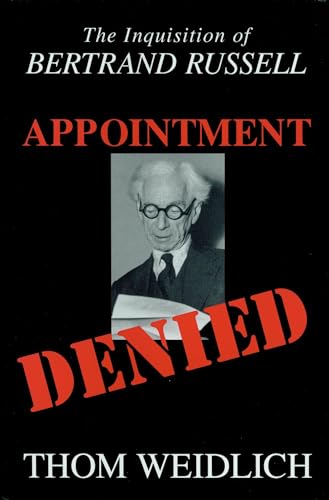
In the spring of 1940 the Great Depression was still spreading misery throughout the world, and war in Europe threatened to drag America into the conflict. Amid these global troubles a tempest in a teapot was brewing on the island of Manhattan, where the board of the City College of New York had just appointed the renowned philosopher Bertrand Russell to teach. With the appointment of this most celebrated of philosophers, the board had intended to boost the school's image. Instead it found itself suddenly embroiled in a controversy involving the city's conservative Episcopal bishop, charges that it was encouraging radical and communist views at the college, and political in-fighting between the popular liberal mayor, Fiorello La Guardia, and corrupt Tammany Hall politicians with a hidden agenda.
Journalist Thom Weidlich masterfully reconstructs this major political imbroglio, which not only captured the attention of New Yorkers but very quickly received national coverage. As political theater, with both farcical and dramatic elements, the denial of Russell's appointment is interesting in and of itself: The sanctimonious and outraged Bishop Manning demands to know how the board could have chosen a man with such radical views on sex, marriage, and religion. Then, amazingly, a seemingly ordinary Brooklyn housewife files a lawsuit to stop Russell's appointment. Journalists begin to wonder, What is her motive? Is she being manipulated by Tammany Hall politicians and their rivalry with the liberal mayor? Before long civil libertarians are holding rallies at City College in defense of the philosopher and academic freedom. And for Russell this trying situation couldn't have come at a worse time with his funds running low and his third marriage falling apart.
But beyond its intrinsic interest, this 1940s' clash between an independent thinker and the guardians of public morality is still of the greatest relevance in light of today's cultural debates and arguments over standards of decency. Journalist Thom Weidlich has written an engrossing page-turner that brings recent history to life and makes us rethink the perennial issues of free thought and moral standards at publicly funded institutions.
"synopsis" may belong to another edition of this title.
About the Author
Thom Weidlich is the managing editor for Direct magazine and a former reporter for the National Law Journal.
From the Inside Flap
In 1940, New York City's Board of Higher Education appointed noted British scholar Bertrand Russell, one of the greatest living philosophers of the day, to the faculty of the publicly funded City College. The board's intent in appointing such a celebrated writer and lecturer was to boost the school's image. Instead, it found itself in the midst of a firestorm when conservative and religious leaders throughout the city and indeed the country - aghast at Russell's unapologetic atheism and his popular writings on "free love" - unleashed a protest over the appointment that raged in the headlines for months.
Russell's appointment seemed to affect every faction in the city. At loggerheads was an amazing cast of characters, including leading politicians, clergymen, and intellectuals of the day. Liberal leaders and civil libertarians hoisted the flag of academic freedom. The City College students - the brilliant children of the city's poor, mostly Jewish immigrants - fought to have the great scholar come to their campus. The board that appointed Russell desperately tried to hang on to its autonomy and prestige.
Members of Tammany Hall - the notorious Manhattan Democratic political machine - and its satellites in the other boroughs used Russell's selection to get back at their nemesis, the reform mayor Fiorello La Guardia. When, in a bizarre twist, a Brooklyn housewife sued the board, the case came before a judge - with surprising results. Despite La Guardia's liberalism, his astute political sense and aspirations for higher office caused him to act in a way that stunned his supporters.
In 1940, the controversy was compared to the "monkey trial" of John Scopes, who was arrested for teaching evolution, and that of the famous Greek philosopher Socrates, who was sentenced to death for the same sins as Russell: impiety and corrupting the youth. Not unlike today's cultural debates over funding the National Endowment for the Arts and the Brooklyn Museum "Sensation" show, Russell's opponents insisted that the issue of his appointment was not one of free speech, but rather something that taxpayers didn't want to support.
Reviews
Weidlich's focus is a narrow one: the controversy that swirled around the City College of New York's 1940 offer of a teaching position to Bertrand Russell. But the battle over the Russell appointment involves such a fascinating cast of characters--among them, Russell himself, the city's Episcopal bishop, Fiorello LaGuardia, Tammany Hall functionaries, Albany legislators, and professors and students of various political stripes--that this small story casts light on larger (and later) issues. The campaign against permitting the British philosopher to corrupt New York students' minds was aggressive, drawing support from religious leaders (and followers) of a number of denominations; legislators moved beyond concern about Russell to investigate subversive activity in the schools, ultimately dismissing 20 teachers (11 others resigned). Russell never did teach at CCNY (and remained bitter about the college's weak response to the campaign against him). "Another battle in religion's war on science," the Russell affair also constituted, Weidlich maintains, a serious "disagree[ment] about the role of education in a democracy." Mary Carroll
"About this title" may belong to another edition of this title.
Search results for Appointment Denied

Stock Image
Appointment Denied : The Inquisition of Bertrand Russell
Seller: Wonder Book, Frederick, MD, U.S.A.
Seller rating 5 out of 5 stars

Condition: Very Good. Very Good condition. Very Good dust jacket. A copy that may have a few cosmetic defects. May also contain light spine creasing or a few markings such as an owner's name, short gifter's inscription or light stamp. Seller Inventory # K01M-00645
Stock Image
Appointment Denied
Published by
The Globe Pequot Publishing Group, Inc., 2000
ISBN 10: 1573927880
ISBN 13: 9781573927888
Used
Hardcover
First Edition
Seller: Better World Books, Mishawaka, IN, U.S.A.
Seller rating 5 out of 5 stars
Condition: Very Good. First Edition. Former library copy. Pages intact with possible writing/highlighting. Binding strong with minor wear. Dust jackets/supplements may not be included. Includes library markings. Stock photo provided. Product includes identifying sticker. Better World Books: Buy Books. Do Good. Seller Inventory # 18412555-75
Stock Image
Appointment Denied
Published by
The Globe Pequot Publishing Group, Inc., 2000
ISBN 10: 1573927880
ISBN 13: 9781573927888
Used
Hardcover
First Edition
Seller: Better World Books, Mishawaka, IN, U.S.A.
Seller rating 5 out of 5 stars
Condition: Good. First Edition. Pages intact with minimal writing/highlighting. The binding may be loose and creased. Dust jackets/supplements are not included. Stock photo provided. Product includes identifying sticker. Better World Books: Buy Books. Do Good. Seller Inventory # 52546217-6
Stock Image
Appointment Denied : The Inquisition of Bertrand Russell
Seller: Midtown Scholar Bookstore, Harrisburg, PA, U.S.A.
Seller rating 5 out of 5 stars
Hardcover. Condition: Very Good. crisp clean w/light shelfwear/edgewear - may have remainder mark Standard-sized. Seller Inventory # 1573927880-02
Stock Image
Appointment Denied The Inquisition of Bertrand Russell
Seller: Willis Monie-Books, ABAA, Cooperstown, NY, U.S.A.
Seller rating 5 out of 5 stars
Hardcover. Condition: Very Good. Dust Jacket Condition: Very Good. First Printing. DJ has some very light wear, but is in a plastic cover. ; 233 pages. Seller Inventory # 321455
Stock Image
Appointment Denied : The Inquisition of Bertrand Russell
Seller: Powell's Bookstores Chicago, ABAA, Chicago, IL, U.S.A.
Seller rating 5 out of 5 stars
Hardcover. Condition: Like New. Clean copy. May have remainder mark. Seller Inventory # 2045696
Stock Image
Appointment Denied : The Inquisition of Bertrand Russell
Seller: Newsboy Books, Ontario, CA, U.S.A.
Seller rating 4 out of 5 stars

Hardcover. Condition: Fine. 1573927880 Two slights indentations near spine on dust jacket. Seller Inventory # 1573927880
Stock Image
Appointment Denied : The Inquisition of Bertrand Russell
Seller: Midtown Scholar Bookstore, Harrisburg, PA, U.S.A.
Seller rating 5 out of 5 stars
Hardcover. Condition: Good. Torn/worn dj. Good hardcover with some shelfwear; may have previous owner's name inside. Standard-sized. Seller Inventory # mon0000300506
Stock Image
The Inquisition of Bertrand Russell - Appointment Denied.
Seller: Boomer's Books, Weare, NH, U.S.A.
Seller rating 3 out of 5 stars

Condition: Very Good+. Dust Jacket Condition: Very Good-. Advance Review Copy. Review Copy with Slip Laid In. DJ has large oval scratch to rear and minor edge/shelf wear. Seller Inventory # 4070
Seller Image
Appointment Denied: The Inquisition of Bertrand Russell
Published by
Prometheus Books, 2000
ISBN 10: 1573927880
ISBN 13: 9781573927888
Used
Hardcover
First Edition
Seller: Zach the Ripper Books, Gillette, WY, U.S.A.
Seller rating 5 out of 5 stars
Hardcover. Condition: Fine. Dust Jacket Condition: Fine. First Edition. First printing. Mylar protected dust jacket. Like new condition. No price on the jacket. The DJ has no tears or chips. Not a remainder. Not an ex-library copy. Seller Inventory # 5182