
Items related to Reflections in Dark Glass: The Life and Times of John...
Synopsis
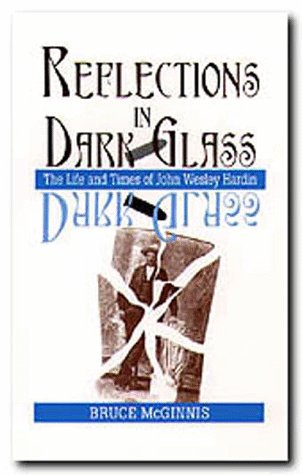
Neither a fictional biography of notorious Texas gunman John Wesley Hardin nor an actual one, Reflections in Dark Glass is based on the personal reminiscences of individuals who knew Hardin best. The book deals with relationships and details not found in the existing literature about the life of Hardin and covers the period from his boyhood to the killing of Deputy Sheriff Charlie Webb in 1874, an altercation which brought about Hardin’s incarceration in 1878 in the state penitentiary in Huntsville, Texas.
"synopsis" may belong to another edition of this title.
About the Author
Bruce McGinnis is a Professor of English at Amarillo College. His previous novels are The Fence and Sweet Cane.
From the Back Cover
Reflections in Dark Glass is based on the personal reminiscences of individuals who knew Hardin best. The story reveals relationships and details not found in the existing literature about the life of Hardin, and covers the period from his boyhood to the killing of Deputy Sheriff Charley Webb in 1874, an altercation which brought about Hardin's incarceration 1878 in the state penitentiary in Huntsville, Texas.
Reviews
John Wesley Hardin (1853-1895) was 15 when he killed his first man, in 1868 in Texas. By the time he was taken down by a policeman's bullet 27 years later, he had killed at least 40, perhaps many more. In his third novel (after The Fence and Sweet Cane), McGinnis presents a surprisingly soft, if not very believable, take on this notorious gunman. Hardin's story is seen through the eyes of three storytellers who are peculiarly tolerant of his bloodletting. His friend Jim Stephens offers the longest and most intriguing account, primarily of Hardin's youthful days, excusing the young killer's mean streak all the while. An anonymous voice reveals Hardin's rescue from a lynch mob; and the outlaw's African American wet nurse, Julie Ola Faye, provides dialect-heavy, often confusing reflections. Some folks, we learn, viewed Hardin as a defender of post-Civil War Southern spirit; indeed, through McGinnis's fictional prism, his crimes are seen mostly as justifiable self-defense. The generally accepted historical record doesn't bear this out, however, presenting Hardin as a cold-blooded murderer who loved his work and who blew away soldiers, gamblers, lawmen and cowboys with equal relish. Still, McGinnis's revisionist chronicle is told with vigor and atmosphere, making this a worthwhile, if offbeat, literary western.
Copyright 1996 Reed Business Information, Inc.
"About this title" may belong to another edition of this title.
Search results for Reflections in Dark Glass: The Life and Times of John...

Stock Image
Reflections in Dark Glass: The Life and Times of John Wesley Hardin
Published by
University of North Texas Press, 1996
ISBN 10: 1574410083
ISBN 13: 9781574410082
Used
Hardcover
Seller: GoldBooks, Denver, CO, U.S.A.
Seller rating 5 out of 5 stars

Hardcover. Condition: very good. Very Good Copy. Customer Service Guaranteed. Seller Inventory # 26E2_4_1574410083
Stock Image
Reflections in Dark Glass: The Life and Times of John Wesley Hardin
Published by
University of North Texas Press, 1996
ISBN 10: 1574410083
ISBN 13: 9781574410082
Used
Hardcover
Seller: HPB-Emerald, Dallas, TX, U.S.A.
Seller rating 5 out of 5 stars
hardcover. Condition: Very Good. Connecting readers with great books since 1972! Used books may not include companion materials, and may have some shelf wear or limited writing. We ship orders daily and Customer Service is our top priority! Seller Inventory # S_459995240
Stock Image
Reflections in Dark Glass: The Life and Times of John Wesley Hardin
Published by
University of North Texas Press, 1996
ISBN 10: 1574410083
ISBN 13: 9781574410082
Used
Hardcover
Seller: ThriftBooks-Dallas, Dallas, TX, U.S.A.
Seller rating 5 out of 5 stars
Hardcover. Condition: Good. No Jacket. Former library book; Pages can have notes/highlighting. Spine may show signs of wear. ~ ThriftBooks: Read More, Spend Less. Seller Inventory # G1574410083I3N10
Stock Image
Reflections in Dark Glass: The Life and Times of John Wesley Hardin
Published by
University of North Texas Press, 1996
ISBN 10: 1574410083
ISBN 13: 9781574410082
Used
Hardcover
Seller: ThriftBooks-Dallas, Dallas, TX, U.S.A.
Seller rating 5 out of 5 stars
Hardcover. Condition: Very Good. No Jacket. May have limited writing in cover pages. Pages are unmarked. ~ ThriftBooks: Read More, Spend Less. Seller Inventory # G1574410083I4N00
Stock Image
Reflections in Dark Glass : The Life and Times of John Wesley Hardin
Published by
University of North Texas Press, 1996
ISBN 10: 1574410083
ISBN 13: 9781574410082
Used
Hardcover
Seller: Better World Books, Mishawaka, IN, U.S.A.
Seller rating 5 out of 5 stars
Condition: Good. Former library copy. Pages intact with minimal writing/highlighting. The binding may be loose and creased. Dust jackets/supplements are not included. Includes library markings. Stock photo provided. Product includes identifying sticker. Better World Books: Buy Books. Do Good. Seller Inventory # 11786334-6
Stock Image
Reflections in Dark Glass: The Life and Times of John Wesley Hardin
Published by
University of North Texas Press, 1996
ISBN 10: 1574410083
ISBN 13: 9781574410082
Used
Hardcover
Seller: HPB-Diamond, Dallas, TX, U.S.A.
Seller rating 5 out of 5 stars
hardcover. Condition: Very Good. Connecting readers with great books since 1972! Used books may not include companion materials, and may have some shelf wear or limited writing. We ship orders daily and Customer Service is our top priority! Seller Inventory # S_474073028
Stock Image
Reflections in Dark Glass The Life and Times of John Wesley Hardin
Published by
University of North Texas Press, 1996
ISBN 10: 1574410083
ISBN 13: 9781574410082
Used
Hardcover
Seller: Inside the Covers, Frost, TX, U.S.A.
Seller rating 5 out of 5 stars
Hardcover. Condition: Fine. Dust Jacket Condition: Fine. Still in shrink wrap. Hard cover published by Univ. of North Texas Press in 1996. Book and dust jacket are in fine condition. Large 8vo, 180 pages, 1.1 lb.; Large 8vo 9" - 10" tall; 180 pages. Seller Inventory # MSM13031
Stock Image
Reflections in Dark Glass The Life and Times of John Wesley Hardin
Published by
University of North Texas Press, 1996
ISBN 10: 1574410083
ISBN 13: 9781574410082
Used
Hardcover
First Edition
Signed
Seller: Inside the Covers, Frost, TX, U.S.A.
Seller rating 5 out of 5 stars
Hardcover. Condition: Very Good. Dust Jacket Condition: Very Good. First Edition; First Printing. Signed and inscribed by author on front endpaper. First edition, first printing. Hard cover published by Univ. of North Texas Press in 1996. Cream-colored covers with rust-colored lettering on spine. Dust jacket is creased on inner back flap, and is in very good condition. Also included is a business card from the author.; 9.34 X 6.34 X 0.75 inches; 180 pages; Signed by Author. Seller Inventory # MSM5922
Stock Image
Reflections In Dark Glass The Life and Times of John Wesley Hardin
Published by
University of North Texas Press, Denton, Texas, 1996
ISBN 10: 1574410083
ISBN 13: 9781574410082
New
Hardcover
First Edition
Seller: Old West Books (ABAA), St. Robert, MO, U.S.A.
Seller rating 5 out of 5 stars
Hardcover. Condition: New. Dust Jacket Condition: New. First Edition. 180pgs Book is based on personal reminiscences of individuals who knew Hardin best. Seller Inventory # 014579
Seller Image
Reflections in Dark Glass: The Life and Times of John Wesley Hardin
Published by
University of North Texas Press, 1996
ISBN 10: 1574410083
ISBN 13: 9781574410082
Used
Hardcover
First Edition
Seller: By-the-side-books, Denver, CO, U.S.A.
Seller rating 4 out of 5 stars

Hardcover. Condition: Very Good. 1st Edition. First Edition. First Printing. Dust jacket protected by BrodArt plastic cover. The book is a fictionalized biography of the notorious 19th-century Texas gunman John Wesley Hardin, who was rumored to have killed at least 40 people. Rather than a standard historical account, McGinnis tells the story through the eyes of individuals who knew Hardin best, such as his friend Jim Stephens and his African American wet nurse, Julia Ola Faye. UNT Press. Seller Inventory # ABE-1776009484559