
Items related to Small Town America in World War II: War Stories from...
Synopsis
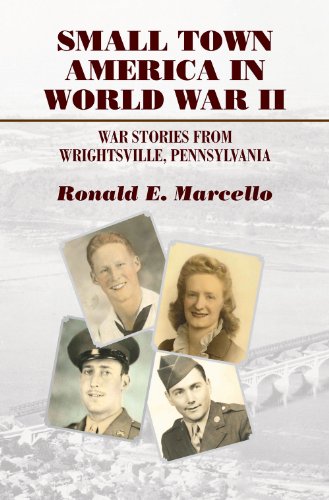
Historians acknowledge that World War II touched every man, woman, and child in the United States. In Small Town America in World War II, Ronald E. Marcello uses oral history interviews with civilians and veterans to explore how the citizens of Wrightsville, Pennsylvania, responded to the war effort. Located along the western shore of the Susquehanna River in York County, Wrightsville was a transportation hub with various shops, stores, and services as well as industrial plants.
Interviews with citizens and veterans are organized in sections on the home front; the North African-Italian, European, and Pacific theatres; stateside military service; and occupation in Germany. Throughout Marcello provides introductions and contextual narrative on World War II as well as annotations for events and military terms.
Overseas the citizens of Wrightsville turned into soldiers. An infantryman in the Italian campaign, Alfred Forry, explained, “I was forty-five days on the line wearing the same clothes, but everybody was in the same situation, so you didn’t mind the stench and body odors.” A veteran of the Battle of the Bulge, Edward Reisinger, remembered, “Replacements had little chance of surviving. They were sent to the front one day, and the next day they were coming back with mattress covers over them. The sergeants never knew the names of these people.” Mortar man Donald Peters described the death of a buddy who was hit by artillery shrapnel: “His arm was just hanging on by the skin, and his intestines were hanging out.”
In the conclusion Marcello examines how the war affected Wrightsville. Did the war bring a return to prosperity? What effects did it have on women? How did wartime trauma affect the returning veterans? In short, did World War II transform Wrightsville and its citizens, or was it the same town after the war?
"synopsis" may belong to another edition of this title.
About the Author
Born in Wrightsville, Pennsylvania, RONALD E. MARCELLO earned his PhD at Duke University. He is professor emeritus of history at the University of North Texas and the co-author/editor of Warriors and Scholars: A Modern War Reader and Remembering Pearl Harbor: Eye-Witness Accounts of American Men and Women.
Excerpt. © Reprinted by permission. All rights reserved.
“We went through the town of Giulino di Mezzagra where the partisans had just shot Mussolini, his mistress, and about fifteen of his henchmen. They had erected this long scaffold and had them hanging upside down like they had butchered hogs years ago. By this time I was so battle-hardened that it didn't bother me. It was just another corpse.”—Infantryman Glenn Blouse
“The next thing we knew, the German tanks attacked us. They knocked out five of our tanks quickly, and they all burned up in flames. I think the Germans damaged at least that many, but we didn't get hit. This battle only lasted about ten minutes. In the end we got one of theirs, but we lost at least ten of ours either destroyed or damaged. Five German Panther tanks were about equal to about twenty of our light tanks, so in a tank-to-tank battle, their tanks were going to win. We would lose.”—Tanker Mervin Haugh
“At Sugar Loaf Hill [on Okinawa], the Japs would stand up there and drop things down on the Marines. All you saw were dead bodies there. That’s all. I saw them come back with the dead Marines in the ‘six-by-sixes’—a layer of bodies, a layer of sheets, and a layer of bodies. I remember smelling the dried blood, and I know it broke my heart.”—Marine Jacob Snyder
"About this title" may belong to another edition of this title.
Search results for Small Town America in World War II: War Stories from...

Stock Image
Small Town America in World War II: War Stories from Wrightsville, Pennsylvania
Published by
University of North Texas Press,U.S., 2014
ISBN 10: 1574415514
ISBN 13: 9781574415513
Used
Hardcover
Seller: World of Books (was SecondSale), Montgomery, IL, U.S.A.
Seller rating 5 out of 5 stars

Hardback. Condition: Good. Historians acknowledge that World War II touched every man, woman, and child in the United States. In Small Town America in World War II, Ronald E. Marcello uses oral history interviews with civilians and veterans to explore how the citizens of Wrightsville, Pennsylvania, responded to the war effort. Interviews with citizens and veterans are organized in sections on the home front; the North African-Italian, European, and Pacific theatres; stateside military service; and occupation in Germany. Throughout Marcello provides introductions and contextual narrative on World War II as well as annotations for events and military terms.Overseas the citizens of Wrightsville turned into soldiers. A veteran of the Battle of the Bulge, Edward Reisinger, remembered, ?Replacements had little chance of surviving. They were sent to the front one day, and the next day they were coming back with mattress covers over them.? Tanker Mervin Haugh recalls, ?The next thing we knew, the German tanks attacked us. They knocked out five of our tanks quickly, and they all burned up in flames.? Seller Inventory # 00110657408
Stock Image
Small Town America in World War II: War Stories from Wrightsville, Pennsylvania
Published by
University of North Texas Press,U.S., 2014
ISBN 10: 1574415514
ISBN 13: 9781574415513
Used
Hardcover
Seller: World of Books Inc, Montgomery, IL, U.S.A.
Seller rating 4 out of 5 stars

Hardback. Condition: Good. Historians acknowledge that World War II touched every man, woman, and child in the United States. In Small Town America in World War II, Ronald E. Marcello uses oral history interviews with civilians and veterans to explore how the citizens of Wrightsville, Pennsylvania, responded to the war effort. Interviews with citizens and veterans are organized in sections on the home front; the North African-Italian, European, and Pacific theatres; stateside military service; and occupation in Germany. Throughout Marcello provides introductions and contextual narrative on World War II as well as annotations for events and military terms.Overseas the citizens of Wrightsville turned into soldiers. A veteran of the Battle of the Bulge, Edward Reisinger, remembered, ?Replacements had little chance of surviving. They were sent to the front one day, and the next day they were coming back with mattress covers over them.? Tanker Mervin Haugh recalls, ?The next thing we knew, the German tanks attacked us. They knocked out five of our tanks quickly, and they all burned up in flames.? Seller Inventory # CIN1574415514G
Stock Image
Small Town America in World War II: War Stories from Wrightsville, Pennsylvania
Published by
University of North Texas Press, 2014
ISBN 10: 1574415514
ISBN 13: 9781574415513
Used
Hardcover
Seller: Half Price Books Inc., Dallas, TX, U.S.A.
Seller rating 5 out of 5 stars
hardcover. Condition: Very Good. Connecting readers with great books since 1972! Used books may not include companion materials, and may have some shelf wear or limited writing. We ship orders daily and Customer Service is our top priority! Seller Inventory # S_461015531
Stock Image
Small Town America in World War II : War Stories from Wrightsville, Pennsylvania
Published by
University of North Texas Press, 2014
ISBN 10: 1574415514
ISBN 13: 9781574415513
Used
Hardcover
Seller: Buchpark, Trebbin, Germany
Seller rating 5 out of 5 stars
Condition: Sehr gut. Zustand: Sehr gut | Seiten: 452 | Sprache: Englisch | Produktart: Bücher | Historians acknowledge that World War II touched every man, woman, and child in the US. In this title, Ronald E. Marcello uses oral history interviews with civilians and veterans to explore how the citizens of Wrightsville, Pennsylvania, responded to the war effort. Interviews with citizens and veterans are organized in sections on the home front; the North African-Italian, European, and Pacific theatres; stateside military service; and occupation in Germany. Seller Inventory # 24424725/2
Buy Used
US$ 42.62
US$ 117.88 shipping
Ships from Germany to U.S.A.
Ships from Germany to U.S.A.
Quantity: 1 available