
Items related to Sensory-Directed Flavor Analysis (Food Science And...
Synopsis
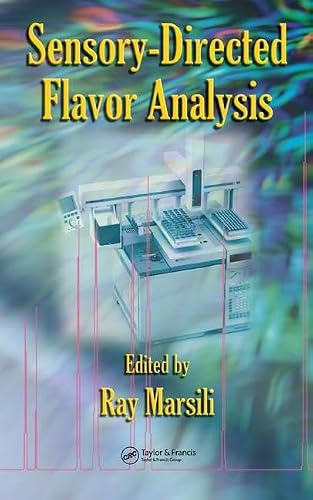
Today, flavor chemists can generate copious amounts of data in a short time with relatively little effort using automated solid phase micro-extraction, Gerstel-Twister® and other extraction techniques in combination with gas chromatographic (GC) analysis. However, more data does not necessarily mean better understanding. In fact, the ability to extract, isolate, and concentrate potential flavor-important chemicals from complex food systems has surpassed the ability to understand how the chemical data relates to flavor. Sensory-Directed Flavor Analysis helps chemists unlock the flavor secrets that may be hiding in their chromatograms by translating cold hard numbers into a better understanding of the sense of smell and taste. The author integrates the two disciplines of sensory science and analytical chemistry, encouraging sensory scientists to incorporate more analytical data while encouraging analytical chemists to include more sensory techniques. Using more ancillary techniques helps each discipline elucidate how various chemical constituents influence food flavor and appeal. The book discusses important enabling technologies and analytical methods including GC-olfactometry (GC-O), combination GC-O and multi-dimensional GC, the application of odor activity values (OAVs), and recombination studies, as well as solid-phase dynamic extraction and preseparation techniques. A broad array of applications, in addition to dozens of tables, graphs, gas chromatograms, and pictures, are included throughout the book. Highlighting the advantages and disadvantages and the appropriate circumstances for each method of analysis, Sensory-Directed Flavor Analysis offers flavor scientists an essential reference to deepen their understanding of the function of chemicals on the perception of taste.
"synopsis" may belong to another edition of this title.
About the Author
Ray Marsili
"About this title" may belong to another edition of this title.
Search results for Sensory-Directed Flavor Analysis (Food Science And...

Stock Image
Sensory-Directed Flavor Analysis. (=Food Science and Technology)
Seller: Antiquariat Thomas Haker GmbH & Co. KG, Berlin, Germany
Seller rating 5 out of 5 stars

Hardcover. Condition: Sehr gut. 2nd ed. 288 S.; Ill. Very good. Shrink wrapped. Sprache: Englisch Gewicht in Gramm: 685. Seller Inventory # 818586
Buy Used
US$ 16.64
US$ 22.44 shipping
Ships from Germany to U.S.A.
Ships from Germany to U.S.A.
Quantity: 2 available
Seller Image
Sensory-Directed Flavor Analysis (Food Science And Technology)
Seller: Bay State Book Company, North Smithfield, RI, U.S.A.
Seller rating 5 out of 5 stars
Condition: good. The book is in good condition with all pages and cover intact, including the dust jacket if originally issued. The spine may show light wear. Pages may contain some notes or highlighting, and there might be a "From the library of" label. Boxed set packaging, shrink wrap, or included media like CDs may be missing. Seller Inventory # BSM.1C78A
Stock Image
Sensory-Directed Flavor Analysis (Food Science And Technology)
Seller: SHIMEDIA, Brooklyn, NY, U.S.A.
Seller rating 4 out of 5 stars

Condition: New. Satisfaction Guaranteed or your money back. Seller Inventory # 1574445685
Stock Image
SENSORY DIRECTED FLAVOR ANALYSIS
Seller: Basi6 International, Irving, TX, U.S.A.
Seller rating 5 out of 5 stars
Condition: Brand New. New. US edition. Expediting shipping for all USA and Europe orders excluding PO Box. Excellent Customer Service. Seller Inventory # ABEOCT25-287427
Stock Image
Sensory-Directed Flavor Analysis
Print on DemandSeller: Majestic Books, Hounslow, United Kingdom
Seller rating 4 out of 5 stars
Condition: New. pp. 288 Illus. This item is printed on demand. Seller Inventory # 8368412
Buy New
US$ 417.99
US$ 8.71 shipping
Ships from United Kingdom to U.S.A.
Ships from United Kingdom to U.S.A.
Quantity: 3 available
Stock Image
Sensory-Directed Flavor Analysis
Seller: Books Puddle, Woodside, NY, U.S.A.
Seller rating 4 out of 5 stars
Condition: New. pp. 288. Seller Inventory # 26528067
Seller Image
Marsili, R: Sensory-Directed Flavor Analysis
Seller: moluna, Greven, Germany
Seller rating 5 out of 5 stars
Gebunden. Condition: New. Seller Inventory # 904351889
Buy New
US$ 400.56
US$ 54.97 shipping
Ships from Germany to U.S.A.
Ships from Germany to U.S.A.
Quantity: Over 20 available
Stock Image
Sensory-Directed Flavor Analysis (Hardcover)
Published by
Taylor & Francis Inc, Bosa Roca, 2006
ISBN 10: 1574445685
ISBN 13: 9781574445688
New
Hardcover
First Edition
Seller: Grand Eagle Retail, Bensenville, IL, U.S.A.
Seller rating 5 out of 5 stars
Hardcover. Condition: new. Hardcover. Today, flavor chemists can generate copious amounts of data in a short time with relatively little effort using automated solid phase micro-extraction, Gerstel-Twister and other extraction techniques in combination with gas chromatographic (GC) analysis. However, more data does not necessarily mean better understanding. In fact, the ability to extract, isolate, and concentrate potential flavor-important chemicals from complex food systems has surpassed the ability to understand how the chemical data relates to flavor.Sensory-Directed Flavor Analysis helps chemists unlock the flavor secrets that may be hiding in their chromatograms by translating cold hard numbers into a better understanding of the sense of smell and taste. The author integrates the two disciplines of sensory science and analytical chemistry, encouraging sensory scientists to incorporate more analytical data while encouraging analytical chemists to include more sensory techniques. Using more ancillary techniques helps each discipline elucidate how various chemical constituents influence food flavor and appeal. The book discusses important enabling technologies and analytical methods including GC-olfactometry (GC-O), combination GC-O and multi-dimensional GC, the application of odor activity values (OAVs), and recombination studies, as well as solid-phase dynamic extraction and preseparation techniques. A broad array of applications, in addition to dozens of tables, graphs, gas chromatograms, and pictures, are included throughout the book.Highlighting the advantages and disadvantages and the appropriate circumstances for each method of analysis, Sensory-Directed Flavor Analysis offers flavor scientists an essential reference to deepen their understanding of the function of chemicals on the perception of taste. Helps chemists unlock the flavor secrets that may be hiding in their chromatograms by translating cold hard numbers into a better understanding of the sense of smell and taste. This book discusses technologies and analytical methods including GC-olfactometry (GC-O) and combination GC-O and multi-dimensional GC. Shipping may be from multiple locations in the US or from the UK, depending on stock availability. Seller Inventory # 9781574445688
Stock Image
Sensory-Directed Flavor Analysis
Seller: Biblios, Frankfurt am main, HESSE, Germany
Seller rating 4 out of 5 stars
Condition: New. pp. 288. Seller Inventory # 18528073
Buy New
US$ 488.55
US$ 11.16 shipping
Ships from Germany to U.S.A.
Ships from Germany to U.S.A.
Quantity: 3 available
Stock Image
Sensory-Directed Flavor Analysis
Seller: Kennys Bookshop and Art Galleries Ltd., Galway, GY, Ireland
Seller rating 5 out of 5 stars
Condition: New. Helps chemists unlock the flavor secrets that may be hiding in their chromatograms by translating cold hard numbers into a better understanding of the sense of smell and taste. This book discusses technologies and analytical methods including GC-olfactometry (GC-O) and combination GC-O and multi-dimensional GC. Editor(s): Marsili, Ray. Series: Food Science and Technology. Num Pages: 288 pages, 102 black & white illustrations, 58 black & white tables, 4 black & white halftones. BIC Classification: TDCT. Category: (P) Professional & Vocational. Dimension: 229 x 152 x 23. Weight in Grams: 544. . 2006. 1st Edition. hardcover. . . . . Seller Inventory # V9781574445688
Buy New
US$ 520.01
US$ 10.66 shipping
Ships from Ireland to U.S.A.
Ships from Ireland to U.S.A.
Quantity: 20 available