
Items related to What Are My Rights?: 95 Questions and Answers About...
Synopsis
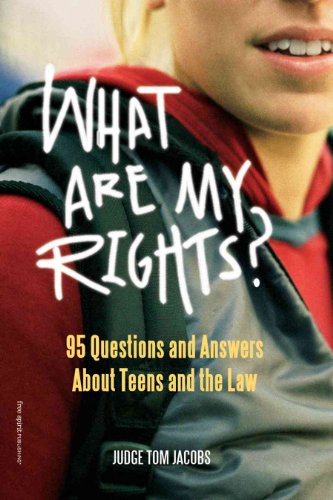
"How long do I have to stay in school?" "Can my property be searched and seized?" "Are my grades public information?" "When can I have a beer?" "What if I'm discriminated against?" Teens often have questions about the law, but they don't know where to turn for answers. Updated with new facts and resources, written in clear, everyday language, this book explores 95 legal questions that pertain specifically to teens. Readers learn about the laws that affect them, appreciate their rights, and consider their responsibilities. Includes questions for reflection and discussion.
"synopsis" may belong to another edition of this title.
About the Author
Thomas a. Jacobs, J.D., was an Arizona Assistant Attorney general from 1972–1985, where he practiced criminal and child welfare law. He was appointed to the Maricopa County Superior Court in 1985 where he served as a judge pro tem and commissioner in the juvenile and family courts until his retirement in 2008. He also taught juvenile law for ten years as an adjunct professor at the Arizona State University School of Social Work. He continues to write for teens, lawyers, and judges. His recent articles on teens and the law have been published in The New York Times and New York ParentGuide. His previous books include They Broke the Law—You Be the Judge and Teens Take It to Court. Judge Jacobs also maintains the popular Web site “Ask the Judge: Answers for Teens About the law” at www.askthejudge.info.
Reviews
Grade 6 Up?An attorney with extensive experience in the area of law as it applies to youth has assembled 95 questions and answers into an exceptionally solid guide for teens. Recognizing that society has grave responsibilities toward young people, Jacobs voices the need for legal systems to guide and protect them. The scope of information is comprehensive, including issues of family, school, employment, the body and growing up, crime, punishment, and the legal system. Jacobs addresses the basics: the authority of parents, the right of children to be free from abuse, what to do when parents divorce, the need for children to be educated, the rights of employers as well as their teenage employees, and health issues, including substance abuse as well as the legal ramifications of HIV infection. In addition, he deals with issues that kids face everyday: "Can my locker be opened and searched?"; "Can I be made to undergo drug testing to engage in school athletics?"; and "Can I get my own apartment?" Every chapter ends with a list of questions and thought-provoking activities that encourage readers to examine the relevance and the ethics of the law as it affects them. Charts and inserts that contain real-life examples, compelling data, and other information enhance the text. A list of books, organizations, and Web sites germane to the questions are included. This current and comprehensive book is an important inclusion for collections serving teens.?Sylvia V. Meisner, Allen Middle School, Greensboro, NC
Copyright 1998 Reed Business Information, Inc.
Gr. 7^-12. Like the more specialized ACLU Handbooks for Young Americans , this one also uses a question-and-answer format. But unlike those books, it generally steers clear of legal specifics and extended discussion. In clear, everyday language, with just a sprinkling of legal terms, Jacobs presents useful guidelines and background on a variety of topically organized concerns related to teens' rights within the family, at school, on the job, in the community, and within the legal system itself: "What will happen if I get caught shoplifting?" "Can I get an abortion without telling my parents?" "What rights do teen parents have?" Jacobs is not overly judgmental, though he occasionally supplies some stern examples of consequences, as in his response to a question about the legality of sniffing glue or paint thinner. Also, when discussing thorny issues, he sometimes suggests that teens consult trusted adults before making big decisions. "FYI" sections following each discussion question steer readers to additional resources, and "Think about It, Talk about It" sections following each chapter are ideal for teachers. Stephanie Zvirin
"About this title" may belong to another edition of this title.
Search results for What Are My Rights?: 95 Questions and Answers About...

Stock Image
What Are My Rights?: 95 Questions and Answers About Teens and the Law
Published by
Teacher Created Materials, Inc, 2006
ISBN 10: 1575420287
ISBN 13: 9781575420288
Used
Paperback
Seller: World of Books (was SecondSale), Montgomery, IL, U.S.A.
Seller rating 5 out of 5 stars

Paperback. Condition: Good. "How long do I have to stay in school?" "Can my property be searched and seized?" "Are my grades public information?" "When can I have a beer?" "What if I'm discriminated against?" Teens often have questions about the law, but they don't know where to turn for answers. Updated with new facts and resources, written in clear, everyday language, this book explores 95 legal questions that pertain specifically to teens. Readers learn about the laws that affect them, appreciate their rights, and consider their responsibilities. Includes questions for reflection and discussion. Seller Inventory # 00106139457
Stock Image
What Are My Rights?: 95 Questions and Answers About Teens and the Law
Seller: Gulf Coast Books, Cypress, TX, U.S.A.
Seller rating 5 out of 5 stars
paperback. Condition: Good. Seller Inventory # 1575420287-3-29118160
Stock Image
What Are My Rights?: 95 Questions and Answers About Teens and the Law
Published by
Free Spirit Publishing (edition Updated), 1997
ISBN 10: 1575420287
ISBN 13: 9781575420288
Used
Paperback
Seller: BooksRun, Philadelphia, PA, U.S.A.
Seller rating 5 out of 5 stars
Paperback. Condition: Very Good. Updated. It's a well-cared-for item that has seen limited use. The item may show minor signs of wear. All the text is legible, with all pages included. It may have slight markings and/or highlighting. Seller Inventory # 1575420287-11-1
Stock Image
What Are My Rights?: 95 Questions and Answers About Teens and the Law
Seller: HPB-Diamond, Dallas, TX, U.S.A.
Seller rating 5 out of 5 stars
paperback. Condition: Very Good. Connecting readers with great books since 1972! Used books may not include companion materials, and may have some shelf wear or limited writing. We ship orders daily and Customer Service is our top priority! Seller Inventory # S_468257043
Stock Image
What Are My Rights? : 95 Questions and Answers about Teens and the Law
Published by
Free Spirit Publishing Inc., 2006
ISBN 10: 1575420287
ISBN 13: 9781575420288
Used
Softcover
Seller: Better World Books, Mishawaka, IN, U.S.A.
Seller rating 5 out of 5 stars
Condition: Fine. 1 Edition. Used book that is in almost brand-new condition. May contain a remainder mark. Better World Books: Buy Books. Do Good. Seller Inventory # 55299059-6
Stock Image
What Are My Rights? : 95 Questions and Answers about Teens and the Law
Published by
Free Spirit Publishing Inc., 2006
ISBN 10: 1575420287
ISBN 13: 9781575420288
Used
Softcover
Seller: Better World Books, Mishawaka, IN, U.S.A.
Seller rating 5 out of 5 stars
Condition: Very Good. 1 Edition. Pages intact with possible writing/highlighting. Binding strong with minor wear. Dust jackets/supplements may not be included. Stock photo provided. Product includes identifying sticker. Better World Books: Buy Books. Do Good. Seller Inventory # 3755213-6
Stock Image
What Are My Rights?: 95 Questions and Answers About Teens and the Law
Published by
Teacher Created Materials, Inc, 2006
ISBN 10: 1575420287
ISBN 13: 9781575420288
Used
Paperback
Seller: World of Books Inc, Montgomery, IL, U.S.A.
Seller rating 4 out of 5 stars

Paperback. Condition: Good. "How long do I have to stay in school?" "Can my property be searched and seized?" "Are my grades public information?" "When can I have a beer?" "What if I'm discriminated against?" Teens often have questions about the law, but they don't know where to turn for answers. Updated with new facts and resources, written in clear, everyday language, this book explores 95 legal questions that pertain specifically to teens. Readers learn about the laws that affect them, appreciate their rights, and consider their responsibilities. Includes questions for reflection and discussion. Seller Inventory # CIN1575420287G
Stock Image
What Are My Rights?: 95 Questions and Answers About Teens and the Law
Seller: ThriftBooks-Dallas, Dallas, TX, U.S.A.
Seller rating 5 out of 5 stars
Paperback. Condition: Very Good. No Jacket. May have limited writing in cover pages. Pages are unmarked. ~ ThriftBooks: Read More, Spend Less. Seller Inventory # G1575420287I4N00
Stock Image
What Are My Rights?: 95 Questions and Answers About Teens and the Law
Seller: ThriftBooks-Atlanta, AUSTELL, GA, U.S.A.
Seller rating 5 out of 5 stars
Paperback. Condition: Very Good. No Jacket. May have limited writing in cover pages. Pages are unmarked. ~ ThriftBooks: Read More, Spend Less. Seller Inventory # G1575420287I4N00
Stock Image
What Are My Rights?: 95 Questions and Answers About Teens and the Law
Published by
Free Spirit Publishing October 1997, 1997
ISBN 10: 1575420287
ISBN 13: 9781575420288
Used
Trade Paperback
Seller: R Bookmark, Youngtown, AZ, U.S.A.
Seller rating 5 out of 5 stars
Trade Paperback. Condition: Used - Good. Seller Inventory # 291941