
Items related to Forensic Science: An Encyclopedia of History, Methods,...
Synopsis
The only A–Z reference work on forensic science, one of the most intriguing and exciting fields in criminological studies.
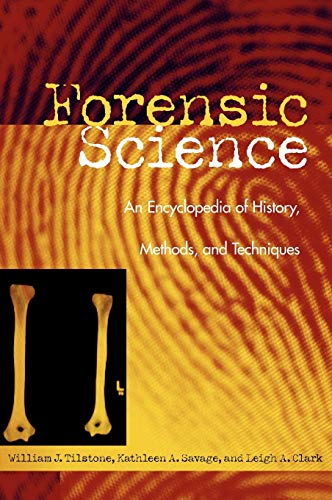
From dandruff to DNA, from ammunition to infrared spectrophotometry, forensic scientists employ the commonplace and the esoteric to get their man or woman. Forensic Science is the only comprehensive reference work accessible to nonexperts on this fast-changing and ever-fascinating field of criminological study. Readers will learn how the latest scientific breakthroughs and the well-honed instincts of forensics experts come together to provide the clues and amass the evidence to bring America's most notorious criminals to justice.
From famous firsts in forensics to possible future developments in the science, the expert team of contributors put together by William Tilstone, executive director of the National Forensic Science Technology Center, examines techniques and technologies, key cases, critical controversies, and ethical and legal issues.
"synopsis" may belong to another edition of this title.
About the Author
William J. Tilstone, PhD, is executive director of the National Forensic Science Technology Center in Largo, FL.
Kathleen A. Savage, PhD, is business and academic program manager at Forensic Quality Services in Largo, FL. She is also academic program manager at the National Forensic Science Technology Center in Largo, FL.
Leigh A. Clark, MS, is crime laboratory analyst at the Florida Department of Law Enforcement; Jacksonville Regional Operations Center; Serology/DNA Section; Jacksonville, FL, and academic programs specialist at the National Forensic Science Technology Center in Largo, FL.
Reviews
The popularity of CSI and other television programs about forensics has brought patrons to the library seeking more information. This volume provides an introduction to the history of forensic science and the techniques that investigators use to solve crimes.
A lengthy introduction gives a historical overview, with see references to articles within the text. The main body of the work contains more than 300 alphabetical entries covering both scientific and legal information. These include famous cases (Bundy, Ted; Pan Am 103); legal decisions (Frye rule); techniques (Document examination, High performance liquid chromatography); and broad topics, such as Firearms, Hair, and Mass disaster victim identification. There are also entries for drugs (Methamphetamine), historical topics (Romanov family), types of crimes (Sexual offenses), and scientific ideas (Objective test, Locard's exchange principle). Cross-references help users find related material. The introduction and each of the entries have references for further reading, and there is a bibliography of books and Web sites at the volume's end. The handful of illustrations are in black and white.
The authors of this work have a scholarly approach, emphasizing history and defining techniques. Facts on File's Encyclopedia of Forensic Science (2003) provides more practical information, explaining how complex tests, such as immunodiffusion, work. It also has color illustrations and feature essays in text boxes. The two works complement each other. Both are more accessible to the general public and far less expensive than the Encyclopedia of Forensic Sciences (Academic Press, 2000). Forensic Science is a useful resource for public and academic libraries. Barbara Bibel
Copyright © American Library Association. All rights reserved
"About this title" may belong to another edition of this title.
Search results for Forensic Science: An Encyclopedia of History, Methods,...

Stock Image
Forensic Science: An Encyclopedia of History, Methods, and Techniques
Seller: The Book Cellar, LLC, Nashua, NH, U.S.A.
Seller rating 4 out of 5 stars

hardcover. Condition: Very Good. Ex-Library copy with some moderate shelf wear. A portion of your purchase of this book will be donated to non-profit organizations.Over 1,000,000 satisfied customers since 1997! Choose expedited shipping (if available) for much faster delivery. Delivery confirmation on all US orders. Seller Inventory # 10866100
Stock Image
Forensic Science : An Encyclopedia of History, Methods, and Techniques
Seller: Better World Books: West, Reno, NV, U.S.A.
Seller rating 5 out of 5 stars

Condition: Very Good. Former library copy. Pages intact with possible writing/highlighting. Binding strong with minor wear. Dust jackets/supplements may not be included. Includes library markings. Stock photo provided. Product includes identifying sticker. Better World Books: Buy Books. Do Good. Seller Inventory # GRP60851474
Stock Image
Forensic Science : An Encyclopedia of History, Methods, and Techniques
Seller: Better World Books, Mishawaka, IN, U.S.A.
Seller rating 5 out of 5 stars
Condition: Good. Former library copy. Pages intact with minimal writing/highlighting. The binding may be loose and creased. Dust jackets/supplements are not included. Includes library markings. Stock photo provided. Product includes identifying sticker. Better World Books: Buy Books. Do Good. Seller Inventory # GRP104762561
Stock Image
Forensic Science: An Encyclopedia of History, Methods, and Techniques
Seller: Bahamut Media, Reading, United Kingdom
Seller rating 4 out of 5 stars
hardcover. Condition: Very Good. This book is in very good condition and will be shipped within 24 hours of ordering. The cover may have some limited signs of wear but the pages are clean, intact and the spine remains undamaged. This book has clearly been well maintained and looked after thus far. Money back guarantee if you are not satisfied. See all our books here, order more than 1 book and get discounted shipping. Seller Inventory # 6545-9781576071946
Buy Used
US$ 13.47
US$ 9.34 shipping
Ships from United Kingdom to U.S.A.
Ships from United Kingdom to U.S.A.
Quantity: 2 available
Stock Image
Forensic Science: An Encyclopedia of History, Methods, and Techniques
Published by
ABC-CLIO, Santa Barbara, CA, 2006
ISBN 10: 1576071944
ISBN 13: 9781576071946
Used
Hardcover
Seller: Foggy Mountain Books, Oakdale, TN, U.S.A.
Seller rating 5 out of 5 stars
Hardcover. Condition: Very Good. No Jacket. Pictorial boards. 2nd printing, 2007. Former library reference copy with usual markings and labels. Light wear, corners sharp. Firmly bound, tight and square. Crisp, bright, unmarked pages. No dust jacket as issued. Very Good condition. Seller Inventory # 007052
Stock Image
Forensic Science: An Encyclopedia of History, Methods, and Techniques
Seller: AwesomeBooks, Wallingford, United Kingdom
Seller rating 5 out of 5 stars
hardcover. Condition: Very Good. Forensic Science: An Encyclopedia of History, Methods, and Techniques This book is in very good condition and will be shipped within 24 hours of ordering. The cover may have some limited signs of wear but the pages are clean, intact and the spine remains undamaged. This book has clearly been well maintained and looked after thus far. Money back guarantee if you are not satisfied. See all our books here, order more than 1 book and get discounted shipping. Seller Inventory # 7719-9781576071946
Buy Used
US$ 33.76
US$ 5.51 shipping
Ships from United Kingdom to U.S.A.
Ships from United Kingdom to U.S.A.
Quantity: 2 available
Stock Image
Forensic Science: An Encyclopedia of History, Methods, and Techniques
Seller: GoldBooks, Denver, CO, U.S.A.
Seller rating 5 out of 5 stars
Hardcover. Condition: new. New Copy. Customer Service Guaranteed. Seller Inventory # 76O60_78_1576071944
Stock Image
Forensic Science: An Encyclopedia of History, Methods, and Techniques
Seller: SHIMEDIA, Brooklyn, NY, U.S.A.
Seller rating 4 out of 5 stars
Condition: New. Satisfaction Guaranteed or your money back. Seller Inventory # 1576071944
Stock Image
Forensic Science: An Encyclopedia of History, Methods, and Techniques
Seller: BennettBooksLtd, Los Angeles, CA, U.S.A.
Seller rating 5 out of 5 stars
hardcover. Condition: New. In shrink wrap. Looks like an interesting title! Seller Inventory # Q-1576071944
Stock Image
Forensic Science: An Encyclopedia of History, Methods, and Techniques
Seller: Read&Dream, SAINT LOUIS, MO, U.S.A.
Seller rating 4 out of 5 stars
Condition: New. Seller Inventory # 24B7X294-31688-N-01-17-2025