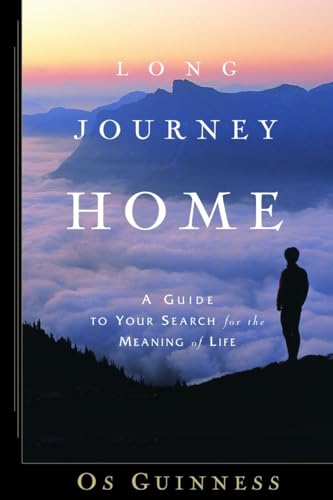
Long Journey Home: A Guide to Your Search for the Meaning of Life - Softcover

Guinness, Os

  • 3.87 out of 5 stars
    118 ratings by Goodreads
 
9781578568468: Long Journey Home: A Guide to Your Search for the Meaning of Life

Synopsis

Have you woken up to the journey of life? Have you reached a point where you long for “something more”? Have the things you have striven to achieve turned out to be far less than enough? Do you desire to unriddle life’s mystery and pursue a life rich with significance?
Long Journey Home is a seeker’s road map to the quest for meaning. Rich in stories and profoundly personal as well as practical, it explores the great philosophies of life and charts the road toward meaning taken by countless thoughtful seekers over the centuries. Written for those who care and those who are open, “it assumes no faith in the reader, only the recognition that the humanness of life as a journey is something we should all care about enough to seek to make sense of it and to make up our minds for ourselves.”

"synopsis" may belong to another edition of this title.

About the Author

Os Guinness was born in China and educated in England. He did undergraduate studies at the University of London and postgraduate work at Oriel College, Oxford, where he earned a D.Phil in the social sciences. Formerly a guest scholar at the Woodrow Wilson Center for International Studies and Visiting Fellow at the Brookings Institution, Os is currently Senior Fellow at the Trinity Forum in McLean, Virginia. Widely traveled, he has written or edited more than twenty books, including The American Hour, Time for Truth, and The Call. He makes his home in northern Virginia.

From the Back Cover

Have you woken up to the journey of life? Have you reached a point where you long for "something more"? Have the things you have striven to achieve turned out to be far less than enough? Do you desire to unriddle life's mystery and pursue a life rich with significance?
"Long Journey Home is a seeker's road map to the quest for meaning. Rich in stories and profoundly personal as well as practical, it explores the great philosophies of life and charts the road toward meaning taken by countless thoughtful seekers over the centuries. Written for those who care and those who are open, "it assumes no faith in the reader, only the recognition that the humanness of life as a journey is something we should all care about enough to seek to make sense of it and to make up our minds for ourselves."

"From the Hardcover edition.

From the Inside Flap

Have you woken up to the journey of life? Have you reached a point where you long for something more ? Have the things you have striven to achieve turned out to be far less than enough? Do you desire to unriddle life s mystery and pursue a life rich with significance?
Long Journey Home is a seeker s road map to the quest for meaning. Rich in stories and profoundly personal as well as practical, it explores the great philosophies of life and charts the road toward meaning taken by countless thoughtful seekers over the centuries. Written for those who care and those who are open, it assumes no faith in the reader, only the recognition that the humanness of life as a journey is something we should all care about enough to seek to make sense of it and to make up our minds for ourselves.


From the Hardcover edition.

Excerpt. © Reprinted by permission. All rights reserved.

Long Journey Home

A Guide to Your Search for the Meaning of LifeBy OS Guinness

Waterbrook Press

Copyright © 2003 OS Guinness
All right reserved.

ISBN: 9781578568468

Chapter One


Waking Up to the
Journey


* * *

"I'm at a point in my life where I realize there has to be somethingmore."

The speaker, a man elegantly dressed, had come up to me after adinner near San Francisco at which I'd been asked to give someremarks on the modern world's search for meaning. He cut straight tothe point, and there was an intensity in his voice that immediately sethim apart from the surrounding small talk.

"Like many of my friends around here," he continued, "I'velearned a lesson I wish I'd known when I started out: Having it all justisn't enough. There's a limit to the successes worth counting and thetoys worth accumulating. Business school never gave me a calculus forassessing the deeper things of life."

Many of the guests at the dinner were eminent names from theworld of high finance in the city and the world of high technology inSilicon Valley farther south. Their conversation was flush with the successof the twentieth century's last two decades, a period that witnessedthe greatest legal creation of wealth in history, much of it in that verycorner of the world.

In my remarks to them, I hadn't uttered the phrase "somethingmore." But in separate conversations with me afterward, no fewerthan four people-each with a very different story-used those verywords to express their sense of longing. As it happens so often in life,the very things they had striven to achieve turned out to be, onceachieved, far less than enough.

I've had many similar conversations in living rooms, classrooms,cafis, pubs, airplanes, and trains across the world. As G. K. Chestertonwrote: "We all feel the riddle of the earth without anyone to pointit out. The mystery of life is the plainest part of it." Nothing is morehuman for people of all backgrounds-for all of us-than a desire tounriddle our life's mystery.

It's often said that there are three requirements for a fulfilling life.The first two-a clear sense of personal identity and a strong sense ofpersonal mission-are rooted in the third: a deep sense of life's meaning.In our time especially, many people are spurred to search for thatmeaning because they're haunted by having too much to live with andtoo little to live for. But there are countless other spurs.

This book is for all who, by whatever prompting, long for "somethingmore," who desire to unriddle life, who are pursuing a life rich withsignificance, who want a seeker's road map to the quest for meaning.

Does that describe you?

For Home, for Love

When rock star Janis Joplin was a small girl, her mother one nightfound her sleepwalking outside, moving away from their house.

"Janis, what are you doing?" she shouted as her daughter keptwalking.

No reply.

"Where are you going?" she asked.

"I'm going home," Janis said, still farther away. "I'm going home."

Even as a child, Janis Joplin seemed to realize that her parents'house and "the great nowhere" of the ugly oil refinery town wherethey lived could never be her real home.

Restless, always restless, she later was devoured by a loneliness sogreat that neither success nor her friends could assuage it. Like a forceof nature she blew aside conventions and rode the storm of her passionto the pinnacle of rock and roll. But even on top of the world, shefelt she was sitting by herself. Crisscrossing the country, she and thousandslike her lived as nomads in an alien world. In Tom Wolfe'swords, they were "sailing like gypsies along the service center fringes"of America.

After Janis Joplin overdosed on heroin at the age of twenty-seven,a close friend described her as the "best publicized homeless person ofthe sixties."

Dying that same year, 1970, was Bertrand Russell, who at firstsight appears less like Janis Joplin than anyone. Lord Russell-theEnglish Voltaire, Cambridge educated, child of privilege, renownedphilosopher and mathematician-lived ninety-eight full years, ratherthan a short twenty-seven, and was famous for his aquiline, patricianprofile and diamond-sharp intellect. No one, it seemed, lived alife more rational, more calmly chiseled by the dictates of the mind.

"I like mathematics," he once wrote, "because it is not human andhas nothing particular to do with this planet or with the whole accidentaluniverse-because, like Spinoza's God, it won't love us inreturn." Russell's powers of analysis were so formidable that one friendcalled him "The Day of Judgment." Russell wrote to another, "I feelmyself so rugged and ruthless, and somewhat removed from the wholeaesthetic side of life-a sort of logic machine warranted to destroy anyidea that is not very robust."

Was this the whole story? Far from it. Orphaned at the age of threeby the death of his parents, and orphaned philosophically at the age ofsixteen by his atheism, Russell was no logic machine. He was literallyravenous for home, for love, and for children of his own. All his life hewas torn-torn between his parents and his grandparents, between hisatheism and his mysticism, between his four wives and his many mistresses,between his life of scholarship and his life of public activism,and above all between his keenly analytical mind and his wildly passionateheart.

"He seemed detached in mind and body," one mistress wrote, "butall the furies of hell raged in his eyes." Or as Russell wrote to LadyOttoline Morrell, another mistress and his deepest love: "The root ofthe whole thing is loneliness. I have a kind of physical loneliness, whichalmost anybody can more or less relieve, but which would be only fullyrelieved by a wife & children. Beyond that, I have a very internal &terrible spiritual loneliness.... I have dreamed of a combination of spiritual& physical companionship, and if I had the good fortune to findit, I could have become something better than I shall ever be."

Companionship, love, home, and the search for purpose and fulfillmentin life-for all their differences, Janis Joplin and BertrandRussell speak for us all. Our deepest human yearning is to know asense of meaning and belonging in this journey that is our life.

Have you felt that longing?

Life as a Journey

As far back as there have been human beings, there have been stories.From the bard weaving word magic around the fire, to the troubadoursinging in the great hall, to the celluloid myths of the grand Hollywoodmythmakers, nothing is more human than stories and story-telling.And no stories are more resonant than those that tap thedeepest reservoirs of what it is to be human. But one theme is almostuniversal-the picture of life as a journey.

"Midway on our life's journey I found myself in a dark wood."So begins Dante's famous metaphysical adventure story, Divine Comedy.Life as journey-from the Hebrew book of Exodus to Homer'sOdyssey, Virgil's Aeneid, Geoffrey Chaucer's Canterbury Tales, Miguelde Cervantes's Don Quixote, John Bunyan's Pilgrim's Progress, MarkTwain's Huckleberry Finn, Joseph Conrad's Heart of Darkness, HermannHesse's Siddhartha, Jack Kerouac's On the Road-the examplesgo on and on, and these are only Western ones. The picture iseverywhere in every century. Life is a journey, a voyage, a quest, a pilgrimage,a personal odyssey, and we're all at some unknown pointbetween the beginning and the end of it.

Dictionaries tell us that an odyssey is a long wandering marked bymany changes of fortune. The word, of course, comes to us fromHomer and the epic age of Greece. But it aptly connotes the progressand setbacks, the twists and turns, the ups and downs of our humanexperience. "The soul is an exile and a wanderer," Plutarch wrote, followingPlato.

"Midway on our life's journey," Dante had written. He was thenthirty-five, at what turned out to be the exact halfway point in a lifethat lasted precisely the biblical "three score years and ten." If ourhuman lot is to journey that long-give or take a few years-at somepoint we ask, What will they all add up to? Where have we comefrom? Where are we going?

Usually we raise such questions in the idealism of our youth, onlyto have them shouldered aside by the busy importance of midlife,then gradually cowed into silence by the tolling bell of our mortality-in deepening wrinkles, graying hair, shortening breath, thickeningwaistlines, and more of our sentences beginning "In my day ..."

War, sickness, accident, or natural disaster can always break inearly, of course. But not for most. Most of us feel immortal in ourteens and twenties, then move through life so fast in our thirties andforties that we lose sight of the journey and think only of our careers.Even in our fifties we barely hear the roar of the rapids several bendsdown the river.

Part of the conceit of the modern age is that we can arrest the flowof time with our science and technology. But time and death remainunstoppable. For some the end comes before they've even begun tothink. For others the shock of realization is a bracing, just-in-timereminder. Lee Iacocca, the legendary carmaker, wrote in his autobiography:"Here I am in the twilight years of my life, still wondering whatit's all about.... I can tell you this, fame and fortune is for the birds."

Making Sense of a Short Stay

Journeying and movement are bigger themes than ever in the twentiethand twenty-first centuries, when travel has become so central thatours is literally a world on the move. The restless journeying in thepast of pilgrims, explorers, conquerors, and colonizers has been overshadowed by the restlessness of modern nomads such as immigrantsand exiles, businesspeople and tourists. For one reason or another,more and more people have been uprooted and made to feel at homenowhere. But the deepest meaning of journeying is still the oldestone-the sense that the journey is the best metaphor for life itself.

"What is life," George Santayana asked, "but a form of motionand a journey through a foreign world?"

In his famous speech "My Credo," delivered in Berlin in 1932,Albert Einstein put it this way: "Our situation on this earth seemsstrange. Everyone of us appears here involuntarily and uninvited for ashort stay, without knowing the whys and the wherefore."

For journalist Malcolm Muggeridge, this theme became the motiffor his entire life. "The first thing I remember about the world-andI pray it may be the last-is that I was a stranger in it. This feeling,which everyone has in some degree, and which is at once the glory anddesolation of homo sapiens, provides the only thread of consistencythat I can see in my life."

Actress Jessica Lange felt the same. "The main thing that I sensedback in my childhood," she said, "was this inescapable yearning that Icould never satisfy. Even now at times I experience an inescapableloneliness and isolation.... Oh, God, how I remember that feeling,though. Sitting on the front steps on a summer night and hearing alawn mower in the distance and a screen door slamming somewhere.It would actually make my heart ache."

One day, a few years ago, I suddenly woke up again to this livesense of journey. Facing the prospect of a suspected brain tumor, I wasin a hospital in northern Virginia ready to undergo a brain scan. Anurse entered the room briskly and said, "Excuse my asking, but areyou claustrophobic?"

"No," I answered.

"Good," she said. "Some people can't take the scanner. Our nicknamefor it is the `coffin machine.'"

"Thanks very much," I replied lightly.

Five minutes later it was hard to get her words out of my mind.Both that session and the next turned out to be an unexpected time ofpersonal review. Just as a drowning person sees his life flash before hiseyes, so I saw the years of my life scroll across my mind as I lay in my"coffin."

I was born in China during World War II, grew up in the midst ofa terrible famine and plague in which millions-including my twobrothers-died, and lived to witness the reign of terror that climaxedthe revolution of Mao Zedong. Since then I've lived on three continentsand in a score of cities. Movement and uprootedness have beena staple of my life. And in the coffin machine, the memories of thatlife came to me not like an archaic black-and-white documentary butas reality. Each memory was alive with sights and sounds and smells. Ishivered at the still-unrealized potential of hopes, dreams, and fears.

It was during that extraordinary life-review that I felt again what Ifirst felt in my twenties-the wonder of this brief but glorious journeyof life. As Winston Churchill said in the last days of his life, "It hasbeen a grand journey-well worth making once." I, too, saw vividlythe sense I had made of this journey since my youth. And I thoughtof many I know who seek now to make sense of their lives as ajourney.

This book comes from that experience. Written for those who careand those who are open, it's a seeker's road map to the quest for meaning.It charts the road toward meaning taken by countless thoughtfulseekers over the centuries and shows how it can be found today.

To be sure, I argue for some choices, not others, and challengereaders to choose a definite path rather than the vacuousness of a perpetuallyopen mind. But the road, the choices, and the thinking are setout openly. The invitation here is to "come and see." It assumes nofaith in the reader, only the recognition that the humanness of life asa journey is something we should all care about enough to seek tomake sense of it and to make up our minds for ourselves.


* * *

Have you awakened to the journey of life? Or are you among those drifting down the years? Are you among those so caught up in the project of themselves that they choose not to hear the flow of time? Are you open to care, to think, to seek?


Let your mind and your heart run deep. Come, join the seeker's path on the long journey home.


Continues...

Excerpted from Long Journey Homeby OS Guinness Copyright © 2003 by OS Guinness. Excerpted by permission.
All rights reserved. No part of this excerpt may be reproduced or reprinted without permission in writing from the publisher.
Excerpts are provided by Dial-A-Book Inc. solely for the personal use of visitors to this web site.

"About this title" may belong to another edition of this title.

Other Popular Editions of the Same Title

9781578564187: Long Journey Home: A Guide to Your Search for the Meaning of Life

Featured Edition

ISBN 10:  1578564182 ISBN 13:  9781578564187
Publisher: WaterBrook Press, 2001
Hardcover