
Items related to Teaching Graphic Design: Course Offerings and Class...
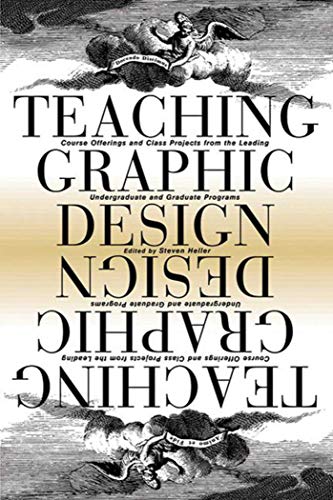
Teaching Graphic Design: Course Offerings and Class Projects from the Leading Graduate and Undergraduate Programs - Softcover
Synopsis
This priceless teaching tool features more than 70 proven-effective programs from the country’s leading graphic design schools. Spanning from traditional, “bricks and mortar” approaches to the ever-widening digital frontier of graphic design, these syllabi include detailed introductions, weekly breakdowns, project suggestions, and selected readings, as well as offer valued background material on the history, social responsibility, and cultural impact of design. More than an instructor’s guide, Teaching Graphic Design is a self-contained chronicle of the past, present, and future of the art and the industry. • No other book on the market shares graphic design course syllabi in such a comprehensive manner• Allows first-time educators to build a lesson plan based on proven successful approaches • Features more than 70 contributors from almost every imaginable design arena, including multimedia courses, design history, and professional practice
Allworth Press, an imprint of Skyhorse Publishing, publishes a broad range of books on the visual and performing arts, with emphasis on the business of art. Our titles cover subjects such as graphic design, theater, branding, fine art, photography, interior design, writing, acting, film, how to start careers, business and legal forms, business practices, and more. While we don't aspire to publish a New York Times bestseller or a national bestseller, we are deeply committed to quality books that help creative professionals succeed and thrive. We often publish in areas overlooked by other publishers and welcome the author whose expertise can help our audience of readers.
"synopsis" may belong to another edition of this title.
About the Author
Steven Heller is the co-chair of the School of Visual Arts MFA Design / Designer as Author + Entrepreneur Program. He is the author, coauthor, and editor of over 170 books on design, social satire, and visual culture. He is the recipient of the 2011 Smithsonian National Design Award for "Design Mind." He lives in New York City.
Excerpt. © Reprinted by permission. All rights reserved.
Those Who Teach
The old Woody Allen line "Those who can t do, teach; and those who can t teach, teach gym" is not applicable to graphic design education. I don t know of any design schools that even have a gym. I also don t know of many graphic design teachers who became educators because they could not hack it in the work-a-day world.
Teaching is dedicated work, and I ve learned that being a good teacher is not as easy as simply passing on one s knowledge base to others. Some great designers with formidable experience are pathetic teachers. Good design educators must have the ability to relate to students, engender trust, show compassion, and instill ideas, techniques, and abilities.
A teacher must be generous to a fault, but not entirely selfless. A teacher must have the courage and confidence of her convictions, yet know when to bend if necessary. A teacher must create a program that will encourage his students to learn how to learn, and then know when to leave the rest up to them. Incidentally, a teacher must be a mentor, which is easy to say but difficult to be.
I have "taught" in design and illustration programs for over two decades, but until I became co-chair of the School of Visual Arts MFA/Design program in 1996, I had not realized that I was not the kind of teacher I have described above. Rather, I am a lecturer, and the distinction is significant. Although a teacher must also give lectures, a lecturer is not always a teacher in the Platonic, Socratic, or any sense of the word. Frankly, as an administrator I have to juggle many balls, but as a lecturer all I have to do is stand in front of a class and confidently and enthusiastically convey my material as the students passively listen. They certainly get a lot of information, but I do not take them to the next stage of discovery. That s the job of a teacher. What I provide is the raw data, while a true teacher uses this material as a foundation for building knowledge and experience. As a lecturer I may leave the students interested, but a good teacher then guides them into immersion, analysis, and critique, which leaves them inspired and hungry for more.
I have watched inspiring teachers teach and it is a grueling mental and physical activity (not to watch, mind you, but to teach). To do it correctly a teacher must balance the requisites of the class, needs of the students, and expectations of the school, and still have a fresh result. An individual educator s energy and charisma is essential to the fulfillment of this process, but the syllabus is her blueprint, roadmap, and manifesto rolled into one. I don t have to stress the role of a syllabus to anyone reading this book, but it is nonetheless necessary to emphasize the unsung cumulative importance of this document as a building block in all design education.
In all but one of the earlier volumes in the Allworth Press Education of . . . series, which I have edited, I included sections devoted to syllabi because they provide indelible, concrete examples of the education process. It was also fascinating to read the unique variations on fundamental classes and ideas behind new and innovative ones. In addition, the syllabi in these books were presented as models for any teachers in need of inspiring ideas for teaching their classes. Of course, these syllabi alone are not panaceas for ailing departments; how the teacher presents his material makes all the difference, but the ideas and methodologies in these syllabi from all parts of the world and at all levels of experience can be valuable in structuring pedagogy.
Given the large number of truly winning syllabi found in hundreds of university programs and art/design schools, I felt it would be beneficial to have a volume entirely dedicated to collecting as many as possible in the form that they are presented to students. I was not at a loss.
Divided into three sections undergraduate, undergraduate/graduate, and graduate are over fifty such examples of courses ranging from basic to intermediate to advanced to eccentric. The focus is on graphic design studio classes with examples of multimedia (Web, film, and games) courses. Design history and professional practice is also included.
Most syllabi follow the same fundamental structure (introduction/purpose, requirements, weekly breakdown, projects, selected reading, etc.), which is how they appear here. Some are more detailed than others, but I have only edited them to eliminate redundancies. Although all of the syllabi came with examples of student work, owing to space constraints I am showing only a few visuals where necessary.
When asked to submit to this volume, not one teacher balked; in fact, they were all extremely anxious to share their methods with others in the education community. Some critics argue that standardized curricula should be instituted throughout design education, and maybe this idea has merit. But judging from the diverse syllabi, even the most rudimentary type class benefits from a modicum of individuality. While suggesting ways of developing standard curricula, the syllabi presented here indicate that it takes a great teacher to inspire and a great course to expand a student s horizons.
- Steven Heller
"About this title" may belong to another edition of this title.
Search results for Teaching Graphic Design: Course Offerings and Class...

Stock Image
Teaching Graphic Design Course
Seller: World of Books (was SecondSale), Montgomery, IL, U.S.A.
Seller rating 5 out of 5 stars

Condition: Good. Item in good condition. Textbooks may not include supplemental items i.e. CDs, access codes etc. Seller Inventory # 00105135012
Seller Image
Teaching Graphic Design: Course Offerings and Class Projects from the Leading Graduate and Undergraduate Programs
Seller: Zoom Books Company, Lynden, WA, U.S.A.
Seller rating 5 out of 5 stars
Condition: very_good. Book is in very good condition and may include minimal underlining highlighting. The book can also include "From the library of" labels. May not contain miscellaneous items toys, dvds, etc. . We offer 100% money back guarantee and 24 7 customer service. Seller Inventory # ZBV.1581153058.VG
Stock Image
Teaching Graphic Design: Course Offerings and Class Projects from the Leading Graduate and Undergraduate Programs
Published by
Allworth (edition First Edition), 2003
ISBN 10: 1581153058
ISBN 13: 9781581153057
Used
Paperback
First Edition
Seller: BooksRun, Philadelphia, PA, U.S.A.
Seller rating 5 out of 5 stars
Paperback. Condition: Very Good. First Edition. It's a well-cared-for item that has seen limited use. The item may show minor signs of wear. All the text is legible, with all pages included. It may have slight markings and/or highlighting. Seller Inventory # 1581153058-8-1
Stock Image
Teaching Graphic Design: Course Offerings and Class Projects from the Leading Graduate and Undergraduate Programs
Seller: World of Books Inc, Montgomery, IL, U.S.A.
Seller rating 4 out of 5 stars

Paperback. Condition: Good. This teaching tool features more than 70 design syllabi from leading design schools across the country. From classic course programmes to the most advanced in digital design, the book offers a comprehensive array of topics, reading lists and teaching tips for courses of all levels. Seller Inventory # CIN1581153058G
Stock Image
Teaching Graphic Design: Course Offerings and Class Projects from the Leading Graduate and Undergraduate Programs
Seller: Wonder Book, Frederick, MD, U.S.A.
Seller rating 5 out of 5 stars
Condition: Good. Good condition. A copy that has been read but remains intact. May contain markings such as bookplates, stamps, limited notes and highlighting, or a few light stains. Bundled media such as CDs, DVDs, floppy disks or access codes may not be included. Seller Inventory # E12O-01290
Stock Image
Teaching Graphic Design : Course Offerings and Class Projects from the Leading Graduate and Undergraduate Programs
Published by
Skyhorse Publishing Company, Incorporated, 2003
ISBN 10: 1581153058
ISBN 13: 9781581153057
Used
Softcover
Seller: Better World Books, Mishawaka, IN, U.S.A.
Seller rating 5 out of 5 stars
Condition: Good. 1 Edition. Former library copy. Pages intact with minimal writing/highlighting. The binding may be loose and creased. Dust jackets/supplements are not included. Includes library markings. Stock photo provided. Product includes identifying sticker. Better World Books: Buy Books. Do Good. Seller Inventory # 4718729-6
Stock Image
Teaching Graphic Design: Course Offerings and Class Projects from the Leading Graduate and Undergraduate Programs
Seller: ThriftBooks-Dallas, Dallas, TX, U.S.A.
Seller rating 5 out of 5 stars
Paperback. Condition: Very Good. No Jacket. May have limited writing in cover pages. Pages are unmarked. ~ ThriftBooks: Read More, Spend Less. Seller Inventory # G1581153058I4N00
Stock Image
Teaching Graphic Design: Course Offerings and Class Projects from the Leading Graduate and Undergraduate Programs
Seller: ThriftBooks-Atlanta, AUSTELL, GA, U.S.A.
Seller rating 5 out of 5 stars
Paperback. Condition: Good. No Jacket. Pages can have notes/highlighting. Spine may show signs of wear. ~ ThriftBooks: Read More, Spend Less. Seller Inventory # G1581153058I3N00
Stock Image
Teaching Graphic Design: Course Offerings and Class Projects from the Leading Graduate and Undergraduate Programs
Seller: ThriftBooks-Atlanta, AUSTELL, GA, U.S.A.
Seller rating 5 out of 5 stars
Paperback. Condition: Very Good. No Jacket. May have limited writing in cover pages. Pages are unmarked. ~ ThriftBooks: Read More, Spend Less. Seller Inventory # G1581153058I4N00
Stock Image
Teaching Graphic Design: Course Offerings and Class Projects from the Leading Graduate and Undergraduate Programs
Seller: HPB-Ruby, Dallas, TX, U.S.A.
Seller rating 5 out of 5 stars
Paperback. Condition: Very Good. Connecting readers with great books since 1972! Used books may not include companion materials, and may have some shelf wear or limited writing. We ship orders daily and Customer Service is our top priority! Seller Inventory # S_459199476