
Items related to The Age of Access: The New Culture of Hypercapitalism,...
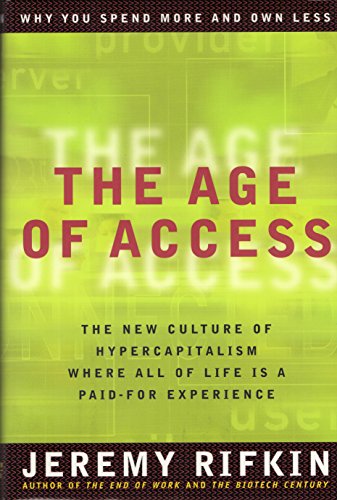
The Age of Access: The New Culture of Hypercapitalism, Where All of Life Is a Paid-For Experience - Hardcover
Synopsis
Identifying and explaining the paradigm shift in American business, the author of The End of Work and The Biotech Century shows how ownership of property is giving way to accessing experiences as the key to power in business. 50,000 first printing.
"synopsis" may belong to another edition of this title.
About the Author
An internationally renowned social critic, Jeremy Rifkin is the bestselling author of The End of Work and The Biotech Century, which was translated into sixteen languages. He is president of the Foundation on Economic Trends in Washington, D.C., and is a fellow at the Wharton School of Finance and Commerce Executive Program. He lives in Washington, D.C.
Reviews
In his latest synthesis of business analysis and academic philosophizing, Rifkin (The End of Work, The Biotech Century, etc.) argues that we are in the midst of a new age in which "concepts, ideas and images--not things--are the real items of value" and where "the purchase of lived experiences becomes the consummate commodity." In the book's first half, Rifkin contends that ownership of property has become increasingly devalued. Today's companies avoid amassing physical capital, which can later prove "an albatross" that prevents them from keeping up with rapid technological advances. Instead, they prefer to "outsource ownership," contracting third parties to provide and maintain equipment. This trend combines with others, such as the proliferation of service relationships, to put more emphasis on access than ownership, heralding a time when what companies sell will be human experience itself and all cultural activities will be commodified. In the book's second half, Rifkin shows how "experience industries"--such as travel and entertainment--are coming to dominate the new global economy. "More and more of the global cultural sphere--its natural wonders, cathedrals, museums, palaces, parks, rituals, festivals--is being siphoned off into the marketplace," he says, where it serves as a backdrop "for enacting paid-for cultural experiences" that is divorced from historical context. As in Rifkin's earlier works, the author asserts the truth of his ideas in considerable detail without offering much supporting evidence, leaving readers either to believe him or not. Even so, his larger historical and social perspective and lack of technological boosterism is refreshing. Agent: Jim Stein. (May)
Copyright 2000 Reed Business Information, Inc.
The author of 14 previous books, including The End of Work and The Biotech Century, Rifkin is a noted social critic and president of the Foundation on Economic Trends in Washington, DC. In this important work, he examines the trends that underlie our transition from a service-based economy to one based on the convergence of commerce and culture. Specifically, he notes a broad range of structural changes, including the shift from markets to networks and from ownership to access, the reduced value of physical property and the rise of intellectual property, and the increased marketing of human relationships where culture has become the ultimate commercial resource. His most riveting assertion is that these developments are in sharp contrast to the situation in the rest of the world, in which, as Rifkin states, over 50 percent of the people have never made a phone call, much less been connected to the emerging global information network. Recommended for both public and academic libraries.
-Norman B. Hutcherson, Kern Cty. Lib., Bakersfield, CA
Copyright 2000 Reed Business Information, Inc.
Rifkin's many books include Beyond Beef: The Rise and Fall of the Cattle Culture (1992) and The Biotech Century: Harnessing the Gene and Remaking the World (1998). He has been dismissed as a gadfly and an alarmist by those who do not agree with him, but what he does do most successfully is popularize the debate over the ethical and moral dilemmas posed by the information revolution, genetic engineering, and other scientific advances. For years, Rifkin has been asking what the ultimate price will be that we pay for all our "progress." Now he turns to the "weightless" economy in which products are becoming indistinguishable from services, experiences (not things) are marketed and sold, and consumers own "access" instead of property. Rifkin calls this phenomenon "hypercapitalism," and he sees examples everywhere: outsourcing, theme parks, virtual reality games, automobile leasing, etc. In his freewheeling, wide-ranging discussion, Rifkin raises concerns yet again about what all this means. David Rouse
"About this title" may belong to another edition of this title.
Search results for The Age of Access: The New Culture of Hypercapitalism,...

Stock Image
The Age of Access: The New Cul
Seller: World of Books (was SecondSale), Montgomery, IL, U.S.A.
Seller rating 5 out of 5 stars

Condition: Good. Item in good condition. Textbooks may not include supplemental items i.e. CDs, access codes etc. Seller Inventory # 00095371375
Seller Image
The Age of Access: The New Culture of Hypercapitalism, Where All of Life Is a Paid-For Experience
Seller: Greenworld Books, Arlington, TX, U.S.A.
Seller rating 5 out of 5 stars
Condition: good. Fast Free Shipping â" Good condition. It may show normal signs of use, such as light writing, highlighting, or library markings, but all pages are intact and the book is fully readable. A solid, complete copy that's ready to enjoy. Seller Inventory # GWV.1585420182.G
Stock Image
The Age of Access: The New Culture of Hypercapitalism, Where All of Life Is a Paid-For Experience
Seller: More Than Words, Waltham, MA, U.S.A.
Seller rating 5 out of 5 stars
Condition: Good. A sound copy with only light wear. Overall a solid copy at a great price! Seller Inventory # BOS-V-13f-01424
Stock Image
The Age of Access: The New Culture of Hypercapitalism, Where All of Life is a Paid-for Experience
Seller: World of Books Inc, Montgomery, IL, U.S.A.
Seller rating 2 out of 5 stars

Hardback. Condition: Good. Visionary activist and author Jeremy Rifkin exposes the real stakes of the new economy, delivering the clearest summation yet of how the Internet is really changing our lives (The Seattle Times).Imagine waking up one day to find that virtually every activity you engage in outside your immediate family has become a paid-for experience. It's all part of a fundamental change taking place in the nature of business, contends Jeremy Rifkin. After several hundred years as the dominant organizing paradigm of civilization, the traditional market system is beginning to deconstruct. On the horizon looms the Age of Access, an era radically different from any we have known. Seller Inventory # CIN1585420182G
Stock Image
The Age of Access: The New Culture of Hypercapitalism, Where All of Life Is a Paid-For Experience
Seller: BooksRun, Philadelphia, PA, U.S.A.
Seller rating 5 out of 5 stars
Hardcover. Condition: Very Good. 1. With dust jacket. It's a well-cared-for item that has seen limited use. The item may show minor signs of wear. All the text is legible, with all pages included. It may have slight markings and/or highlighting. Seller Inventory # 1585420182-8-1-29
Stock Image
The Age of Access : The New Culture of Hypercaptialism, Where all of Life is a Paid-for Experience
Published by
Penguin Publishing Group, 2000
ISBN 10: 1585420182
ISBN 13: 9781585420186
Used
Hardcover
First Edition
Seller: Better World Books, Mishawaka, IN, U.S.A.
Seller rating 5 out of 5 stars
Condition: Very Good. 1st Edition. Former library copy. Pages intact with possible writing/highlighting. Binding strong with minor wear. Dust jackets/supplements may not be included. Includes library markings. Stock photo provided. Product includes identifying sticker. Better World Books: Buy Books. Do Good. Seller Inventory # GRP66081555
Stock Image
The Age of Access : The New Culture of Hypercaptialism, Where all of Life is a Paid-for Experience
Published by
Penguin Publishing Group, 2000
ISBN 10: 1585420182
ISBN 13: 9781585420186
Used
Hardcover
First Edition
Seller: Better World Books, Mishawaka, IN, U.S.A.
Seller rating 5 out of 5 stars
Condition: Very Good. 1st Edition. Pages intact with possible writing/highlighting. Binding strong with minor wear. Dust jackets/supplements may not be included. Stock photo provided. Product includes identifying sticker. Better World Books: Buy Books. Do Good. Seller Inventory # GRP102728335
Stock Image
The Age of Access : The New Culture of Hypercaptialism, Where all of Life is a Paid-for Experience
Published by
Penguin Publishing Group, 2000
ISBN 10: 1585420182
ISBN 13: 9781585420186
Used
Hardcover
First Edition
Seller: Better World Books, Mishawaka, IN, U.S.A.
Seller rating 5 out of 5 stars
Condition: Good. 1st Edition. Former library copy. Pages intact with minimal writing/highlighting. The binding may be loose and creased. Dust jackets/supplements are not included. Includes library markings. Stock photo provided. Product includes identifying sticker. Better World Books: Buy Books. Do Good. Seller Inventory # GRP76567414
Stock Image
The Age of Access : The New Culture of Hypercaptialism, Where all of Life is a Paid-for Experience
Published by
Penguin Publishing Group, 2000
ISBN 10: 1585420182
ISBN 13: 9781585420186
Used
Hardcover
First Edition
Seller: Better World Books: West, Reno, NV, U.S.A.
Seller rating 5 out of 5 stars
Condition: Fine. 1st Edition. Used book that is in almost brand-new condition. May contain a remainder mark. Better World Books: Buy Books. Do Good. Seller Inventory # GRP86353379
Stock Image
The Age of Access: The New Culture of Hypercapitalism, Where All of Life Is a Paid-For Experience
Seller: Wonder Book, Frederick, MD, U.S.A.
Seller rating 5 out of 5 stars
Condition: Very Good. Very Good condition. Very Good dust jacket. A copy that may have a few cosmetic defects. May also contain light spine creasing or a few markings such as an owner's name, short gifter's inscription or light stamp. Seller Inventory # R05S-00439