
Items related to FDR and Fear Itself: The First Inaugural Address (The...
Synopsis
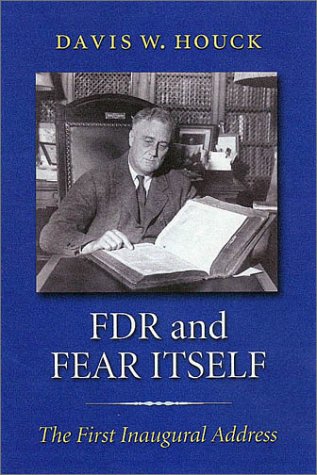
"The only thing we have to fear is fear itself." These are some of the most famous, the most quoted, and the best remembered words in American political history. They seem to be a natural expression of American democratic will, yet these words from Franklin Roosevelt's first inaugural address had an actual author who struggled with how best to express that thought - and it was not the new president. In this book on the crafting of this crucial speech, Davis W. Houck leads the reader from its negative, mechanical, and Hooverian first draft through its final revision, its delivery, and the responses of those who were inspired by it during those troubled times.
Houck's analysis, dramatic and at points riveting, focuses on three themes: how the speech came to be written; an explication of the text itself; and its reception. Drawing on the writings and memories of several people who were present in the crowd at the inauguration, Houck shows how powerfully the new president's speech affected those who were there or who heard it on the radio. Some were so moved by Roosevelt's delivery that they would have been willing to make him a dictator, and many believed such inspired words could have come only from a divine source.
Houck then flashes back to the final year of the 1932 presidential campaign to show how Raymond Moley, the principal architect of the address, came to be trusted by Roosevelt to craft this important speech. Houck traces the relationships of Moley with Roosevelt and Roosevelt's influential confidante, Louis Howe, who was responsible for important changes in the speech's later drafts, including the famous aphorism.
"synopsis" may belong to another edition of this title.
About the Author
Davis W. Houck is an assistant professor of communication at Florida State University.
Reviews
With his first inaugural address, which was fewer than 2000 words, Franklin Roosevelt won the confidence of the American public something his predecessor, Herbert Hoover, failed to do in four years as president. In this worthy inaugural volume in a new series about presidential rhetoric, Houck (Rhetoric as Currency: Hoover, Roosevelt, and the Great Depression) investigates the crafting of Roosevelt's speech and the inspiration it gave to a Depression-demoralized nation. The story is mostly that of Raymond Moley, a member of Roosevelt's "brain trust," who struggled with jealous aides and Roosevelt himself as he drafted what is arguably the most memorable presidential speech of the 20th century. Other important themes discussed here are the bitter relationship between Roosevelt and Hoover and the loneliness of First Lady Eleanor Roosevelt, made worse following her husband's election. Ultimately, the speech proclaiming that we had "nothing to fear but fear itself" (a phrase coined by neither Roosevelt nor Moley but by presidential aide Louis Howe) projected the goals of a self-assured leader who through four terms became the most enduring presidential communicator. Recommended for public and academic libraries. Karl Helicher, Upper Merion Twp. Lib., PA
Copyright 2002 Cahners Business Information, Inc.
"About this title" may belong to another edition of this title.
Search results for FDR and Fear Itself: The First Inaugural Address (The...

Stock Image
FDR and Fear Itself: The First Inaugural Address (The Library of Presidential Rhetoric)
Published by
Texas A & M Univ Pr, 2002
ISBN 10: 158544197X
ISBN 13: 9781585441976
Used
Hardcover
First Edition
Seller: Star 'N Space Books, Prescott, AZ, U.S.A.
Seller rating 5 out of 5 stars

Hardcover. Condition: Very Good. Dust Jacket Condition: Very Good. First Edition Stated. Ex-Library With Usual Stamps, Stickers, Etc. Dj In Plastic. Book Appears Little Read. Index. 166 Pp. Seller Inventory # 208351