
Items related to The Lost Messiah: In Search of the Mystical Rabbi Sabbatai...
Synopsis
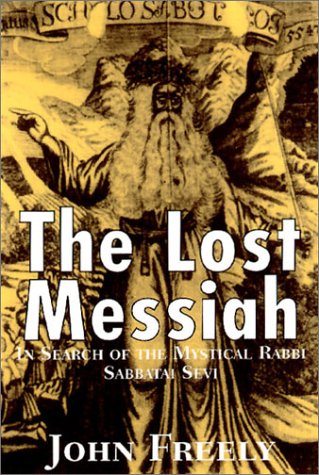
This is the `astonishing story of Sabbatai Sevi, seventeenth-century rabbi, Kabbalist and probable manic depressive, who convinced large numbers of Jews throughout Europe, the Middle East and North Africa that he was their long-awaited Messiah.' The amazing story of Sabbatai Sevi is told in this biography.
"synopsis" may belong to another edition of this title.
About the Author
John Freely was born in Brooklyn, New York in 1926. He teaches physics at Bosphorous University in Istanbul. He has written more than forty books, including The Lost Messiah, The Grand Turk, and Aladdin's Lamp.
Reviews
Historian and travel writer Freely retraces the 17th-century rabbi Sabbatai Sevi's steps from his birth in Izmir (in Turkey) to his exile and death in Dulcigno (in northern Albania) in this plodding and workmanlike account-part travelogue, part detective story and part religious history.. Sevi traveled through the Ottoman Empire declaring himself to be the Messiah; he claimed to be born on the Ninth of Ab, the traditional birthdate of the Messiah, and fervently studied the mystical texts of the Kabbalah. Although he gathered some followers, most thought he was a madman and a fool. When he began to declare that fast days should become feast days, that women could read from the Torah and that Jews could pronounce the sacred name of God (YHWH), the rabbis in Istanbul drove him out of the country. Sevi became the target of even greater animosity when he converted to Islam. After his conversion he maintained a syncretistic religious lifestyle, trying to convert his followers to Islam, yet still proclaiming himself the Jewish Messiah. After his death, many of his followers declared that he had not died but that his presence was hidden, and that he would appear again at the end of time. Drawing upon the writings of Gershom Scholem and others, Freely offers a fascinating glimpse into a little-known chapter of Jewish religious history. However, he depends too heavily on secondary source material, encumbering his own writing with lengthy quotations that fail to illuminate Sevi's exciting story.
Copyright 2003 Reed Business Information, Inc.
The idea of a messiah who will come to offer salvation and heal the world remains one of Judaism's most enduring yearnings. Freely focuses on one who assumed the mantle of Messiah. In the mid-seventeenth century a messiah appeared, a rabbi named Sabbatai Sevi. As Freely describes him, Sabbatai would be described in modern terms as manic-depressive. In his own time, his "illuminations" (which alternated with moods of deep despair) and his knowledge of the Torah and kabbalah allowed Sabbatai to attract followers. When the respected Nathan of Gaza, serving as Sabbatai's John the Baptist, proclaimed him the Messiah, his fame grew throughout the Jewish world. Freely, quoting extensively from primary sources, follows Sabbatai's movements up to his shocking conversion to Islam, which, perhaps even more shockingly, did not dissolve all of his support. Freely paints a portrait of the Jewish community in the Ottoman Empire that brings time and place alive. He is less successful in describing Sabbatai the man. Although Freely makes us understand the circumstances that made the masses long for a messiah, he fails to show how Sabbatai, a not particularly appealing figure, could have successively assumed that role. Still, this volume gathers the threads of many sources into one fabric, providing a valuable interweaving of history and biography. Ilene Cooper
Copyright © American Library Association. All rights reserved
"About this title" may belong to another edition of this title.
Search results for The Lost Messiah: In Search of the Mystical Rabbi Sabbatai...

Stock Image
The Lost Messiah: In Search of the Mystical Rabbi Sabbatai Sevi
Seller: World of Books (was SecondSale), Montgomery, IL, U.S.A.
Seller rating 5 out of 5 stars

Hardback. Condition: Very Good. Seller Inventory # 00107842044
Stock Image
The Lost Messiah: In Search of the Mystical Rabbi Sabbatai Sevi
Seller: World of Books Inc, Montgomery, IL, U.S.A.
Seller rating 4 out of 5 stars

Hardback. Condition: Very Good. Seller Inventory # CIN1585673188VG
Stock Image
The Lost Messiah: In Search of the Mystical Rabbi Sabbatai Sevi
Seller: MatSamstore, Chantilly, VA, U.S.A.
Seller rating 5 out of 5 stars
Condition: Fair. Seller Inventory # 09-04-2025_MA_2.2M_H0000BWC
Stock Image
The Lost Messiah
Seller: Better World Books, Mishawaka, IN, U.S.A.
Seller rating 5 out of 5 stars
Condition: Good. Pages intact with minimal writing/highlighting. The binding may be loose and creased. Dust jackets/supplements are not included. Stock photo provided. Product includes identifying sticker. Better World Books: Buy Books. Do Good. Seller Inventory # 42497831-6
Stock Image
The Lost Messiah
Seller: Better World Books, Mishawaka, IN, U.S.A.
Seller rating 5 out of 5 stars
Condition: Very Good. Former library copy. Pages intact with possible writing/highlighting. Binding strong with minor wear. Dust jackets/supplements may not be included. Includes library markings. Stock photo provided. Product includes identifying sticker. Better World Books: Buy Books. Do Good. Seller Inventory # 11437920-6
Stock Image
The Lost Messiah: In Search of the Mystical Rabbi Sabbatai Sevi
Published by
Overlook Books, 2003
ISBN 10: 1585673188
ISBN 13: 9781585673186
Used
Hardcover
First Edition
Seller: Project HOME Books, Philadelphia, PA, U.S.A.
Seller rating 5 out of 5 stars
Condition: Very Good. tape holding dust jacket to the hard cover, stamps and stickers Bennett Zion Feld Memorial Library Former Library book. Has old stickers and stamps. hardcover Used - Very Good 1st Edition All purchases support project HOME - ending homelessness in Philadelphia. Seller Inventory # HQ05-000067
Stock Image
The Lost Messiah: In Search of the Mystical Rabbi Sabbatai Sevi
Published by
Abrams Press, 2003
ISBN 10: 1585673188
ISBN 13: 9781585673186
New
Hardcover
First Edition
Seller: BooksByLisa, Highland Park, IL, U.S.A.
Seller rating 4 out of 5 stars
Hardcover. Condition: New. First Edition. PHOTO AND VIDEO OF PAGES TAKEN TO SHOW CONDITION PRIOR TO SHIPPING; PHOTOS EMAILED FOR MORE SPECIFICS WHEN REQUESTED; Book. Book. Seller Inventory # 1681
Stock Image
The Lost Messiah: In Search of the Mystical Rabbi Sabbatai Sevi
Seller: More Than Words, Waltham, MA, U.S.A.
Seller rating 5 out of 5 stars
Condition: Good. A sound copy with only light wear. Overall a solid copy at a great price! Seller Inventory # BOS-W-09e-01555
Seller Image
The Lost Messiah
Seller: Griffin Rare Books, Charleston, SC, U.S.A.
Seller rating 5 out of 5 stars
Hardcover. Condition: As New. Dust Jacket Condition: Fine. As new. Unread, clean, unmarked, and with only the slightest signs of wear to the jacket. "Sabbatai Sevi was and remains one of history's most controversial and enigmatic religious figures. It was he, in the seventeenth century, who used the mysticism of the Kabbalah to convince vast numbers of Jews throughout Europe, the Middle East, and North Africa that he was the long-awaited messiah. Many of his followers were dismayed, however, when, on threat of execution from the Turkish Sultan, Sevi converted to Islam - though many continued to believe in him. Even today there are a few Sabbatians who maintain the belief that their messiah will return and lead them to redemption.". "In The Lost Messiah, John Freely follows Sevi's trail across Europe and into Africa, tracing the cult that grew up around this "false messiah," as he is often called, and within Judaism. Freely evokes the vanished world of the seventeenth-century diaspora in the Ottoman Empire, as the narrative travels from Sevi's birthplace in Izmir, on the Aegean coast of Turkey, to the ghettos of Venice and Rome, the bazaars of Cairo, and the rabbinical schools of Jerusalem and Safed. This exotic tapestry is placed into a rich context also detailing the then-current state of Jewish communities in these areas."--BOOK JACKET. Seller Inventory # GRB-the-lost-messiah-06251b
Stock Image
Lost Messiah, The : In Search of the Mystical Rabbi Sabbatai Sevi
Published by
Overlook Hardcover, 2003
ISBN 10: 1585673188
ISBN 13: 9781585673186
Used
Hardcover
First Edition
Seller: Monroe Street Books, Middlebury, VT, U.S.A.
Seller rating 4 out of 5 stars
Hardcover. Condition: Very Good. 1st. 275 pages. Light soil to edges, remainder mark to bottom edge, else a clean, tight copy. Seller Inventory # 463453