Items related to What Happened to Notre Dame?
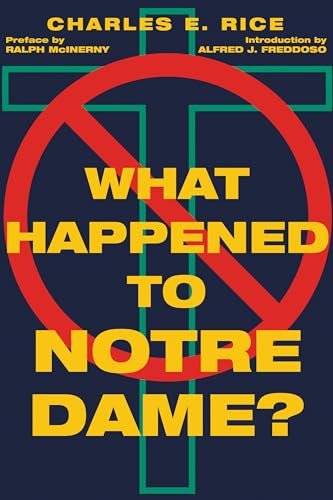

When the University of Notre Dame announced that President Barack Obama would speak at its 2009 Commencement and would receive an honorary doctor of laws degree, the reaction was more than anyone expected. Students, faculty, alumni, and friends of Notre Dame denounced the honoring of Obama, who is the most relentlessly pro-abortion public official in the world. Beyond abortion, Obama has taken steps to withdraw from health-care professionals the right of conscientious objection. Among them are thousands of Notre Dame alumni who will be forced to choose between continuing their profession and participating in activities they view as immoral, including the execution of the unborn. And they will be forced to that choice by the politician upon whom their alma mater confers its highest honors. (Mary Ann Glendon, distinguished Harvard law professor and former ambassador to the Vatican, felt obliged to turn down the prestigious Laetare Medal because of this.)
Notre Dame’s honoring of Obama is not merely a “Catholic” thing. Many thousands of citizens with no Catholic or Notre Dame connections have protested it. They see it as a capitulation of faith to expedience and the pursuit of vain prestige. Obama’s record and stated purposes are hostile to the most basic truths of faith and the natural law affirmed by the Catholic Church and by many others. Four decades ago, in 1967, the major “Catholic” universities declared their “autonomy” from the Catholic Church in the Land O’Lakes Declaration. The honoring of Obama reflects the replacement by those universities of the benign authority of the Church with the politically correct standards of the secular academic establishment and, especially, of the government.
There is a lesson here for all Americans. Notre Dame fell into relativism and expediency because it rejected the Church as the authentic interpreter of the moral law. In this post-Christian era, American culture is following a similar path by reducing morality to the unguided consensus of individual choices. If no code of right and wrong has moral authority – not even the Ten Commandments – then society is ruled by the conflict of interests, and might makes right. The jurisprudence of such relativism is legal positivism in which no law can be criticized as unjust because no one can know what is “just.”
What Happened to Notre Dame? by Charles E. Rice, with a Preface by Ralph McInerny and Introduction by Alfred Freddoso – three of Notre Dame’s most distinguished scholars, who together have served the University 124 years – first recounts the details of Notre Dame’s honoring of President Obama. It then examines the succession of fall-back excuses offered by the Notre Dame President Rev. John I. Jenkins, c.s.c., and University publicists to justify Notre Dame’s defiance of the nation’s bishops and of Catholic teaching.
But Rice is not content with mere reportage. What Happened to Notre Dame? diagnoses the problem’s roots by first providing an overview of the Land O’Lakes Declaration, its inception and its aftermath, including the ways in which its false autonomy from the Church has led to an erosion of the Catholic identity of Notre Dame and other Catholic universities.
Then, it offers a cure. Christ, who is God, is the author of the divine law and the natural law. The book presents reasons why an acknowledged interpreter of these laws is necessary, and why that interpreter has to be the Pope exercising the Magisterium, or teaching authority of the Church. And it shows why it is so important that we have such a moral interpreter for all citizens and not just for Catholics. The alternative is what Pope Benedict XVI calls the “dictatorship of relativism,” which the book analyzes. Even for those who do not share the Catholic faith, our reason leads us to conclude that the natural law is the only moral code that makes entire sense and points to the conclusion that the Vicar of Christ is uniquely suited to give authoritative interpretation to that law.
In the final chapter Rice shows why great good can come out of Notre Dame’s blunder in rendering its highest honors to such an implacable foe. Notre Dame got itself into such a mess because it attempted to be Catholic without the Church and ended up defying the Church and disgracing itself. But good can result from the lesson here that roll-your-own morality is no more tenable than roll-your-own Catholicism.
Rice shows why what happened to Notre Dame is symptomatic of what’s happening in other Catholic colleges, indeed colleges with non-Catholic religious affiliations. He shows how the abandonment of principle at the college level spills over to the general culture, with devastating effect, as religious standards get pushed out of the public square. And, finally, he shows why people who have never seen the Golden Dome, never rooted for the Fighting Irish, and never graced a Catholic Church, also have a stake in what happened to Notre Dame.
"synopsis" may belong to another edition of this title.
About the Author:
Charles E. Rice is prof. emer. in the Law School, University of Notre Dame, and is author, among other works, of Where Did I Come From? Where Am I Going? How Do I Get There? and The Winning Side, both from St. Augustine's Press. He has long been a pro-life activist, and was a founding member and legal counsel to the New York Conservative Party.
Ralph McInerny, prof. emer. of Philosophy, University of Notre Dame, and past director of the Maritain Center, is author of over 100 books, including scores of mysteries (most famously, the bestselling Fr. Dowling Mystery series and the Notre Dame series), many works in philosophy and history, and is translator of more than ten books.
Alfred J. Freddoso, prof. of Philosophy, University of Notre Dame, is a renowned translator from medieval Latin, most recently Thomas Aquinas's Treatise on Law: The Complete Text, from St. Augustine's Press.
"About this title" may belong to another edition of this title.
- PublisherSt. Augustines Press
- Publication date2009
- ISBN 10 1587319209
- ISBN 13 9781587319204
- BindingPaperback
- Edition number1
- Number of pages224
- Rating
Buy New
Learn more about this copy
US$ 18.12
Shipping:
US$ 2.64
Within U.S.A.
Top Search Results from the AbeBooks Marketplace
Seller Image
What Happened to Notre Dame?
Published by
St. Augustines Press
(2009)
ISBN 10: 1587319209
ISBN 13: 9781587319204
New
Softcover
Quantity: 2
Seller:
Rating

Book Description Condition: New. Seller Inventory # 6859626-n
Buy New
US$ 18.12
Convert currency
Stock Image
What Happened to Notre Dame
Published by
University of Chicago Press
(2009)
ISBN 10: 1587319209
ISBN 13: 9781587319204
New
PAP
Quantity: 2
Seller:
Rating
Book Description PAP. Condition: New. New Book. Shipped from UK. Established seller since 2000. Seller Inventory # WG-9781587319204
Buy New
US$ 20.77
Convert currency
Stock Image
What Happened to Notre Dame?
Published by
St. Augustine Press 2009-09-25, South Bend, Ind.
(2009)
ISBN 10: 1587319209
ISBN 13: 9781587319204
New
paperback
Quantity: 1
Seller:
Rating
Book Description paperback. Condition: New. Language: ENG. Seller Inventory # 9781587319204
Buy New
US$ 15.43
Convert currency
Stock Image
What Happened to Notre Dame?
Published by
St. Augustines Press
(2009)
ISBN 10: 1587319209
ISBN 13: 9781587319204
New
Paperback
Quantity: 1
Seller:
Rating
Book Description Paperback. Condition: new. New. Fast Shipping and good customer service. Seller Inventory # Holz_New_1587319209
Buy New
US$ 21.31
Convert currency
Stock Image
What Happened to Notre Dame?
Published by
St Augustine Pr Inc
(2009)
ISBN 10: 1587319209
ISBN 13: 9781587319204
New
Paperback
Quantity: 2
Seller:
Rating
Book Description Paperback. Condition: Brand New. 1st edition. 224 pages. 8.90x6.00x0.70 inches. In Stock. Seller Inventory # __1587319209
Buy New
US$ 15.04
Convert currency
Stock Image
What Happened to Notre Dame?
Published by
St. Augustines Press
(2009)
ISBN 10: 1587319209
ISBN 13: 9781587319204
New
Paperback
Quantity: 1
Seller:
Rating
Book Description Paperback. Condition: new. New. Seller Inventory # Wizard1587319209
Buy New
US$ 26.25
Convert currency
Stock Image
What Happened to Notre Dame?
Published by
St. Augustine's Press
(2009)
ISBN 10: 1587319209
ISBN 13: 9781587319204
New
Paperback / softback
Quantity: 2
Seller:
Rating
Book Description Paperback / softback. Condition: New. New copy - Usually dispatched within 4 working days. Seller Inventory # B9781587319204
Buy New
US$ 19.17
Convert currency
Stock Image
What Happened to Notre Dame?
Published by
St. Augustines Press
(2009)
ISBN 10: 1587319209
ISBN 13: 9781587319204
New
Paperback
Quantity: 1
Seller:
Rating
Book Description Paperback. Condition: new. New Copy. Customer Service Guaranteed. Seller Inventory # think1587319209
Buy New
US$ 27.63
Convert currency
Stock Image
What Happened to Notre Dame?
Published by
St. Augustine's Press
(2009)
ISBN 10: 1587319209
ISBN 13: 9781587319204
New
Softcover
Quantity: 1
Seller:
Rating
Book Description Condition: new. Seller Inventory # FrontCover1587319209
Buy New
US$ 29.43
Convert currency
Stock Image
What Happened to Notre Dame?
Published by
St Augustine's Press
(2009)
ISBN 10: 1587319209
ISBN 13: 9781587319204
New
Softcover
Quantity: 1
Seller:
Rating

Book Description Condition: New. 2009. 1st Edition. Paperback. . . . . . Books ship from the US and Ireland. Seller Inventory # V9781587319204
Buy New
US$ 28.37
Convert currency