
Items related to The Golden Oriole
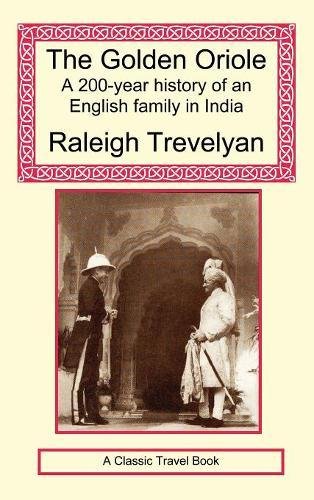
Synopsis
Raleigh Trevelyan's great longing was always to return to the place he had remembered best, Gilgit, on the borders of Sinkiang and the USSR. Could any place have been so beautiful? Could he ever have been so happy? For eight months of the year what had seemed like Shangri-La had been cut off from the world by snow. Summer was spent in a 'hut' at Gulmarg with a vast view over the Vale of Kashmir. As for his birthplace, he was determined to revisit this too-the Andaman Islands, then a penal settlement and where there are still stone-age savages. It was G. M. Trevelyan who suggested that some day he might think of writing about the family in India. He had in mind chiefly his own grandfather, the stormy reformer Sir Charles Trevelyan, brother-in-law of Macaulay and who was recalled as Governor of Madras. G. M. Trevelyan's brother had travelled in India with E. M. Forster. His father, George Otto Trevelyan, wrote the famous book on Cawnpore where ten relatives were massacred. Setting his book within five journeys, including Afghanistan, Burma and Sri Lanka, going backwards and forwards in time, quoting from Macaulay's brilliant letters, using family papers as well as those of family friends, Raleigh Trevelyan has produced a unique and very vivid panorama of the British experience in India, from Seringapatam onwards. Life at Simla, Delhi, Calcutta, Oooty, J. R. Ackerley's 'Chhokrapur' are all marvellously evoked, as are Amritsar in 1919 and Quetta in 1935. On his recent travels, in search of memories of a vanished social world in the phenomenon of empire, he has discovered some of the mysteries and wonders against which he was securely insulated as a child. And he has heard again the song of the golden oriole, a symbol for him of his last memory of Gilgit when he left at the age of eight.
"synopsis" may belong to another edition of this title.
From Publishers Weekly
Among the best-known members of the Trevelyan family, which served in India for nearly 200 years, the most prominent were the great Whig historian Macaulay and Sir Charles Edward Trevelyan, founder of the modern Indian civil service. Less famous is 64-year-old Raleigh. Born in the Andaman Islands and raised in Gilgit in the mountainous northwest, he was sent to England when he was eight and eventually became a publisher and prolific author. Interspersed here among his five travel journals, which depict his searches throughout India for evidences of his family's lives and exploits, are letters, papers and reminiscences of his eminent and less distinguished forebears, as well as of Thackeray and E. M. Forster. High points are descriptions of the Mutiny of 1857, the Amritsar massacre of 1919 and his father's experiences as a military man. Many of the tourist vignettes have little relevance to the story of the Trevelyans or of colonial India, yet there are interesting details of life under the Raj. This overlong hodgepodge is certainly kaleidoscopic, bloody and colorful, but neither charming nor masterful. Photos. History Book Club alternate.
Copyright 1987 Reed Business Information, Inc.
From Library Journal
The Macauley and Trevelyan families marked deeply the 19th- and 20th-century history of British India. The Golden Oriole traces the history of the two families through five contemporary journeys made by the author, a descendant of both families. Amidst personal visits to Gilgit, Kabul, Calcutta, Madras, and Cawnpore, Trevelyan skillfully uses flashbacks to present his own memories and those of others or to provide a narrative history capturing a uniquely interesting political and social glimpse of British India. Trevelyan's transitions are easily followed and his choice of detail is evocative. He makes considerable use of unpublished diaries, memoirs, and letters, which provide a sense of intimacy and immediacy, giving the work great charm. John F. Riddick, Central Michigan Univ. Lib., Mt. Pleasant
Copyright 1987 Reed Business Information, Inc.
"About this title" may belong to another edition of this title.

