Items related to Wikinomics: How Mass Collaboration Changes Everything
Synopsis
In just the last few years, traditional collaboration?in a meeting room, a conference call, even a convention center?has been superseded by collaborations on an astronomical scale.
Today, encyclopedias, jetliners, operating systems, mutual funds, and many other items are being created by teams numbering in the thousands or even millions. While some leaders fear the heaving growth of these massive online communities, Wikinomics proves this fear is folly. Smart firms can harness collective capability and genius to spur innovation, growth, and success.
A brilliant guide to one of the most profound changes of our time, Wikinomics challenges our most deeply-rooted assumptions about business and will prove indispensable to anyone who wants to understand competitiveness in the twenty-first century.
Based on a $9 million research project led by bestselling author Don Tapscott, Wikinomics shows how masses of people can participate in the economy like never before. They are creating TV news stories, sequencing the human genome, remixing their favorite music, designing software, finding a cure for disease, editing school texts, inventing new cosmetics, or even building motorcycles. You'll read about:
? Rob McEwen, the Goldcorp, Inc. CEO who used open source tactics and an online competition to save his company and breathe new life into an old-fashioned industry.
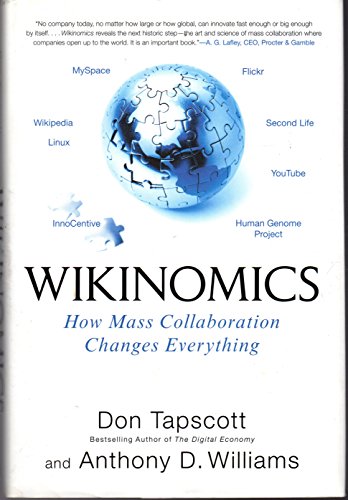
? Flickr, Second Life, YouTube, and other thriving online communities that transcend social networking to pioneer a new form of collaborative production.
? Mature companies like Procter & Gamble that cultivate nimble, trust-based relationships with external collaborators to form vibrant business ecosystems.
An important look into the future, Wikinomics will be your road map for doing business in the twenty-first century.
"synopsis" may belong to another edition of this title.
About the Author
Don Tapscott is chief executive of New Paradigm, a think tank and strategy consulting company he founded in 1992. He is the author of ten books, including the bestsellers Paradigm Shift, The Digital Economy, Growing Up Digital, The Naked Corporation and Digital Capital. He teaches at the Rotman School of Management at the University of Toronto.
Anthony D. Williams is a research director at New Paradigm. He holds a masterÂ’s of research from the London School of Economics where he has been teaching over the last year. He leads New ParadigmÂ’s work in the areas of innovation and intellectual property.
Reviews
The word "wiki" means "quick" in Hawaiian, and here author and think tank CEO Tapscott (The Naked Corporation), along with research director Williams, paint in vibrant colors the quickly changing world of Internet togetherness, also known as mass or global collaboration, and what those changes mean for business and technology. Wikipedia, the online encyclopedia written, compiled, edited and re-edited by "ordinary people" is the most ubiquitous example, and its history makes remarkable reading. But also considered are lesser-known success stories of global collaboration that star Procter & Gamble, BMW, Lego and a host of software and niche companies. Problems arise when the authors indulge an outsized sense of scope-"this may be the birth of a new era, perhaps even a golden one, on par with the Italian renaissance, or the rise of Athenian democracy"-while acknowledging only reluctantly the caveats of weighty sources like Microsoft's Bill Gates. Methods for exploiting the power of collaborative production are outlined throughout, an alluring compendium of ways to throw open previously guarded intellectual property and to invite in previously unavailable ideas that hide within the populace at large. This clear and meticulously researched primer gives business leaders big leg up on mass collaboration possibilities; as such, it makes a fine next-step companion piece to James Surowiecki's 2004 bestseller The Wisdom of Crowds.
Copyright © Reed Business Information, a division of Reed Elsevier Inc. All rights reserved.
Anyone who has done even a modest amount of browsing on the Internet has probably run across Wikipedia, the user-edited online encyclopedia that now dwarfs the online version of Encyclopedia Britannica. This is the prime example of what is called the new Web, or Web 2.0, where sites such as MySpace, YouTube, Flickr, and even the Human Genome Project allow mass collaboration from participants in the online community. These open systems can produce faster and more powerful results than the traditional closed proprietary systems that have been the norm for private industry and educational institutions. Detractors claim that authentic voices are being overrun by "an anonymous tide of mass mediocrity," and private industry laments that competition from the free goods and services created by the masses compete with proprietary marketplace offerings. The most obvious example of this is Linux, the open-source operating system that has killed Microsoft in the server environment. But is this a bad thing? Tapscott thinks not; and as a proponent of peering, sharing, and open-source thinking, he has presented a clear and exciting preview of how peer innovation will change everything. David Siegfried
Copyright © American Library Association. All rights reserved
"About this title" may belong to another edition of this title.
Other Popular Editions of the Same Title

Search results for Wikinomics: How Mass Collaboration Changes Everything

Stock Image
Wikinomics: How Mass Collaboration Changes Everything
Published by
Portfolio Hardcover (edition ), 2006
ISBN 10: 1591841380
ISBN 13: 9781591841388
Used
Hardcover
Seller: BooksRun, Philadelphia, PA, U.S.A.
Seller rating 5 out of 5 stars

Hardcover. Condition: Very Good. Ship within 24hrs. Satisfaction 100% guaranteed. APO/FPO addresses supported. Seller Inventory # 1591841380-8-1
Quantity: 1 available
Stock Image
Wikinomics : How Mass Collaboration Changes Everything
Published by
Penguin Publishing Group, 2006
ISBN 10: 1591841380
ISBN 13: 9781591841388
Used
Hardcover
Seller: Better World Books, Mishawaka, IN, U.S.A.
Seller rating 5 out of 5 stars
Condition: Very Good. Used book that is in excellent condition. May show signs of wear or have minor defects. Seller Inventory # 38386194-75
Quantity: 1 available
Stock Image
Wikinomics: How Mass Collaboration Changes Everything
Seller: More Than Words, Waltham, MA, U.S.A.
Seller rating 5 out of 5 stars
Condition: Good. A sound copy with only light wear. Overall a solid copy at a great price! Seller Inventory # BOS-H-13f-01685
Quantity: 1 available
Stock Image
Wikinomics: How Mass Collaboration Changes Everything
Seller: More Than Words, Waltham, MA, U.S.A.
Seller rating 5 out of 5 stars
Condition: Very Good. A bright, square, and overall a nice copy. Seller Inventory # BOS-H-04h-01498
Quantity: 1 available
Stock Image
Wikinomics: How Mass Collaboration Changes Everything
Seller: Once Upon A Time Books, Siloam Springs, AR, U.S.A.
Seller rating 4 out of 5 stars

Hardcover. Condition: Acceptable. This is a used book. It may contain highlighting/underlining and/or the book may show heavier signs of wear . It may also be ex-library or without dustjacket. This is a used book. It may contain highlighting/underlining and/or the book may show heavier signs of wear . It may also be ex-library or without dustjacket. Seller Inventory # mon0001109486
Quantity: 1 available
Stock Image
Wikinomics: How Mass Collaboration Changes Everything
Seller: The Book Cellar, LLC, Nashua, NH, U.S.A.
Seller rating 4 out of 5 stars
hardcover. Condition: Very Good. May have highlighting or writing and wear to cover. May not include supplemental items like CDs or access codes. A portion of your purchase of this book will be donated to non-profit organizations.Over 1,000,000 satisfied customers since 1997! Choose expedited shipping (if available) for much faster delivery. Delivery confirmation on all US orders. Seller Inventory # 10279403
Quantity: 1 available
Stock Image
Wikinomics: How Mass Collaboration Changes Everything
Seller: The Book Cellar, LLC, Nashua, NH, U.S.A.
Seller rating 4 out of 5 stars
hardcover. Condition: Very Good. Has some shelf wear, highlighting, underlining and/or writing. Great used condition. A portion of your purchase of this book will be donated to non-profit organizations.Over 1,000,000 satisfied customers since 1997! Choose expedited shipping (if available) for much faster delivery. Delivery confirmation on all US orders. Seller Inventory # 10713089
Quantity: 1 available
Stock Image
Wikinomics: How Mass Collaboration Changes Everything
Seller: Wonder Book, Frederick, MD, U.S.A.
Seller rating 5 out of 5 stars
Condition: As New. Like New condition. Very Good dust jacket. A near perfect copy that may have very minor cosmetic defects. Seller Inventory # R01B-03156
Quantity: 1 available
Stock Image
Wikinomics: How Mass Collaboration Changes Everything
Seller: Wonder Book, Frederick, MD, U.S.A.
Seller rating 5 out of 5 stars
Condition: Good. Good condition. Good dust jacket. A copy that has been read but remains intact. May contain markings such as bookplates, stamps, limited notes and highlighting, or a few light stains. Bundled media such as CDs, DVDs, floppy disks or access codes may not be included. Seller Inventory # C11J-00630
Quantity: 1 available
Stock Image
Wikinomics: How Mass Collaboration Changes Everything
Seller: BookHolders, Towson, MD, U.S.A.
Seller rating 5 out of 5 stars
Condition: Good. [ No Hassle 30 Day Returns ][ Ships Daily ] [ Underlining/Highlighting: NONE ] [ Writing: NONE ] [ Edition: Reprint ] Publisher: Portfolio Hardcover Pub Date: 12/28/2006 Binding: Hardcover Pages: 320 Reprint edition. Seller Inventory # 6738910
Quantity: 1 available