Items related to The Third Reich at War
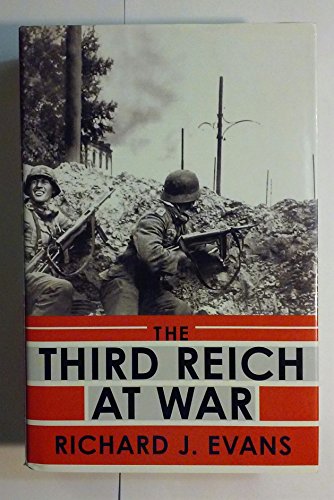

The final volume in Richard J. Evans’s masterly trilogy on the history of Nazi Germany traces the rise and fall of German military might, the mobilization of a “people’s community” to serve a war of conquest, and Hitler’s campaign of racial subjugation and genocide
Already hailed as “a masterpiece” (William Grimes in The New York Times) and “the most comprehensive history... of the Third Reich” (Ian Kershaw), this epic trilogy reaches its terrifying climax in this volume.
Evans interweaves a broad narrative of the war’s progress with viscerally affecting personal testimony from a wide range of people—from generals to front-line soldiers, from Hitler Youth activists to middle-class housewives. The Third Reich at War lays bare the dynamics of a nation more deeply immersed in war than any society before or since. Fresh insights into the conflict’s great events are here, from the invasion of Poland to the Battle of Stalingrad to Hitler’s suicide in the bunker. But just as important is the re-creation of the daily experience of ordinary Germans in wartime, staggering under pressure from Allied bombing and their own government’s mounting demands upon them. At the center of the book is the Nazi extermination of Europe’s Jews, set in the context of Hitler’s genocidal plans for the racial restructuring of Europe.
Blending narrative, description and analysis, The Third Reich at War creates an engrossing picture—at once sweeping and precise—of a society rushing headlong to self-destruction and taking much of Europe with it. It is the culmination of a historical masterwork that will remain the most authoritative work on Nazi Germany for years to come.
Already hailed as “a masterpiece” (William Grimes in The New York Times) and “the most comprehensive history... of the Third Reich” (Ian Kershaw), this epic trilogy reaches its terrifying climax in this volume.
Evans interweaves a broad narrative of the war’s progress with viscerally affecting personal testimony from a wide range of people—from generals to front-line soldiers, from Hitler Youth activists to middle-class housewives. The Third Reich at War lays bare the dynamics of a nation more deeply immersed in war than any society before or since. Fresh insights into the conflict’s great events are here, from the invasion of Poland to the Battle of Stalingrad to Hitler’s suicide in the bunker. But just as important is the re-creation of the daily experience of ordinary Germans in wartime, staggering under pressure from Allied bombing and their own government’s mounting demands upon them. At the center of the book is the Nazi extermination of Europe’s Jews, set in the context of Hitler’s genocidal plans for the racial restructuring of Europe.
Blending narrative, description and analysis, The Third Reich at War creates an engrossing picture—at once sweeping and precise—of a society rushing headlong to self-destruction and taking much of Europe with it. It is the culmination of a historical masterwork that will remain the most authoritative work on Nazi Germany for years to come.
"synopsis" may belong to another edition of this title.
About the Author:
Richard J. Evans is professor of modern history at Cambridge University. His previous books include In Defense of History, Lying About Hitler, and the companions to this title, The Coming of the Third Reich and The Third Reich in Power.
Excerpt. © Reprinted by permission. All rights reserved.:
Note: The views or opinions expressed in this book and the context in which the images are used do not necessarily reflect the views or policy of, nor imply approval or endorsement by, the United States Holocaust Memorial Museum.
Preface
This book tells the story of the Third Reich, the regime created in Germany by Hitler and his National Socialists, from the outbreak of the Second World War on 1 September 1939 to its end in Europe on 8 May 1945. It can be read on its own, as a history of Germany during the war. But it is also the final volume in a series of three, starting with The Coming of the Third Reich, which deals with the origins of Nazism, the development of its ideas and its rise to power in 1933. The second volume in the series, The Third Reich in Power, covers the peacetime years from 1933 to 1939, when Hitler and the Nazis built up Germany’s military strength and prepared it for war. The general approach of all three volumes is set out in the Preface to The Coming of the Third Reich and does not need to be repeated in detail here. Taken together, they aim to provide a comprehensive account of Germany under the Nazis.
Dealing with the history of the Third Reich during the war poses two special problems. The first is a relatively minor one. After 1939, Hitler and the Nazis became increasingly reluctant to refer to their regime as ‘The Third Reich’, preferring instead to call it ‘The Great German Reich’ (Grossdeutsches Reich) to draw attention to the massive expansion of its boundaries that took place in 1939-40. For the sake of unity and consistency, however, I have chosen, like other historians, to continue calling it ‘The Third Reich’; after all, the Nazis chose to abandon this term silently rather than repudiate it openly. The second problem is more serious. The central focus of this book is on Germany and the Germans; it is not a history of the Second World War, not even of the Second World War in Europe. Nevertheless, of course, it is necessary to narrate the progress of the war, and to deal with the Germans’ administration of the parts of Europe they conquered. Within the scope even of so large a book as this, it is not possible to pay equal attention to every phase and every aspect of the war. I have chosen, therefore, to focus on the major turning-points - the conquest of Poland and France and the Battle of Britain in the first year of the war, the Battle of Moscow in the winter of 1941- 2, the Battle of Stalingrad in the winter of 1942- 3, and the beginning of the sustained strategic bombing of German cities in 1943. In doing so, I have tried to convey something of the flavour of what it was like for Germans to take part in these vast conflicts, using the diaries and letters of both soldiers and civilians. The reasons for choosing these particular turning-points will, I hope, become apparent to readers in the course of the book.
At the heart of German history in the war years lies the mass murder of millions of Jews in what the Nazis called ‘the final solution of the Jewish question in Europe’. This book provides a full narrative of the development and implementation of this policy of genocide, while also setting it in the broader context of Nazi racial policies towards the Slavs, and towards minorities such as Gypsies, homosexuals, petty criminals and ‘asocials’. I have tried to combine the testimony of some of those it affected - both those who survived, and those who did not - with that of some of the men who implemented it, including the commandants of major death camps. The deportation and murder of Jews from Western European countries is covered in the chapter dealing with the Nazi empire, while the reactions of ordinary Germans at home, and the extent to which they knew about the genocide, are covered in a later chapter on the Home Front. The fact that the mass murder of the Jews is discussed in almost every part of the book, from the narrative of the foundation of the ghettos in Poland in the opening chapter right up to the coverage of the ‘death marches’ of 1945 in the final chapter, reflects its centrality to so many aspects of the history of the Third Reich at war. Wherever one looks, even for example in the history of music and literature, dealt with in Chapter 6, it is an inescapable part of the story. Nevertheless, it is important to reiterate that this book is a history of Nazi Germany in all its aspects; it is not in the first place a history of the extermination of the Jews, any more than it is a history of the Second World War, though both play an essential role in it.
The book opens where The Third Reich in Power left off, with the invasion of Poland on 1 September 1939. Chapter 1 discusses the Germans’ occupation of Poland and in particular their ill-treatment, exploitation and murder of many thousands of Poles and Polish Jews from this point to the eve of the invasion of the Soviet Union in June 1941. For the Nazis, and indeed for many Germans, Poles and ‘Eastern Jews’ were less than human, and this attitude applied, though with significant differences, to the mentally ill and handicapped in Germany itself, whose mass murder in the course of the ‘euthanasia’ action steered from Hitler’s Chancellery in Berlin forms the subject of the last part of the chapter. The second chapter is largely devoted to the progress of the war, from the conquest of Western Europe in 1940 through to the Russian campaign of 1941. That campaign forms the essential backdrop to the events narrated in Chapter 3, which deals with the launching and implementation of what the Nazis called ‘the final solution of the Jewish question in Europe’. Chapter 4 turns to the war economy, and looks at how the Third Reich ruled the countries it occupied in Europe, drafting in millions of forced labourers to man its arms factories and pushing ahead with the arrest, deportation and murder of the Jews who lived within the boundaries of the Nazi empire. That empire began to fall apart with the momentous German defeat at the Battle of Stalingrad early in 1943, which is narrated in the concluding part of the chapter. It was followed the same year by reversals in many spheres of the war, from the devastation of Germany’s towns and cities by the Allied strategic bombing offensive to the defeat of Rommel’s armies in North Africa and the collapse of the Third Reich’s main European ally, the Fascist state of Mussolini’s Italy. These events form the principal focus of Chapter 5, which goes on to examine the way they affected the armed forces, and the impact they had on the conduct of the war at home. Chapter 6 is largely devoted to the ‘Home Front’, and looks at how religious, social, cultural and scientific life interacted with the war. It concludes with an account of the emergence of resistance to Nazism, particularly within the Third Reich itself. Chapter 7 begins with an account of the ‘wonder-weapons’ which Hitler promised would reverse Germany’s military collapse, before going on to tell the story of how the Reich was finally defeated, and to examine briefly what happened afterwards. Each chapter interweaves thematic aspects with an ongoing narrative of military events, so that Chapter 1 deals with military action in 1939, Chapter 2 covers 1940 and 1941, Chapter 3 discusses further military events in 1941, Chapter 4 takes the story on through 1942, Chapter 5 narrates the war on land, in the air and at sea in 1943, Chapter 6 moves the narrative on through 1944, and the final chapter gives an account of the closing months of the war, from January to May 1945.
This book is written to be read from start to finish, as a single, if complex, narrative, interspersed with description and analysis; I hope that the ways in which the different parts of the story interact with one another will become apparent to readers as the narrative proceeds. The chapter headings are intended more to provoke reflection on the contents than to provide precise descriptions of what each chapter contains; in some cases they are intentionally ambiguous or ironical. Anyone who wishes to use the book simply as a work of reference is recommended to turn to the index, where the location of the book’s principal themes, characters and events is laid out in detail. The bibliography lists works cited in the notes; it is not intended to be a comprehensive guide to the vast literature on the topics dealt with in the book.
Much of this book deals with countries in Central and Eastern Europe where towns and cities have a variety of names and spellings in different languages. The Polish city of Lvov, for example, is spelt L’vov in Russian and L’viv in Ukrainian, while the Germans called it something different altogether, namely Lemberg; there are similar variations in the spelling of Kaunas in Lithuanian and Kovno in Polish, Theresienstadt in German and Terez’n in Czech, or Reval in German and Tallinn in Estonian. The Nazi authorities also renamed L’d’ as Litzmannstadt in an attempt to obliterate all aspects of its Polish identity altogether and used German names for a variety of other sites, such as Kulmhof for Chelmno, or Auschwitz for Oswiecim. In this situation it is impossible to be consistent, and I have chosen to use the name current at the time about which I am writing, or on occasion simply the name with which English and American readers will be most familiar, while alerting them to the existence of alternatives. I have also simplified the use of accents and diacriticals in place-names and proper names - dropping the Polish character Ł, for instance - to remove what to my mind are distractions for the English-language reader.
In the preparation of this book I have enjoyed the huge advantage of access to the superb collections of Cambridge University Library, as well as to those of the Wiener Library and the German Historical Institute in London. The University of Melbourne kindly appointed me to a Miegunyah Distinguished Visiting Fellowship in 2007, and I was able to use the excellent research collection on modern German history purchased for the University Library from the bequest of the late, and much-missed, John Foster. The Staatsarchiv der Freien- und Hansestadt Hamburg and the Forschungsstelle f̈r Zeitgeschichte in Hamburg kindly permitted consultation of the unpublished diaries of Luise Solmitz. The encouragement of many readers, especially in the United States, has been crucial in spurring me on to complete the book, though it has taken longer to do so than I originally intended. The advice and support of many friends and colleagues has been crucial. My agent Andrew Wylie and my editor at Penguin, Simon Winder, and their teams have been enormously helpful. Chris Clark, Christian Goeschel, Victoria Harris, Sir Ian Kershaw, Richard Overy, Kristin Semmens, Astrid Swenson, Hester Vaizey and Nikolaus Wachsmann read early drafts and made many useful suggestions. Victoria Harris, Stefan Ihrig, Alois Maderspacher, David Motadel, Tom Neuhaus and Hester Vaizey checked through the notes and saved me from many errors. Andr’s Berezn’y provided maps that are a model of clarity and accuracy; working on them with him was extremely instructive. The expertise of David Watson in copy-editing was invaluable, and it was a pleasure to work with Cecilia Mackay on the illustrations. Christine L. Corton applied her practised eye to the proofs, and provided essential support in too many ways to mention. Our sons, Matthew and Nicholas, to whom this final volume, like the previous two, is dedicated, have cheered me up on innumerable occasions during the writing of a book the subject matter of which was sometimes shocking and depressing almost beyond belief. I am profoundly grateful to them all.
"About this title" may belong to another edition of this title.
- PublisherPenguin Press
- Publication date2009
- ISBN 10 1594202060
- ISBN 13 9781594202063
- BindingHardcover
- Number of pages944
- Rating
Buy New
Learn more about this copy
US$ 36.90
Shipping:
US$ 4.00
Within U.S.A.
Other Popular Editions of the Same Title
Top Search Results from the AbeBooks Marketplace
Stock Image
The Third Reich at War
Published by
Penguin Press
(2009)
ISBN 10: 1594202060
ISBN 13: 9781594202063
New
Hardcover
Quantity: 1
Seller:
Rating

Book Description Hardcover. Condition: new. New. Fast Shipping and good customer service. Seller Inventory # Holz_New_1594202060
Buy New
US$ 36.90
Convert currency
Stock Image
The Third Reich at War
Published by
Penguin Press
(2009)
ISBN 10: 1594202060
ISBN 13: 9781594202063
New
Hardcover
Quantity: 1
Seller:
Rating
Book Description Condition: new. Seller Inventory # FrontCover1594202060
Buy New
US$ 37.84
Convert currency
Stock Image
The Third Reich at War
Published by
Penguin Press
(2009)
ISBN 10: 1594202060
ISBN 13: 9781594202063
New
Hardcover
Quantity: 1
Seller:
Rating
Book Description Hardcover. Condition: new. Brand New Copy. Seller Inventory # BBB_new1594202060
Buy New
US$ 39.34
Convert currency
Stock Image
The Third Reich at War
Published by
Penguin Press
(2009)
ISBN 10: 1594202060
ISBN 13: 9781594202063
New
Hardcover
Quantity: 1
Seller:
Rating
Book Description Hardcover. Condition: new. New Copy. Customer Service Guaranteed. Seller Inventory # think1594202060
Buy New
US$ 41.81
Convert currency
Stock Image
The Third Reich at War
Published by
Penguin Press, New York
(2009)
ISBN 10: 1594202060
ISBN 13: 9781594202063
New
Hardcover
First Edition
Quantity: 1
Seller:
Rating
Book Description Hardcover. Condition: New. No Jacket. 1st Edition. First Edition., no writing, marks, underlining, or bookplates. No remainder marks. Spine is tight and crisp. Boards are flat and true and the corners are square. No dust jacket. This collectible, " NEW" condition first edition/first printing copy is protected with a clear polyester archival cover. Beautiful collectible copy. Unread. Pristine. GIFT QUALITY. Seller Inventory # 007537
Buy New
US$ 39.95
Convert currency
Stock Image
The Third Reich at War
Published by
Penguin Press
(2009)
ISBN 10: 1594202060
ISBN 13: 9781594202063
New
Hardcover
Quantity: 1
Seller:
Rating
Book Description Condition: New. Buy with confidence! Book is in new, never-used condition. Seller Inventory # bk1594202060xvz189zvxnew
Buy New
US$ 66.56
Convert currency
Stock Image
THE THIRD REICH AT WAR
Published by
Penguin Press
(2009)
ISBN 10: 1594202060
ISBN 13: 9781594202063
New
Hardcover
Quantity: 1
Seller:
Rating

Book Description Condition: New. New. In shrink wrap. Looks like an interesting title! 2.75. Seller Inventory # Q-1594202060
Buy New
US$ 62.30
Convert currency
Stock Image
The Third Reich at War
Published by
Penguin Press
(2009)
ISBN 10: 1594202060
ISBN 13: 9781594202063
New
Hardcover
Quantity: 1
Seller:
Rating
Book Description Hardcover. Condition: new. Buy for Great customer experience. Seller Inventory # GoldenDragon1594202060
Buy New
US$ 69.55
Convert currency
Stock Image
The Third Reich at War
Published by
Penguin Press
(2009)
ISBN 10: 1594202060
ISBN 13: 9781594202063
New
Hardcover
Quantity: 1
Seller:
Rating
Book Description Hardcover. Condition: new. New. Seller Inventory # Wizard1594202060
Buy New
US$ 69.70
Convert currency
Stock Image
The Third Reich at War Evans, Richard J.
Published by
Penguin Press
(2009)
ISBN 10: 1594202060
ISBN 13: 9781594202063
New
Hardcover
Quantity: 1
Seller:
Rating
Book Description Hardcover. Condition: New. Seller Inventory # DRQ-1-0037
Buy New
US$ 52.00
Convert currency