
Items related to Packing the Court: The Rise of Judicial Power and the...
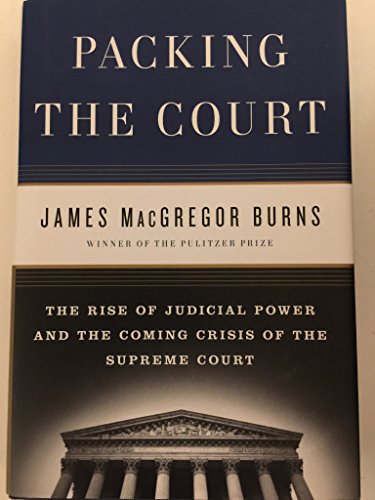
Packing the Court: The Rise of Judicial Power and the Coming Crisis of the Supreme Court - Hardcover
Synopsis
From renowned political theorist James MacGregor Burns, an incisive critique of the overreaching power of an ideological Supreme Court
For decades, Pulitzer Prize-winner James MacGregor Burns has been one of the great masters of the study of power and leadership in America. In Packing the Court, he turns his eye to the U.S. Supreme Court, an institution that he believes has become more powerful, and more partisan, than the founding fathers ever intended. In a compelling and provocative narrative, Burns reveals how the Supreme Court has served as a reactionary force in American politics at critical moments throughout the nation's history, and concludes with a bold proposal to rein in the court's power.
"synopsis" may belong to another edition of this title.
About the Author
James MacGregor Burns is the Woodrow Wilson Professor of Government Emeritus at Williams College and Distinguished Leadership Scholar at the James MacGregor Burns Academy of Leadership at the University of Maryland. He is the author of more than two dozen books, including Roosevelt: Soldier of Freedom, which won both the Pulitzer Prize and the National Book Award, and Leadership, which is considered a seminal work in the field of leadership studies.
Reviews
From The Washington Post's Book World/washingtonpost.com Reviewed by Jeffrey Rosen The history of the Supreme Court is too important to be monopolized by lawyers. It's a welcome development, therefore, that James MacGregor Burns, one of America's most distinguished historians of presidential power and leadership, has turned his attention to the court. In many respects, "Packing the Court" is just what you would expect of Burns: a readable and accessible history, full of memorable details about the byzantine nominations and political peculiarities of famous and obscure justices during the past two centuries. But "Packing the Court" also turns out to be a polemic, although an elegant and interestingly radical one. Burns's thesis rests on a series of bold claims. "Most justices have been political activists -- party politicos," he insists, because "from George Washington to George W. Bush, the opportunity for presidents to pack the bench with loyalists . . . has been irresistible." From the beginning, Burns continues, the court has established its "supremacy" over the president and Congress because of Chief Justice John Marshall's "brilliant political coup" in Marbury v. Madison (1803): asserting a power to strike down unconstitutional laws. By aggressively wielding this power, which Burns controversially claims that the framers never intended, the court has become the "most unstable" branch of government, "as well as the most unrepresentative of all the people." What Burns calls "the unconstitutional obstacle of the judicial veto" can often "reduce Congress to helplessness and make bystanders of presidents." Each of these claims is open to vigorous debate. Burns is too quick to equate Marshall's assertions about judicial review -- namely, the claim that the court has the power to strike down unconstitutional laws -- with assertions about judicial supremacy -- namely, the far more controversial claim that the court alone has the power to interpret the Constitution. In fact, in Marbury, Marshall defended judicial review, not judicial supremacy, which weakens Burns's argument that he engineered a "political coup" that would have appalled the framers. (The more conventional view is that judicial review was widely accepted by the time of Marbury.) And it wasn't until 1959 that the court equated its own decision in Brown v. Board of Education with the "supreme law of the land." Although Burns provocatively calls the judicial power to veto laws "unconstitutional," he is an inconsistent champion of judicial deference. At times, he seems to defend complete judicial abstinence, criticizing Felix Frankfurter, one of the most restrained justices in the 20th century, for occasionally striking down laws. But he also seems to applaud recent court decisions that challenged President Bush in the war on terror. Then, just when you think Burns is attacking the court for striking down liberal but not conservative laws and policies, he convincingly warns liberals that "looking to the Supreme Court for continuing liberal leadership was always a bad bet," because the court over time has tended to be an enemy of progressive legislation. Burns is part of an honorable bipartisan tradition of judicial restraint, associated most prominently with Justice Oliver Wendell Holmes. He criticizes what he calls the O'Connor court as an "imperious court" that "reigned supreme over the political and constitutional landscape." But although Justice Sandra Day O'Connor was indeed an activist, judged by her willingness to strike down state and federal laws, her record challenges Burns's thesis that the court has often "stood outside the mainstream of public opinion." It's arguable, for example, that O'Connor represented the views of the moderate majority of the American people -- fiscally conservative and socially moderate -- more accurately than the Gingrich Congress. More generally, Burns does not engage with the extensive legal and historical literature that suggests the Supreme Court has tended to reflect the views of the majority of Americans more often than to challenge them, and that on the rare occasions that it has produced anti-majoritarian rulings, the resulting backlashes usually produced a hasty judicial retreat. Burns predicts that "within a generation or two -- perhaps much sooner," a "conservative, obstructionist" Supreme Court will once again confront a liberal president and Congress. He imagines that the "coming crisis" of his subtitle may arise as a pro-business court composed of "formidable free-marketeers" strikes down progressive economic legislation. It's possible, but I wouldn't bet on it. The Roberts court is indeed pro-business, but not especially libertarian: For this reason, among the current justices, only Clarence Thomas might be instinctively inclined to challenge President Obama's economic recovery program at its core. I'm similarly skeptical of Burns's extreme prescription for taming the court: In a proposal he calls "momentous," "daring," "inspiring" and "risky," he suggests that the president should "announce flatly that he or she would not accept the Supreme Court's verdicts" unless the people pass a constitutional amendment explicitly authorizing the justices to strike down unconstitutional laws. Obama, a former constitutional law professor, seems to have a more measured view of the role the Supreme Court has tended to play in American democracy: ratifying social change that has emerged from political activism, rather than unilaterally causing or obstructing change on its own. But although I wasn't convinced by Burns's prescriptions for the very real problem of judicial supremacy, I was engaged, entertained and provoked by this surprising and energetic history of the court.
Copyright 2009, The Washington Post. All Rights Reserved.
Pulitzer-winning historian Burns gives a brisk, readable tour of the history of the appointment of Supreme Court justices since 1789. In this respect, the book is fresh and compelling. But Burns (Running Alone) has another aim. Particularly aggrieved by the Rehnquist and Roberts courts, he argues that every president since Washington has sought to fill the Court with justices who think as he does; that judicial review is unconstitutional; that the unelected Court has never been politically accountable to the American people;and that a courageous president (like Barack Obama, he suggests) should simply announce that, like Andrew Jackson, he won't abide by Supreme Court rulings that invalidate laws enacted by Congress and signed by him. Known for the liberal flags he flies, Burns runs up the radical pennant here. There's no evidence that the American people are as aggrieved over the Court as Burns is. And the term packing should be reserved, as until now it has been, for extreme manipulative efforts like FDR's. This is a terrific little book—save for its politics run amok. (June)
Copyright © Reed Business Information, a division of Reed Elsevier Inc. All rights reserved.
"About this title" may belong to another edition of this title.
Search results for Packing the Court: The Rise of Judicial Power and the...

Stock Image
Packing the Court: The Rise of Judicial Power and the Coming Crisis of the Supreme Court
Seller: World of Books (was SecondSale), Montgomery, IL, U.S.A.
Seller rating 5 out of 5 stars

Hardback. Condition: Very Good. From renowned political theorist James MacGregor Burns, an incisive critique of the overreaching power of an ideological Supreme Court For decades, Pulitzer Prize-winner James MacGregor Burns has been one of the great masters of the study of power and leadership in America. In Packing the Court, he turns his eye to the U.S. Supreme Court, an institution that he believes has become more powerful, and more partisan, than the founding fathers ever intended. In a compelling and provocative narrative, Burns reveals how the Supreme Court has served as a reactionary force in American politics at critical moments throughout the nation's history, and concludes with a bold proposal to rein in the court's power. Seller Inventory # 00089248944
Stock Image
Packing the Court: The Rise of Judicial Power and the Coming Crisis of the Supreme Court
Seller: World of Books (was SecondSale), Montgomery, IL, U.S.A.
Seller rating 5 out of 5 stars
Hardback. Condition: Good. From renowned political theorist James MacGregor Burns, an incisive critique of the overreaching power of an ideological Supreme Court For decades, Pulitzer Prize-winner James MacGregor Burns has been one of the great masters of the study of power and leadership in America. In Packing the Court, he turns his eye to the U.S. Supreme Court, an institution that he believes has become more powerful, and more partisan, than the founding fathers ever intended. In a compelling and provocative narrative, Burns reveals how the Supreme Court has served as a reactionary force in American politics at critical moments throughout the nation's history, and concludes with a bold proposal to rein in the court's power. Seller Inventory # 00090226601
Stock Image
Packing the Court: The Rise of Judicial Power and the Coming Crisis of the Supreme Court
Seller: New Legacy Books, Annandale, NJ, U.S.A.
Seller rating 5 out of 5 stars
hardcover. Condition: Very Good. Fast shipping and order satisfaction guaranteed. A portion of your purchase benefits Non-Profit Organizations, First Aid and Fire Stations! Seller Inventory # mon0000020322
Seller Image
Packing the Court: The Rise of Judicial Power and the Coming Crisis of the Supreme Court
Seller: Greenworld Books, Arlington, TX, U.S.A.
Seller rating 5 out of 5 stars
Condition: like_new. Fast Free Shipping â" Excellent condition book with clean cover and pages. Barely handled, with minimal wear. An outstanding copy, close to enjoy! Seller Inventory # GWV.1594202192.LN
Stock Image
Packing the Court: The Rise of Judicial Power and the Coming Crisis of the Supreme Court
Published by
Penguin Press (edition First Edition), 2009
ISBN 10: 1594202192
ISBN 13: 9781594202193
Used
Hardcover
First Edition
Seller: BooksRun, Philadelphia, PA, U.S.A.
Seller rating 5 out of 5 stars
Hardcover. Condition: Very Good. First Edition. It's a well-cared-for item that has seen limited use. The item may show minor signs of wear. All the text is legible, with all pages included. It may have slight markings and/or highlighting. Seller Inventory # 1594202192-11-1
Stock Image
Packing the Court: The Rise of Judicial Power and the Coming Crisis of the Supreme Court
Seller: HPB-Ruby, Dallas, TX, U.S.A.
Seller rating 5 out of 5 stars
hardcover. Condition: Very Good. Connecting readers with great books since 1972! Used books may not include companion materials, and may have some shelf wear or limited writing. We ship orders daily and Customer Service is our top priority! Seller Inventory # S_479235627
Stock Image
Packing the Court : The Rise of Judicial Power and the Coming Crisis of the Supreme Court
Published by
Penguin Publishing Group, 2009
ISBN 10: 1594202192
ISBN 13: 9781594202193
Used
Hardcover
Seller: Better World Books, Mishawaka, IN, U.S.A.
Seller rating 5 out of 5 stars
Condition: Very Good. Pages intact with possible writing/highlighting. Binding strong with minor wear. Dust jackets/supplements may not be included. Stock photo provided. Product includes identifying sticker. Better World Books: Buy Books. Do Good. Seller Inventory # 54607944-6
Stock Image
Packing the Court : The Rise of Judicial Power and the Coming Crisis of the Supreme Court
Published by
Penguin Publishing Group, 2009
ISBN 10: 1594202192
ISBN 13: 9781594202193
Used
Hardcover
Seller: Better World Books, Mishawaka, IN, U.S.A.
Seller rating 5 out of 5 stars
Condition: Good. Pages intact with minimal writing/highlighting. The binding may be loose and creased. Dust jackets/supplements are not included. Stock photo provided. Product includes identifying sticker. Better World Books: Buy Books. Do Good. Seller Inventory # 46494457-6
Stock Image
Packing the Court: The Rise of Judicial Power and the Coming Crisis of the Supreme Court
Seller: World of Books Inc, Montgomery, IL, U.S.A.
Seller rating 4 out of 5 stars

Hardback. Condition: Very Good. From renowned political theorist James MacGregor Burns, an incisive critique of the overreaching power of an ideological Supreme Court For decades, Pulitzer Prize-winner James MacGregor Burns has been one of the great masters of the study of power and leadership in America. In Packing the Court, he turns his eye to the U.S. Supreme Court, an institution that he believes has become more powerful, and more partisan, than the founding fathers ever intended. In a compelling and provocative narrative, Burns reveals how the Supreme Court has served as a reactionary force in American politics at critical moments throughout the nation's history, and concludes with a bold proposal to rein in the court's power. Seller Inventory # CIN1594202192VG
Stock Image
Packing the Court: The Rise of Judicial Power and the Coming Crisis of the Supreme Court
Seller: World of Books Inc, Montgomery, IL, U.S.A.
Seller rating 4 out of 5 stars
Hardback. Condition: Good. From renowned political theorist James MacGregor Burns, an incisive critique of the overreaching power of an ideological Supreme Court For decades, Pulitzer Prize-winner James MacGregor Burns has been one of the great masters of the study of power and leadership in America. In Packing the Court, he turns his eye to the U.S. Supreme Court, an institution that he believes has become more powerful, and more partisan, than the founding fathers ever intended. In a compelling and provocative narrative, Burns reveals how the Supreme Court has served as a reactionary force in American politics at critical moments throughout the nation's history, and concludes with a bold proposal to rein in the court's power. Seller Inventory # CIN1594202192G