
Items related to Field Guide to Meat: How to Identify, Select, and Prepare...
Field Guide to Meat: How to Identify, Select, and Prepare Virtually Every Meat, Poultry, and Game Cut - Softcover
Book 9 of 13: Field Guide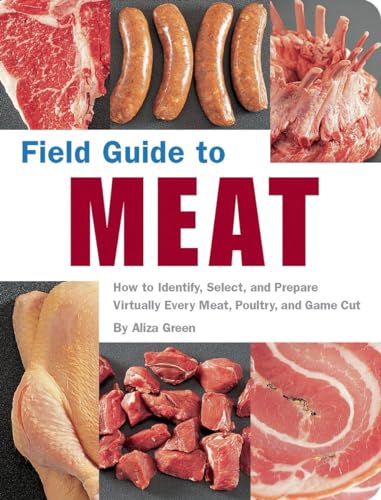
Synopsis
What's the difference between pork sirloin and pork tenderloin? Are Spanish chorizo and Mexican chorizo the same thing? Do quail and pheasant really taste just like chicken?
Whether you're a casual griller or a haute foodie, you need the latest volume in our popular Field Guide series--Field Guide to Meat. With engaging text from award-winning chef Aliza Green, this illustrated guide shows how to identify and prepare more than 100 different kinds of meat, from beef and pork to lamb, poultry, wild game, sausages, and more. Featuring detailed descriptions, selection tips, and full-color photographs for easy identification, Field Guide to Meat is every carnivore's one-stop reference book.
"synopsis" may belong to another edition of this title.
About the Author
Aliza Green is a chef, food writer, and teacher based in Philadelphia. She is the author of Field Guide to Produce .
Reviews
What are variety meats? What differentiates a T-bone from a porterhouse steak? How do you store foie gras? How do you prepare ground veal? And what does head cheese taste like? This most useful of kitchen references answers all those burning questions and more, in clean, matter-of-fact text accompanied by catalogue-type color photographs of everything from beef rolls to rack of lamb and smoked turkey wings. Green (Field Guide to Produce) covers beef, veal, pork, lamb, poultry and game birds, game and other domesticated meats (which includes rattlesnake and squirrel), and sausage and cured meats. Each compact chapter explains the various cuts available and gives instructions on choosing, storing and preparing. Home cooks will find Green's guidelines on how much to buy of a given product helpful, while professionals will appreciate her inclusion of North American Meat Producers, or NAMP, cut numbers and names. And all chefs will benefit from the listing of international names for each meat (e.g., beef cheeks are called guancia in Italian, joue in French and mejilla or cachete in Spanish). (May)
"About this title" may belong to another edition of this title.
Search results for Field Guide to Meat: How to Identify, Select, and Prepare...

Stock Image
Field Guide to Meat: How to Identify, Select, and Prepare Virtually Every Meat, Poultry, and Game Cut
Published by
Andrews McMeel Publishing, 2005
ISBN 10: 1594740178
ISBN 13: 9781594740176
Used
Paperback
Seller: World of Books (was SecondSale), Montgomery, IL, U.S.A.
Seller rating 5 out of 5 stars

Paperback. Condition: Very Good. At last, a field guide to identifying and selecting more than 200 different cuts and kinds of meat, from beef and poultry to game and cured meat! An essential resource for every home cook or chef, Field Guide to Meat offers details on virtually every kind of meat available. This practical guide includes more than 200 full-color photographs of cuts of beef, veal, pork, lamb, game, and poultry as well as more than 100 different kinds of cured meats and sausages. Cross-referenced with the photographs are in-depth descriptions of the cuts, including basic history, location in the animal, characteristics, information on how to choose the cut, and flavor affinities. Step-by-step preparation directions tell you whether the item is best marinated, braised, grilled, roasted, or pan-seared. Trips to the butcher?s aisle will no longer be intimidating, and you?ll never end up with a cut that?s too tough for dinner. Seller Inventory # CIN1594740178VG
Stock Image
Field Guide to Meat: How to Identify, Select, and Prepare Virtually Every Meat, Poultry, and Game Cut
Published by
Andrews McMeel Publishing, 2005
ISBN 10: 1594740178
ISBN 13: 9781594740176
Used
Paperback
Seller: World of Books (was SecondSale), Montgomery, IL, U.S.A.
Seller rating 5 out of 5 stars
Paperback. Condition: Good. At last, a field guide to identifying and selecting more than 200 different cuts and kinds of meat, from beef and poultry to game and cured meat! An essential resource for every home cook or chef, Field Guide to Meat offers details on virtually every kind of meat available. This practical guide includes more than 200 full-color photographs of cuts of beef, veal, pork, lamb, game, and poultry as well as more than 100 different kinds of cured meats and sausages. Cross-referenced with the photographs are in-depth descriptions of the cuts, including basic history, location in the animal, characteristics, information on how to choose the cut, and flavor affinities. Step-by-step preparation directions tell you whether the item is best marinated, braised, grilled, roasted, or pan-seared. Trips to the butcher?s aisle will no longer be intimidating, and you?ll never end up with a cut that?s too tough for dinner. Seller Inventory # 00109505927
Seller Image
Field Guide to Meat: How to Identify, Select, and Prepare Virtually Every Meat, Poultry, and Game Cut
Seller: Zoom Books East, Glendale Heights, IL, U.S.A.
Seller rating 5 out of 5 stars
Condition: acceptable. Book is in acceptable condition and shows signs of wear. Book may also include underlining highlighting. The book can also include "From the library of" labels. May not contain miscellaneous items toys, dvds, etc. . We offer 100% money back guarantee and 24 7 customer service. Seller Inventory # ZEV.1594740178.A
Seller Image
Field Guide to Meat: How to Identify, Select, and Prepare Virtually Every Meat, Poultry, and Game Cut
Seller: Greenworld Books, Arlington, TX, U.S.A.
Seller rating 5 out of 5 stars
Condition: good. Fast Free Shipping â" Good condition. It may show normal signs of use, such as light writing, highlighting, or library markings, but all pages are intact and the book is fully readable. A solid, complete copy that's ready to enjoy. Seller Inventory # GWV.1594740178.G
Stock Image
Field Guide to Meat: How to Identify, Select, and Prepare Virtually Every Meat, Poultry, and Game Cut
Seller: BooksRun, Philadelphia, PA, U.S.A.
Seller rating 5 out of 5 stars
Paperback. Condition: Fair. The item might be beaten up but readable. May contain markings or highlighting, as well as stains, bent corners, or any other major defect, but the text is not obscured in any way. Seller Inventory # 1594740178-7-1
Seller Image
Field Guide to Meat: How to Identify, Select, and Prepare Virtually Every Meat, Poultry, and Game Cut
Seller: Greenworld Books, Arlington, TX, U.S.A.
Seller rating 5 out of 5 stars
Condition: like_new. Fast Free Shipping â" Excellent condition book with clean cover and pages. Barely handled, with minimal wear. An outstanding copy, close to enjoy! Seller Inventory # GWV.1594740178.LN
Stock Image
Field Guide to Meat: How to Identify, Select, and Prepare Virtually Every Meat, Poultry, and Game Cut
Published by
Andrews McMeel Publishing, 2005
ISBN 10: 1594740178
ISBN 13: 9781594740176
Used
Paperback
Seller: World of Books Inc, Montgomery, IL, U.S.A.
Seller rating 4 out of 5 stars

Paperback. Condition: Very Good. At last, a field guide to identifying and selecting more than 200 different cuts and kinds of meat, from beef and poultry to game and cured meat! An essential resource for every home cook or chef, Field Guide to Meat offers details on virtually every kind of meat available. This practical guide includes more than 200 full-color photographs of cuts of beef, veal, pork, lamb, game, and poultry as well as more than 100 different kinds of cured meats and sausages. Cross-referenced with the photographs are in-depth descriptions of the cuts, including basic history, location in the animal, characteristics, information on how to choose the cut, and flavor affinities. Step-by-step preparation directions tell you whether the item is best marinated, braised, grilled, roasted, or pan-seared. Trips to the butcher?s aisle will no longer be intimidating, and you?ll never end up with a cut that?s too tough for dinner. Seller Inventory # CIN1594740178VG
Stock Image
Field Guide to Meat: How to Identify, Select, and Prepare Virtually Every Meat, Poultry, and Game Cut
Published by
Andrews McMeel Publishing, 2005
ISBN 10: 1594740178
ISBN 13: 9781594740176
Used
Paperback
Seller: World of Books Inc, Montgomery, IL, U.S.A.
Seller rating 4 out of 5 stars
Paperback. Condition: Good. At last, a field guide to identifying and selecting more than 200 different cuts and kinds of meat, from beef and poultry to game and cured meat! An essential resource for every home cook or chef, Field Guide to Meat offers details on virtually every kind of meat available. This practical guide includes more than 200 full-color photographs of cuts of beef, veal, pork, lamb, game, and poultry as well as more than 100 different kinds of cured meats and sausages. Cross-referenced with the photographs are in-depth descriptions of the cuts, including basic history, location in the animal, characteristics, information on how to choose the cut, and flavor affinities. Step-by-step preparation directions tell you whether the item is best marinated, braised, grilled, roasted, or pan-seared. Trips to the butcher?s aisle will no longer be intimidating, and you?ll never end up with a cut that?s too tough for dinner. Seller Inventory # CIN1594740178G
Stock Image
Field Guide to Meat: How to Identify, Select, and Prepare Virtually Every Meat, Poultry, and Game Cut
Seller: ThriftBooks-Reno, Reno, NV, U.S.A.
Seller rating 5 out of 5 stars
Paperback. Condition: Good. No Jacket. Former library book; Pages can have notes/highlighting. Spine may show signs of wear. ~ ThriftBooks: Read More, Spend Less. Seller Inventory # G1594740178I3N10
Stock Image
Field Guide to Meat: How to Identify, Select, and Prepare Virtually Every Meat, Poultry, and Game Cut
Seller: ThriftBooks-Reno, Reno, NV, U.S.A.
Seller rating 5 out of 5 stars
Paperback. Condition: Good. No Jacket. Pages can have notes/highlighting. Spine may show signs of wear. ~ ThriftBooks: Read More, Spend Less. Seller Inventory # G1594740178I3N00