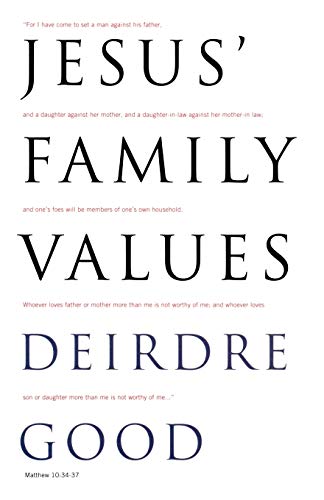
Many people claim to know what Jesus would say or do in the kinds of ethical dilemmas we face today, but applying "traditional" Christian values out of context actually sells Jesus' teaching short. What are Christian family values, Deirdre Good asks, why are there so many interpretations of what Jesus actually taught and said, and which of these biblical values should guide our lives?
She begins by setting this conversation in the context of the Greek, Roman, Jewish, and first-century sectarian world, and criticizes the attempts to use biblical texts literally in advocating for marriage and the family. Other chapters will take up the meaning of house and home, marriage and divorce, and biological ties vs. extended families and communities.
Through careful attention to the words and stories of Matthew, Luke, Mark, John, and the letters of Paul, Good provides an ideal method for studying the Bible to find out what it actually says to our communities and households today.
"synopsis" may belong to another edition of this title.
Deirdre Good is Professor of New Testament at The General Theological Seminary in New York. A widely published author and prominent lecturer, she is also a program consultant to television on religious history. Her most recent book is Mariam, the Magdalen, and the Mother, a collection of essays on the Mary figures of the Bible.
| ACKNOWLEDGMENTS | |
| 1. THE BIBLE AND FAMILY VALUES | |
| 2. THE HOLY FAMILY | |
| 3. MATTHEW'S NEW FAMILY | |
| 4. LUKFS RESPECTABLE FAMILY | |
| 5. PAULS URBAN HOUSEHOLDS | |
| CONCLUSION: JESUS AND FAMILY VALUES | |
| APPENDIX: EASY REFERENCE CHART | |
| SELECTED BIBLIOGRAPHY |
THE BIBLE AND FAMILY VALUES
When I was about thirteen, I wrote an essay for homework on the importance ofwood in modern life. Having identified only two items, namely telegraph polesand wooden shafts in mines to support tunnel construction, I asked my mother'sopinion. "What's the most important thing wood is used for today?" I asked her."A bed," she said. I was sufficiently taken aback to remember the story to thisday. However, her answer points not just to the need for rest (at that time myfather, an ordained priest, was working in a teacher training college, and shehad her own job as a physiotherapist, in addition to household responsibilitiesthat included two teenagers), but to the importance of structures of support forher life and that of her family. She herself, of course, was the primary"structure of support" for her husband and children, and while she considered abed to be the most important use of wood, no mere thing would be the mostimportant support structure in her life.
To this day my parents' primary support structures include each other, dailyprayer time together, the routine of daily work despite "retirement," meals,recreation, and affection shared, as well as work and recreation taken apartfrom each other. The needs and difficulties and interests attendant upon a largenetwork of extended family and parish relationships provide a different kind ofsupport for my parents, who have both a vocation and passion for ministry Theirbaptismal vows, marriage vows, and his ordination vows are crucial structures ofsupport for them and have remained constant through radically different settings— rural East Africa where two children were born and raised; urban England withtwo adolescents growing up; tropical Fiji, far distant from any relatives; urbanEngland again, but this time with responsibility for an aging parent.
This core family of two adults and two children looks very much like thearchetypal conservative Christian family promoted by groups like James Dobson'sFocus on the Family. The sources of support for this family — the God of JesusChrist, Holy Scripture, purpose-driven lives — seem very similar, if notidentical, to the sources of support for mine. But move one degree out of mycore family into the extended family, and every possible variation that can befound in modern Western society exists — except perhaps polygamy, although Icouldn't absolutely guarantee that! There are divorces, remarriages, step-relatives,partnerships (heterosexual and homosexual) without benefit ofmarriage, ex-spouses and ex-spouses' children. There are people in my extendedfamily for whom there are no English terms to describe the nature and degree ofrelationship.
Further, there are lots of people in my extended family, related to me by nomore than one degree of separation, for whom the sources of support my parents'generation consider indispensable — the God of Jesus Christ, Holy Scripture — areperipheral if not meaningless. And there are still more members who findtheir sources of support in scriptural Christianity but understand family as farlarger than those related by blood or indissoluble marriage. But whatcharacterizes my extended family members as family is an extraordinary degree ofpermanence within flux and change, brought about by the family's own response toitself. Every divorce, every relationship without benefit of marriage has causedmy parents deep distress and consternation; but every exspouse, new spouse,unmarried partner remains in their thoughts, love, prayers, and, perhaps moretellingly, on the guest list of their fiftieth wedding anniversary.
But would all religious groups understand that my family reflects legitimate"family values"? Yes, according to a 2005 Valuing Families resource on the Website of the National Council of Churches (USA). The package "is designed toinspire Christian families to honor and prayerfully support families of allshapes and sizes" and connect them with discussions and activities to help themidentify and appreciate the many characteristics that shape families today.Focus on the Family, on the other hand, proscribes sex outside of marriage forbelievers (whether homosexual or heterosexual). While the group understandsscripture to condemn homosexuality and premarital heterosexuality, it mandatesacceptance of those violating these ordinances, as we can see in the example ofJesus' compassion for the women taken in adultery. Similarly, FamilyLife.comexplains that conservative evangelicals understand God to release people fromthe lifelong covenant of marriage in only two circumstances: consistent andunrepentant immorality (based on a reading of Matt. 19:7–9) and when anunbelieving spouse deserts a believer (based on a reading of 1 Cor. 7:15–17).
What exactly are family values and where do they come from? If you Google"family values" you might find, "Looking for Family Values? Find exactly whatyou want today, www.ebay.com." Values become whatever you want them to be oneBay. But if you tried a similar search on texts that existed in Jesus' time,you would be in trouble immediately. There is no word in Greek or Hebrew thatexactly corresponds to the modern word "family"; the closest Greek word, oikia,or oikos, means variously household or house, like bet in Hebrew, whichsimilarly means house and can be used for household in the sense of familylineage. Two other Hebrew words used for related groups of people are toldot andmishpachah, generations and clan or tribe. Similarly with the word "values" — anyGreek or Hebrew word that might be translated "value" refers specifically tomonetary or market worth. Of course, our word "family" comes from the Latin wordfamilia, but for the Romans, the meaning and the reality were far more similarto the Greek oikia and the Hebrew bet than to our modern "family," as we shallsee.
So if we can't find "family values" anywhere in the Bible, or in the linguisticworld of Jesus, when and where does the phrase begin to appear? What constitutesfamily values and who decides? What can we find in the teachings of Jesus orother Christian scripture that speaks to family values today? What would"family" have looked like in the world and time of Jesus? Is there anyscriptural warrant for elevating "family values" to a primary position inChristian belief systems today? What would a scripture-defined "family" looklike today, and what would its "values" be? These are the questions that we willexplore.
Where Do Family Values Come From?
Most Americans assume the exclusively domestic function and private character ofour houses, and we identify the home as a place of refuge from daily work. Thepinnacle of the American Dream is home ownership, and the preferred home is theone-family house. But these are modern ideas going back only to the Victorianperiod. When we consider the home as a place for the raising of children, wemust remember that childhood as we know it, an extended time of shelterednurturing, was practically invented by the Victorians, and reserved to wealthyfamilies. Suburbia as a bedroom community for the city originated in theVictorian period with the advent of rapid public transit. When people use theterm "traditional family," what is meant may look a lot more like a Victorianfamily than a family in the time of Jesus.
For example, Victorian religious art ordinarily depicts the Holy Family as acalm, detached, affluent nuclear family, typified by James Collinson's The HolyFamily. Here a young, healthily padded woman sits on an invisible seat in frontof the corner of a red brick building set in a garden with hollyhocks. Hercarefully draped dress and cloak are immaculate, as is her person. Under asimple nimbus, a pure white veil with no visible means of anchoring partiallycovers her hair. The child stands in perfect composure on her knee, reaching outto a dove resting on Joseph's hand. Joseph, also with nimbus, wears a long cleangarment under a cloak whose careful folds mark a citizen of leisure; his hairand beard have been professionally groomed. Each character wears an expressionof serene gravity. Behind the tableau a cypress frames a calm meandering riverunder a blue sky with a few tentative clouds.
A significant departure from this pattern is John Everett Millais' Christ in theHouse of His Parents, also known as The Carpenter's Shop. The controversysurrounding this work suggests the extent to which Victorians considered theHoly Family to be elevated above and apart from the experience of ordinaryworking-class family life. Millais clearly understood that Joseph's carpentryshop was located in the house, a confusion of contexts abhorrent to the emergingVictorian ideal that particular places be reserved for particular functions, andthat the home be protected from the incursions of work. For a twenty-first-centuryviewer, however, the painting is a perfectly respectable representationof an extended family at work in some ancient period. In the center a motherkneels comforting a child perhaps ten years old, clad in a white shift, who hashurt his hand. All of the figures in the painting lean toward the wounded boy inconcern; the younger apprentice, perhaps John the Baptist since his breeches aremade of some wild animal's fur, carries a bowl of water for cleansing the wound.The shop is clean, littered only with the expected wood shavings; lumber isstacked and tools hung tidily in the background; a dove hunching on a ladderbehind the table watches the child with a worried look. The door of the shopreveals a pastoral landscape with green fields under a blue sky beyond; from apen of clean farm animals close to the house, even the rams and sheep focus uponthe child with concern. The Victorian outcry against the painting maydemonstrate the extent to which working-class life was considered incompatiblewith the upbringing of children and the maintenance of a proper home. So deeplywas the understanding of respectable family divorced from the reality ofworking-class life that Millais is recorded as having hoped that QueenVictoria's private viewing of the painting had not been too "corrupting."
The term "family values" was popularized in the Republican presidential campaignof 1992 after Dan Quayle attributed the then recent Rodney King riots in LosAngeles to a "breakdown of family structure, personal responsibility and socialorder," and then cited as "mocking fatherhood" the TV sitcom Murphy Brown, inwhich Brown chooses to bear and raise a child by herself, rather than to abort.While a number of the components of the current "family values" debate have beenin public and political contention for decades, the current debate about "familyvalues" as a package dates to 1992.
In 1980 a White House "Conference on Families" took place, and in 1983 theFamily Research Council associated with James Dobson was incorporated. TheFamily Research Council (FRC) extols the virtue and value of the two-parent,marriage-based family as the foundation of society. According to its Web site,the FRC holds that marriage can only be the life-long union of one man and onewoman, and believes that sexual relations should occur only within lawfulmarriage.
In scholarly circles, it was also in the 1980s that several publicationsappeared on family, house, and house church in the period of Christian origins.By the mid-eighties a consensus existed: households were at the center of themission of the early Christian movement. The house church was vital for localchurches or assemblies, serving as a focal point for prayer, Eucharist, andinstruction. It was a base for outreach, and as a community it was a place toexperience and exercise fellowship or love of brothers (and sisters). Earlybelievers of the Christ cult existed in a wider social world. Architecturalevidence from Dura-Europos indicates that Jews, followers of the Roman cult ofMithras, and Christians all adapted private homes for worship purposes. As faras the New Testament is concerned, evidence from Luke and Matthew indicates thatfrom 50 to 150 CE early believers met in the private homes of wealthy members ofthe group. Since the gatherings included a common meal, they probably took placein a dining room or living quarters. Nothing distinguishes the buildings thathosted such assemblies from domestic houses. Subsequently, larger houses wereprobably altered and used in part or perhaps primarily for worship. At the sametime, believers probably continued to meet in houses. In the mid-second century,a gradual expansion to larger buildings and halls is evident.
Once the centrality of the oikos as the basic social, legal, and economic unitwithin Hellenistic and Roman society and the importance of the oikos as a placeof individual and public identity was understood, studies on networks of theoikos and the family took on a new importance. Moreover the wider politicalNorth American context in which scholarship has occurred since the 1980s (andprobably before) gives such academic undertakings a particular relevance.
A major distinction between traditional and progressive scholarship concerns theapplication of biblical material: traditional scholarship views the Bibleprescriptively while progressive scholarship views biblical material primarilydescriptively and secondarily considers its current application. Traditionalscholarship regards biblical teaching on marriage and family as a blueprint forthe modern home. There is no gap between the text and my life. Progressivescholarship prefers to "mind the gap" and to describe as fully as possiblehistorical contexts in which meaning is disclosed as the first step towardunderstanding biblical statements on marriage and family. For example, materialfrom Hebrew scriptures has an entirely different social, economic, andhistorical context from material in the New Testament. Observing this historicalcontext respects the historical circumstances in which divine disclosure tookplace. Paying attention to historical contexts goes some way toward preventingan interpreter from projecting his or her own mental landscape onto the text.
Recent traditional writing (e.g., Andreas Köestenberger, God, Marriage, andFamily) understands marriage and the family to be the primary divinelyinstituted order for the human race. These institutions are to be characterizedby monogamy, fidelity, hetero-sexuality, fertility, complementarity, andpermanence. (Note the prescriptive language: these institutions are to becharacterized ...). The New Testament, Köestenberger continues, defines maritalroles in terms of respect and love as well as submission and authority. Whilethere is "neither male nor female" as far as salvation in Christ is concerned(Gal. 3:28), there remains a pattern in which the wife is to emulate thechurch's submission to Christ and the husband is to imitate Christ's love forthe church (Eph. 5:21–33). The married couple witnesses to surrounding cultureand ought to understand itself within the larger framework of God's end-timepurposes in Christ. Again, note the prescriptive language: "the wife is toemulate" "the husband is to imitate" "the married couple ... ought tounderstand." How do we know marriage and family is the primary divinelyinstituted order of the human race? By what means is marriage and the familyselected over any other divinely instituted human institution? Such a judgmentindicates that there are some covert presuppositions operating to privilegemarriage and family over anything else. As for "neither male nor female" inGalatians 3:28, the text is misquoted. The original text actually reads, "thereis no male and female," alluding specifically to the text of Genesis 1:27, thecreation of humanity as "male and female"; what baptism into Christ does is totranscend the original complementarity, not to perpetuate the polarity. In otherwords, in Pauline thought, baptism creates an identity exclusive of gender,whether that means by unifying the male and female, or by creating an entirelygender-free category. Galatians dispenses with gender categories, Ephesiansemphasizes them; by subordinating Galatians to Ephesians, Köestenbergeroverrides Paul's mandate for gender-free baptismal life in Christ, andreinscribes sexual differences as operative. This is an example of how certaintexts are privileged in support of a modern traditional understanding ofmarriage; most scholars would agree that Ephesians was not written by Paul, andtherefore should not be elevated over Galatians, which everyone agrees waswritten by Paul.
Surely marriage today is not the same thing as marriage in Eden or in ancientIsrael, or in the time of Jesus. It is too obvious to say that there is no onesingle understanding of marriage in the Bible and that collapsing teaching onmarriage and family into one single model reduces diversity to the point ofdistortion. Moreover, Jesus wasn't married, and Paul seems to commend singlenessor sexual asceticism over marriage. What do Jesus' singleness and Paul'scommendations imply for the human condition? If barrenness is generally viewedas divine disfavor, is Jesus the exception that proves the rule? What does thissay about Paul?
Excerpted from JESUS' FAMILY VALUES by DEIRDRE GOOD. Copyright © 2010 Deirdre Good. Excerpted by permission of Church Publishing Incorporated.
All rights reserved. No part of this excerpt may be reproduced or reprinted without permission in writing from the publisher.
Excerpts are provided by Dial-A-Book Inc. solely for the personal use of visitors to this web site.
"About this title" may belong to another edition of this title.
Seller: Better World Books, Mishawaka, IN, U.S.A.
Condition: Very Good. Used book that is in excellent condition. May show signs of wear or have minor defects. Seller Inventory # 11835353-6
Seller: BooksRun, Philadelphia, PA, U.S.A.
Paperback. Condition: Good. It's a preowned item in good condition and includes all the pages. It may have some general signs of wear and tear, such as markings, highlighting, slight damage to the cover, minimal wear to the binding, etc., but they will not affect the overall reading experience. Seller Inventory # 1596270276-11-1
Seller: Windows Booksellers, Eugene, OR, U.S.A.
Paperback. Very good. 159 pages. 159 pp. Seller Inventory # 499542
Seller: Grand Eagle Retail, Bensenville, IL, U.S.A.
Paperback. Condition: new. Paperback. Many people claim to know what Jesus would say or do in the kinds of ethical dilemmas we face today, but applying "traditional" Christian values out of context actually sells Jesus' teaching short. What are Christian family values, Deirdre Good asks, why are there so many interpretations of what Jesus actually taught and said, and which of these biblical values should guide our lives?She begins by setting this conversation in the context of the Greek, Roman, Jewish, and first-century sectarian world, and criticizes the attempts to use biblical texts literally in advocating for marriage and the family. Other chapters will take up the meaning of house and home, marriage and divorce, and biological ties vs. extended families and communities.Through careful attention to the words and stories of Matthew, Luke, Mark, John, and the letters of Paul, Good provides an ideal method for studying the Bible to find out what it actually says to our communities and households today. Includes many interpretations of what Jesus actually taught and said. Shipping may be from multiple locations in the US or from the UK, depending on stock availability. Seller Inventory # 9781596270275
Seller: Rarewaves.com USA, London, LONDO, United Kingdom
Paperback. Condition: New. Many people claim to know what Jesus would say or do in the kinds of ethical dilemmas we face today, but applying "traditional" Christian values out of context actually sells Jesus' teaching short. What are Christian family values, Deirdre Good asks, why are there so many interpretations of what Jesus actually taught and said, and which of these biblical values should guide our lives?She begins by setting this conversation in the context of the Greek, Roman, Jewish, and first-century sectarian world, and criticizes the attempts to use biblical texts literally in advocating for marriage and the family. Other chapters will take up the meaning of house and home, marriage and divorce, and biological ties vs. extended families and communities.Through careful attention to the words and stories of Matthew, Luke, Mark, John, and the letters of Paul, Good provides an ideal method for studying the Bible to find out what it actually says to our communities and households today. Seller Inventory # LU-9781596270275
Quantity: 14 available
Seller: Rarewaves USA, OSWEGO, IL, U.S.A.
Paperback. Condition: New. Many people claim to know what Jesus would say or do in the kinds of ethical dilemmas we face today, but applying "traditional" Christian values out of context actually sells Jesus' teaching short. What are Christian family values, Deirdre Good asks, why are there so many interpretations of what Jesus actually taught and said, and which of these biblical values should guide our lives?She begins by setting this conversation in the context of the Greek, Roman, Jewish, and first-century sectarian world, and criticizes the attempts to use biblical texts literally in advocating for marriage and the family. Other chapters will take up the meaning of house and home, marriage and divorce, and biological ties vs. extended families and communities.Through careful attention to the words and stories of Matthew, Luke, Mark, John, and the letters of Paul, Good provides an ideal method for studying the Bible to find out what it actually says to our communities and households today. Seller Inventory # LU-9781596270275
Seller: Lucky's Textbooks, Dallas, TX, U.S.A.
Condition: New. Seller Inventory # ABLIING23Mar2811580094502
Seller: Anybook.com, Lincoln, United Kingdom
Condition: Good. This is an ex-library book and may have the usual library/used-book markings inside.This book has soft covers. Clean from markings. In good all round condition. Please note the Image in this listing is a stock photo and may not match the covers of the actual item,300grams, ISBN:9781596270275. Seller Inventory # 8968251
Quantity: 1 available
Seller: Chiron Media, Wallingford, United Kingdom
PF. Condition: New. Seller Inventory # 6666-IUK-9781596270275
Quantity: 10 available
Seller: Ria Christie Collections, Uxbridge, United Kingdom
Condition: New. In. Seller Inventory # ria9781596270275_new
Quantity: Over 20 available