
Items related to A Basic Introduction to Biblical Hebrew: with CD
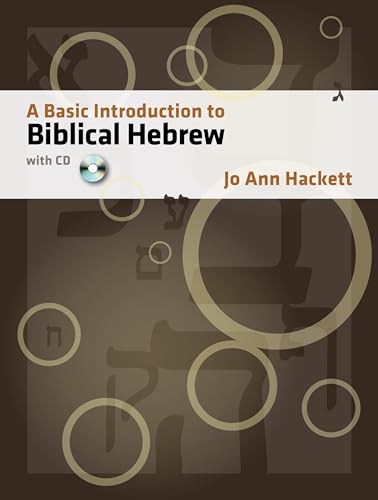
Synopsis
Hackett’s grammar is arranged in 30 lessons which makes it excellent for intensive study over the period of 1 semester, or for 2 semesters over the course of an entire school year. During the study the student will encounter several new approaches to learning the language. First, Hackett lists verbal forms from 1st person to 3rd person, rather than the traditional approach of 3rd to 1st. She acknowledges that the traditional way is counter intuitive with English speaking students because they learn their verbs from 1st to 3rd.
Second, rather than introducing both strong and weak verbs together, Hackett divides them and presents all strong verbs first, and then introduces weak verbs near the end of the book. Again, the principle in play here is to follow a formal order that layers and slowly introduces nuance into the language rather than shifting back and forth between straight forward items, and more difficult aspects of the language.
Third, Hackett also jettisons what she believes are “old-fashioned methods” of teaching the Hebrew verbal system in favor of a more simple, but also more descriptive system using the terms “prefix conjugation” and “suffix conjugation”. She also uses ve-qatal to describe what is popularly known as the “converted perfect”.
Fourth, unlike many Hebrew grammars, Hackett introduces her verbal forms logically. She notes, “It is a logical progression to begin with the prefix conjugation and lead up to the consecutive preterite. The consecutive preterite is the form beginning students must know thoroughly in order to read most biblical prose, and in order to lead them to that form, I needed to introduce the jussive, and in order to introduce the jussive, I first needed to present the prefix conjugation.”
Finally, Hackett introduces several new pedagogical techniques in her grammar. She emphasizes accent marks in her exercises, though both are artificial, or written by Hackett rather than taken from the biblical text. But Hackett’s goal justifies her actions; she wants “to present both disjunctive and conjunctive accents to the students, and at this early time in their biblical Hebrew study, the impossibility of some of my combinations will not affect their learning the [accent] system as a whole.” Along with this Hackett does stress the memorization of paradigms, and supplies verbs, where needed, to complete the paradigm even if a particular verbal form does not appear in the Hebrew text.
The CD which accompanies the book contains several helpful features for the student, not least of which is its helpful pronunciation guide. This includes the pronunciation of all Hebrew-to-English exercises in lessons 1-15, and the first two exercises of lessons 16-30. It also supplies the full pronunciation of Genesis 22.1-19, a common text used by instructors to help students learn pronunciation. Lastly, the answers for the books exercises can be found on the CD-ROM, and an additional workbook containing graded reading of biblical passages, glosses, additional vocabulary, is in the works and will be keyed to this book.
"synopsis" may belong to another edition of this title.
About the Author
Jo Ann Hackett is Professor of Middle Eastern Studies at the University of Texas, Austin. She is the author of The Bolcom Text from Deir 'A/Id and for many years was Professor of the Practice of Biblical Hebrew and Northwest Semitic Epigraphy at Harvard University.
"About this title" may belong to another edition of this title.
Search results for A Basic Introduction to Biblical Hebrew: with CD

Stock Image
A Basic Introduction to Biblical Hebrew: 1st Edition
Published by
Hendrickson Publishers Inc, 2010
ISBN 10: 159856028X
ISBN 13: 9781598560282
Used
Hardcover
Seller: World of Books (was SecondSale), Montgomery, IL, U.S.A.
Seller rating 5 out of 5 stars

Condition: Good. Hackett's grammar is arranged in 30 lessons which makes it excellent for intensive study over the period of 1 semester, or for 2 semesters over the course of an entire school year. During the study the student will encounter several new approaches to learning the language. First, Hackett lists verbal forms from 1st person to 3rd person, rather than the traditional approach of 3rd to 1st. She acknowledges that the traditional way is counter intuitive with English speaking students because they learn their verbs from 1st to 3rd. Second, rather than introducing both strong and weak verbs together, Hackett divides them and presents all strong verbs first, and then introduces weak verbs near the end of the book. Again, the principle in play here is to follow a formal order that layers and slowly introduces nuance into the language rather than shifting back and forth between straight forward items, and more difficult aspects of the language. Third, Hackett also jettisons what she believes are "old-fashioned methods" of teaching the Hebrew verbal system in favor of a more simple, but also more descriptive system using the terms "prefix conjugation" and "suffix conjugation". She also uses ve-qatal to describe what is popularly known as the "converted perfect". Fourth, unlike many Hebrew grammars, Hackett introduces her verbal forms logically. She notes, "It is a logical progression to begin with the prefix conjugation and lead up to the consecutive preterite. The consecutive preterite is the form beginning students must know thoroughly in order to read most biblical prose, and in order to lead them to that form, I needed to introduce the jussive, and in order to introduce the jussive, I first needed to present the prefix conjugation." Finally, Hackett introduces several new pedagogical techniques in her grammar. She emphasizes accent marks in her exercises, though both are artificial, or written by Hackett rather than taken from the biblical text. But Hackett's goal justifies her actions; she wants "to present both disjunctive and conjunctive accents to the students, and at this early time in their biblical Hebrew study, the impossibility of some of my combinations will not affect their learning the [accent] system as a whole." Along with this Hackett does stress the memorization of paradigms, and supplies verbs, where needed, to complete the paradigm even if a particular verbal form does not appear in the Hebrew text. The CD which accompanies the book contains several helpful features for the student, not least of which is its helpful pronunciation guide. This includes the pronunciation of all Hebrew-to-English exercises in lessons 1-15, and the first two exercises of lessons 16-30. It also supplies the full pronunciation of Genesis 22.1-19, a common text used by instructors to help students learn pronunciation. Lastly, the answers for the books exercises can be found on the CD-ROM, and an additional workbook containing graded reading of biblical passages, glosses, additional vocabulary, is in the works and will be keyed to this book. Seller Inventory # 00110023642
Stock Image
A Basic Introduction to Biblical Hebrew: 1st Edition
Published by
Hendrickson Publishers Inc, 2010
ISBN 10: 159856028X
ISBN 13: 9781598560282
Used
Hardcover
Seller: World of Books Inc, Montgomery, IL, U.S.A.
Seller rating 4 out of 5 stars

Condition: Good. Hackett's grammar is arranged in 30 lessons which makes it excellent for intensive study over the period of 1 semester, or for 2 semesters over the course of an entire school year. During the study the student will encounter several new approaches to learning the language. First, Hackett lists verbal forms from 1st person to 3rd person, rather than the traditional approach of 3rd to 1st. She acknowledges that the traditional way is counter intuitive with English speaking students because they learn their verbs from 1st to 3rd. Second, rather than introducing both strong and weak verbs together, Hackett divides them and presents all strong verbs first, and then introduces weak verbs near the end of the book. Again, the principle in play here is to follow a formal order that layers and slowly introduces nuance into the language rather than shifting back and forth between straight forward items, and more difficult aspects of the language. Third, Hackett also jettisons what she believes are "old-fashioned methods" of teaching the Hebrew verbal system in favor of a more simple, but also more descriptive system using the terms "prefix conjugation" and "suffix conjugation". She also uses ve-qatal to describe what is popularly known as the "converted perfect". Fourth, unlike many Hebrew grammars, Hackett introduces her verbal forms logically. She notes, "It is a logical progression to begin with the prefix conjugation and lead up to the consecutive preterite. The consecutive preterite is the form beginning students must know thoroughly in order to read most biblical prose, and in order to lead them to that form, I needed to introduce the jussive, and in order to introduce the jussive, I first needed to present the prefix conjugation." Finally, Hackett introduces several new pedagogical techniques in her grammar. She emphasizes accent marks in her exercises, though both are artificial, or written by Hackett rather than taken from the biblical text. But Hackett's goal justifies her actions; she wants "to present both disjunctive and conjunctive accents to the students, and at this early time in their biblical Hebrew study, the impossibility of some of my combinations will not affect their learning the [accent] system as a whole." Along with this Hackett does stress the memorization of paradigms, and supplies verbs, where needed, to complete the paradigm even if a particular verbal form does not appear in the Hebrew text. The CD which accompanies the book contains several helpful features for the student, not least of which is its helpful pronunciation guide. This includes the pronunciation of all Hebrew-to-English exercises in lessons 1-15, and the first two exercises of lessons 16-30. It also supplies the full pronunciation of Genesis 22.1-19, a common text used by instructors to help students learn pronunciation. Lastly, the answers for the books exercises can be found on the CD-ROM, and an additional workbook containing graded reading of biblical passages, glosses, additional vocabulary, is in the works and will be keyed to this book. Seller Inventory # CIN159856028XG
Stock Image
A Basic Introduction to Biblical Hebrew: with CD
Published by
Tyndale House Publishers, 2010
ISBN 10: 159856028X
ISBN 13: 9781598560282
Used
Hardcover
Seller: HPB-Red, Dallas, TX, U.S.A.
Seller rating 5 out of 5 stars
Hardcover. Condition: Good. Connecting readers with great books since 1972! Used textbooks may not include companion materials such as access codes, etc. May have some wear or writing/highlighting. We ship orders daily and Customer Service is our top priority! Seller Inventory # S_481712497
Stock Image
A Basic Introduction to Biblical Hebrew (English and Hebrew Edition)
Seller: Half Price Books Inc., Dallas, TX, U.S.A.
Seller rating 5 out of 5 stars
Hardcover. Condition: Very Good. Connecting readers with great books since 1972! Used books may not include companion materials, and may have some shelf wear or limited writing. We ship orders daily and Customer Service is our top priority! Seller Inventory # S_483325265
Stock Image
Basic Introduction to Biblical Hebrew W/CD
Published by
Hendrickson Publishers Marketing, LLC, 2010
ISBN 10: 159856028X
ISBN 13: 9781598560282
Used
Hardcover
Seller: Better World Books, Mishawaka, IN, U.S.A.
Seller rating 5 out of 5 stars
Condition: Good. Pages intact with minimal writing/highlighting. The binding may be loose and creased. Dust jackets/supplements are not included. Stock photo provided. Product includes identifying sticker. Better World Books: Buy Books. Do Good. Seller Inventory # 40567718-6
Seller Image
Basic Introduction to Biblical Hebrew
Seller: GreatBookPrices, Columbia, MD, U.S.A.
Seller rating 5 out of 5 stars
Condition: New. Seller Inventory # 9358085-n
Stock Image
A Basic Introduction to Biblical Hebrew (English and Hebrew Edition)
Seller: Lakeside Books, Benton Harbor, MI, U.S.A.
Seller rating 5 out of 5 stars
Condition: New. Brand New! Not Overstocks or Low Quality Book Club Editions! Direct From the Publisher! We're not a giant, faceless warehouse organization! We're a small town bookstore that loves books and loves it's customers! Buy from Lakeside Books! Seller Inventory # OTF-S-9781598560282
Stock Image
Basic Introduction to Biblical Hebrew
Seller: GreatBookPrices, Columbia, MD, U.S.A.
Seller rating 5 out of 5 stars
Condition: As New. Unread book in perfect condition. Seller Inventory # 9358085
Stock Image
A Basic Introduction to Biblical Hebrew [With CDROM]
Seller: Russell Books, Victoria, BC, Canada
Seller rating 5 out of 5 stars
Hardcover. Condition: New. Special order direct from the distributor. Seller Inventory # ING9781598560282
Buy New
US$ 39.95
US$ 19.99 shipping
Ships from Canada to U.S.A.
Ships from Canada to U.S.A.
Quantity: 2 available
Seller Image
Basic Introduction to Biblical Hebrew
Seller: GreatBookPricesUK, Woodford Green, United Kingdom
Seller rating 5 out of 5 stars
Condition: As New. Unread book in perfect condition. Seller Inventory # 9358085
Buy Used
US$ 43.18
US$ 19.82 shipping
Ships from United Kingdom to U.S.A.
Ships from United Kingdom to U.S.A.
Quantity: 16 available