
Items related to Last Stand of the Pack: Critical Edition (Timberline...
Last Stand of the Pack: Critical Edition (Timberline Books) - Softcover
Book 14 of 15: Timberline Books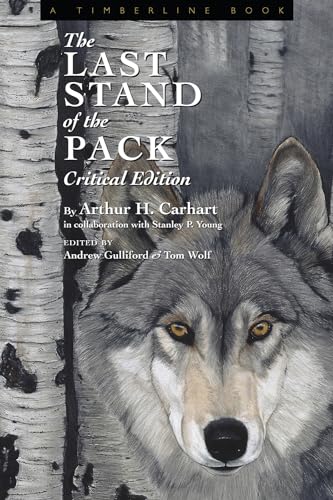
Synopsis
This critical edition explores the past and future of wolves in Colorado. Originally published in 1929, The Last Stand of the Pack is a historical account of the extermination of what were then believed to be the last wolves in Colorado. Arthur H. Carhart and Stanley P. Young describe the wolves’ extermination and extoll the bravery of the federal trappers hunting them down while simultaneously characterizing the wolves as cunning individuals and noble adversaries to the growth of the livestock industry and the settlement of the West. This is nature writing at its best, even if the worldview expressed is at times jarring to the twenty-first-century reader.
Now, almost 100 years later, much has been learned about ecology and the role of top-tier predators within ecosystems. In this new edition, Carhart and Young’s original text is accompanied by an extensive introduction with biographical details on Arthur Carhart and an overview of the history of wolf eradication in the west; chapters by prominent wildlife biologists, environmentalists, wolf reintroduction activists, and ranchers Tom Compton, Bonnie Brown, Mike Phillips, Norman A. Bishop, and Cheney Gardner; and an epilogue considering current issues surrounding the reintroduction of wolves in Colorado. Presenting a balanced perspective, these additional chapters address views both in support of and opposed to wolf reintroduction.
Coloradans are deeply interested in wilderness and the debate surrounding wolf reintroduction, but for wolves to have a future in Colorado we must first understand the past. The Last Stand of the Pack: Critical Edition presents both important historical scholarship and contemporary ecological ideas, offering a complete picture of the impact of wolves in Colorado.
"synopsis" may belong to another edition of this title.
About the Author
Andrew Gulliford is professor of history and environmental studies at Fort Lewis College in Durango, Colorado. He has twice won the Colorado Book Award and the Arizona–New Mexico Book Award. He also received the National Individual Volunteer Award from the US Forest Service for wilderness education and a certificate of recognition from the Secretary of Agriculture for “outstanding contributions to America’s natural and cultural resources.” He is the author of America’s Country Schools, Sacred Objects and Sacred Places, and Boomtown Blues and editor of Preserving Western History and Outdoors in the Southwest: An Adventure Anthology.
Tom Wolf is the author of Ice Crusaders, Colorado’s Sangre de Cristo Mountains, In Fire’s Way, Arthur Carhart, and La Guadalupana. He has taught at Brandeis University and Colorado College and worked for the National Park Service, the Wyoming Outdoor Council, and The Nature Conservancy.
Excerpt. © Reprinted by permission. All rights reserved.
The Last Stand of the Pack
By Arthur H. Carhart, Stanley P. YoungUniversity Press of Colorado
Copyright © 2017 University Press of Colorado
All rights reserved.
ISBN: 978-1-60732-692-2All rights reserved.
Contents
Foreword STEVE LEONARD, TIMBERLINE SERIES EDITOR,
Introduction TOM WOLF,
The Text of The Last Stand of the Pack ARTHUR H. CARHART AND STANLEY P. YOUNG,
Wolf Reintroduction: Historical and Current Issues,
The Past and Future of Wolves in Colorado ANDREW GULLIFORD,
Reasons Not to Reintroduce Wolves into Colorado: A Rancher and Biologist Responds TOM COMPTON,
The Great Divide: Wolves in Colorado? BONNIE BROWN,
The Wolf in Colorado: Destruction to Restoration MIKE PHILLIPS, NORM BISHOP, AND CHENEY GARDNER,
About the Contributors,
Index,
CHAPTER 1
Old Lefty of Burns Hole
I: FROM THIS — RENEGADES
Soft sounds filled the night. Murmuring winds, the yip-yap of far-distant coyote, the mellow hooting of an owl — and the soft pad of wolf feet.
The four-year-old led. He had mastered the fighting gray demon that for years had headed the pack. The old leader now ranged alone. He had been one of the greatest fighters on the range. But his teeth were worn down. He had become what the wolfers call a gummer. This new wolf surpassed the old leader. Never in all the upper valley of the Colorado had there been such a strong back, rangy body, deep chest in a wolf.
They traveled quietly. Occasionally a whimper or a snarl came from the pack. They foraged beside the trail as a matter of habit, but the leader stuck to the runway. They were crossing a ridge between cattle feeding grounds.
Faint man taint came on the breeze. The leader stopped, stood motionless. His mane bristled. His lips came back from his teeth in a silent snarl. The others fidgeted. The leader's delicate nostrils moved, sniffing. He started forward cautiously.
One instant there was quiet. The next, raucous turmoil!
From the path there leaped a thing which clenched the left forefoot of the four-year-old. Steel jaws set on the sinews and bone, just below the dewclaw.
The sagebrush swayed as the pack fled scurrying. The leader leaped, fell, turned, bit snarling at the thing that held his paw. He plunged. Again he was thrown, savagely. He attempted to sink his teeth into this unknown torture that had so suddenly leaped out of the solid earth.
But the trap chain was solidly wired to a rock. There was no give to it, no swivel permitting it to turn. There were not even offsets in the jaws. They cut in. Already the flesh was torn by the wolf's first instinctive hurtling leap.
The wolf lunged back toward the trail along which a moment before he had trodden in safety. He circled, tugging, thrashing through the low scrub brush within the radius of the chain.
He stopped, panting. Then another wild dive. Sinews and flesh tore. The big wolf sickened.
He lay down a moment, ill and dizzy. The circulation was cut off. The paw was numbing. The pain eased.
Slowly, cautiously, the wolf wavered to his feet, tried to sneak away from the trap. So long as he was quiet the trap was quiet. When he moved, it moved. It hurt him with every motion.
Rage — animal rage — unreasoning, fierce, without check, surged through his wolf soul. He dived, stumbled, fought the trap, slammed it against the rocks near the trail, gnashed at it with slavering mouth, cut his lips, left blood-flecked foam on the cruel biting metal jaws. The trap held. His fighting madness continued.
Long he fought the trap in blind fury. It was dive, twist, plunge, stumble, shake the imprisoned foot, turn and snarl, bite, kick out with his other legs, lay panting for a moment and then up in a wild scramble in an effort to escape the thing that held him.
The bewildered pack came back. They whined, came in to help, but were turned on and snapped at by the frantic leader. They slunk through the brush only to return, fascinated by the spectacle.
Dawn paled the eastern horizon. It limned the castellated peak to the southeastward across the wide river. Still the fight raged intermittently. There was not the crazed plunging of the first hour. Instead, there was dogged persistent tugging, turning, twisting. This continued perhaps for hours. The leg was numb. Occasionally the wolf stopped to lick where sinew still held him. The bones had been broken in that first wild, hurtling scramble ending with the taut jerk of the chain. The sinew was not so brittle, would not break. Nor would it cut like the flesh and skin.
Twisted many times, frayed a little, cut a bit by the sharp edges of the trap, the tendons still refused to give release. Instinct alone prompted him to twist and turn.
Clear dawn climbed up from beyond the ridge. The red flame of the sun ball mounted over the Gore mountains. Day life of the range started. A rabbit came loping down the trail, stopped, leaped in frenzied fear as he sighted the bedraggled, gaunt form in the trap, kicked his stout hind legs in fright, and sped away like a ghost thing through the sage. Magpies came to bicker and curse, waiting for the wolf to die. They would be there before the trapper. At least the wolf's eyes would be a feast for the magpies if they did not peck through the protecting hide and rip at the flesh. Meanwhile they flapped and cawed and screamed and said vile things to each other in the manner of magpies.
The pack was gone. With morning it had sought safety in the higher slopes.
Morning and afternoon both came and waned. But the stout heart of the wolf would not permit surrender. Rests were more frequent. The fight continued fiercely, even though subdued. The trap cut more deeply. The twisted chain was knotted. The strong body got more purchase with its lunges even though they were more feeble.
Evening was near. It brought no truce. Occasionally the tired wolf would lie and pant, with lolling tongue. Then the struggle would start again.
Evening cool came into the shadows. The sun set. New vigor and just a little new courage came to the wolf. He spun, plunged, bit at the leg, leaped groggily, tugged — He stumbled forward and lay panting as the last shred of frayed tendon fiber cut through.
He was free. But in the trap was that big, well-formed wolf foot.
He struggled up, limped a few feet, looked back through the deepening dusk at that bloody stump in the trap. Then he lifted his blood-stained head and whined. It was a new sharp note. Hate, the vicious hate of man and his chattels, had seared into the soul of that wolf.
He had escaped. But he was a sick wolf. He stumbled, hobbled, stopped for breath, licked his poor maimed stump where blood oozed from the end around the broken bone. After each stop he struggled up and on. The will of a leader, a conqueror, drove him ahead. That power did not lie in his brawn alone. There was some of it lodged in his stout wolf heart.
He reached half shelter beside the clear stream in the next ravine. Here he lay for many moments resting and lapping up the cold water that helped to allay the fever that had started to flow through his veins. The left stump was tongue-licked, once, twice, hundreds of times, in an effort to allay the pain. Repeated licking kept it clean, finally started it toward healing.
His mate came. She whined, ran away, then returned, trotted anxiously beside him as he limped toward secure higher country. Painfully, he forced his way through the brush away from trails. He distrusted trails, distrusted everything. The second dawn came. He slept in the sun by an oak thicket. His mate nervously scouted the near country. Sun was fading when she returned with the partial remnants of a rabbit she had just killed. Fever gripped him now. He raised his heavy head, his eyes wide with pain. He growled menacingly. The mate slunk away. He slept. He awakened and hobbled to a spring, drank gulps of the pure, cleansing water, then slept again.
The next morning the fever was passing. In a few days it was gone. The stump healed a little. Infection had not entered the wound, the fever being body reaction. More days passed. The last scab dropped from the red, scarred stump and it became black, calloused. The wolf started again to follow the trails. The pack came back to this part of their range. With it came a new challenge of leadership. But the wolf with the stump avoided his kind. In his heart grew greater hatred of man and traps. For without his four feet he might not dare to fight again for kingship, and leader was the only place that this wolf would accept in any pack.
Rutting season came. When the pack came back again the four-year- old, the stump entirely healed, returned to the pack. He stalked through their midst on three legs, holding the stub carefully from the ground. A young wolf made a lunge at him. The leader leaped, threw his ponderous weight back of the blow, sunk his curved, scimitar teeth. The youngster twisted, cried in pain, scrambled away. The leader turned, his fangs bared, stalked to the center of the circle, looked at each of the possible dog wolf leaders, slowly walked up to them in majestic movements marred by the curious hitching walk, sniffed at them, growled, bristled.
In all the circle none protested his return to command.
A leader had returned in Burns Hole, a king of the wolves had asserted his right to rule.
That night he led the pack in their raid on a pasture within rifle shot of the Benton ranch.
New cunning was in this wolf. There was a vicious, cruel, wanton lust of murder in his heart. Man had maimed him. He retaliated. Steers bellowed and ran frantically from that leaping gray death that hurled itself at their heels. Fat heifers, snorting and bawling, plunged through the night to fall before vicious onslaught, or ran blindly into the tearing barbs of fences where they floundered while blood-smeared wolf teeth ripped them to pieces before their last gurgling breath came gustily through slit windpipes.
Nor did one killing of one night, one week or one month quiet the thirst of this super killer, the wolf with the left foot missing. No stockman in northern Eagle County was immune from the raids of his band of slaughterers. No part of the range but heard the bellowing call of the crippled leader, the excited howls of the pack as it coursed at the heels of a doomed cow critter.
Years rolled along. Poison, traps, rifles took their toll from the coyote packs, cut into the other wolf packs, finally eliminated all wolves but those that ranged fearlessly and unhurt under the direction of the three- footed renegade that greedily slaughtered stock and game for the pure lust of killing.
By sheer power he held sway over the killers that came under his dominance. Weighing nearly a hundred and twenty pounds, with teeth that were capable of clipping through bone in one snap, with cunning brain, he became the terror of the wild that lies in tumbled slopes around Castle Peak near Burns Hole, Colorado.
Thus emerged the renegade. Thus was the hate of man and traps founded with him. Thus did Old Lefty of Burns Hole, the wolf with "left front foot missing," come to be the scourge of all living things in the wide sweep of wild range in which he and his murderous pack made their kills.
II: STRANGE SCENT
Eight years had passed since Lefty had lost his foot. Each had added its wisdom of man, traps, poison. Lefty had seen magpies spotted over the flats where a dead carcass had been ringed around with poison pellets. Some of the young wolves swallowed these tempting morsels of beef flank and pork tenderloin fats. One had died. The others had tasted the bitterness of straight strychnine in time and had disgorged the death- dealing drug. Many times he had seen coyotes shiver in death as poison ate out their life.
Mating season was on. Lefty ran at the head of the pack. No other wolves had been in this section of the country for years. In all of Colorado, only the renegade killer wolves were left. Ordinary traps and ordinary hunting would never stop them in their depredations. Old Lefty was one of the wisest of the surviving leaders.
He had greater bulk. He topped all other wolves of the pack by a full inch in stature. Fifteen pounds of fighting fiber he had in excess of the greatest dog wolf that ran with him. Barring the invasion of a wolf such as no one had ever known, with teeth sharper, with muscles more springy, with greater alertness, or the coming of a man versed in wolf lore greater than that possessed by this wolf himself, Lefty would for years lead his marauders over the slopes of Castle Peak.
Recently there had been new man scent on the range. He could not tell why it made him uneasy. This stranger had been there but a few days. Lefty had not seen him in all their early forenoon and late evening scouting. But the tracks of this man on long wooden feet had been left in the snow in many of their runways. Lefty bristled whenever he saw these tracks.
Now the gray-coated leader hobbled ahead, leading his band along an established runway between hunting grounds. The crispy crackle of the snow under their feet made faint music. The light breeze whipped loose snow along the drifted crust. It hissed lightly in passing.
It was another killing time for the wolf pack. In this season they ran together. Later they would separate and find their dens. In a few months there would be woolly, soft, whimpering whelps nuzzling their mother's breasts. That would be spring. But now in mid-January there was no softness in the wind. It was full of nip and bite. It was the time of wolf raids on the stockmen, the setting traps, the spreading of poison.
Suddenly Lefty stopped, froze in his tracks.
New scent! New wolf scent filled his nostrils!
Deep, rumbling, in his throat came the challenge, boiling up from the rage that surged within him. Mincingly he strutted around that foreign wolf smell. It was on a scent post of Lefty's. It was the wordless challenge of an invader to combat!
No wolf could stay on Lefty's range without Lefty's permission, and then that permission had to be battled for!
The pack shied out of the trail. Lefty sniffed, advanced, stopped, growled, then bared his teeth and snarled. Vicious hate filled his heart.
For with that wolf taint there came the slightest taint of that foreign man!
Lefty edged around that scent post. Something told him it was not safe. Instinct came to back up that uncanny reasoning which warned him that strange wolf scent and strange man scent together at one of their own scent posts was not a normal combination of odors.
The other dog wolves growled, strutted, nosed out toward that challenging scent. They too would fight the intruder until he found his proper place in the pack or was killed in the ordeal of adoption! The females sniffed, whined. The coming of a stranger twitted their curiosity, inveigled their feminine fancy to see this wayfarer that dared challenge the pack by leaving his scent on their range.
Lefty growled, snarled, lunged at the closest female, driving her back. The thought of the strange wolf faded. In its place was the unknown fear caused by this new combination of scents.
Cautiously, Lefty started around that place. Normally, he would have rushed heedlessly at the scent post, sniffed, howled, challenged the invader, hunted him until it was decided who was master of the range.
But now, cautious wolf mind warning of danger, he led the pack out of the old trail.
Then there was the quick, leaping snap of a trap. It was a futile snap. For a young female wolf had yielded to the instinct aroused by that strange dog scent. She had rolled on the ground near the scent post. And in rolling had tripped the pan of the trap set.
For a moment the wolf pack stopped, looked back. The incautious young female had left a jaw full of hair in the steel lips of the trap. But it had not even nipped the hide in its quick clutch at the wolf.
With a sharp whine, Lefty started off, away from the trail, climbing over little windfalls, using his round stump to lift him over tiny obstructions. Unhurried was the flight. There was no racing away from some dread thing. But rather, they sensed danger, and following the heady old leader, they put snow-covered distance between them and that danger at the rate of an easy fast trot.
The next night Lefty returned to sniff the scent post. That strange wolf scent made his hair bristle on his broad gray back. He lifted his head and howled, challenged that intruder. But along with the wolf scent he got man scent; and that lifted in his wolf mind the picture of the torturing hours in that old trap eight years before.
In wide circles, he traveled from this scent, then came back. Each time he bristled, growled, sent out his bellowing challenge over the snow- covered mountain side. Enemies only could leave that scent on Lefty's range, and he challenged them both, man and wolf.
But although he hunted and howled his dare to battle, he could not find the antagonists. The pack moved on to a new kill, then back over the ridge south of Castle, and started recircling their run that led near Bull Gulch. Lefty was in the lead. It was night and they foraged as they traveled.
Ahead there came a cry. Lefty stopped, listened, sniffed. The coyote that had sent out that shrill screech was not hunting, had not made a kill, was not calling his mates to a feast of carrion meat. Something had struck, struck mortally at the coyote. It was there in the cry.
Some new challenger was on the range, perhaps that new wolf; some enemy hinted at in that new man scent. Lefty leaped ahead. He raced the trail with the pack following. But there was caution in his movements. His sensitive nose was stretched wide at the nostrils to catch the faintest scent; his ears alert to detect the first sound.
(Continues...)
Excerpted from The Last Stand of the Pack by Arthur H. Carhart, Stanley P. Young. Copyright © 2017 University Press of Colorado. Excerpted by permission of University Press of Colorado.
All rights reserved. No part of this excerpt may be reproduced or reprinted without permission in writing from the publisher.
Excerpts are provided by Dial-A-Book Inc. solely for the personal use of visitors to this web site.
"About this title" may belong to another edition of this title.
Search results for Last Stand of the Pack: Critical Edition (Timberline...

Stock Image
The Last Stand of the Pack: Critical Edition (Timberline Books)
Published by
University Press of Colorado, 2017
ISBN 10: 1607326922
ISBN 13: 9781607326922
Used
Paperback
Seller: Midtown Scholar Bookstore, Harrisburg, PA, U.S.A.
Seller rating 5 out of 5 stars

Paperback. Condition: Acceptable. Water damaged. Acceptable - This is a significantly damaged book. It should be considered a reading copy only. Please order this book only if you are interested in the content and not the condition. May be ex-library. PAPERBACK Standard-sized. Seller Inventory # M1607326922Z4
Seller Image
Last Stand of the Pack
Published by
University Press of Colorado, 2017
ISBN 10: 1607326922
ISBN 13: 9781607326922
New
Softcover
Seller: GreatBookPrices, Columbia, MD, U.S.A.
Seller rating 5 out of 5 stars
Condition: New. Seller Inventory # 29698742-n
Stock Image
The Last Stand of the Pack Format: Paperback
Published by
University of Chicago press, 2017
ISBN 10: 1607326922
ISBN 13: 9781607326922
New
Softcover
Seller: INDOO, Avenel, NJ, U.S.A.
Seller rating 5 out of 5 stars
Condition: New. Brand New. Seller Inventory # 9781607326922
Stock Image
The Last Stand of the Pack: Critical Edition (Timberline Books)
Published by
University Press of Colorado, 2017
ISBN 10: 1607326922
ISBN 13: 9781607326922
New
Softcover
Seller: Lakeside Books, Benton Harbor, MI, U.S.A.
Seller rating 5 out of 5 stars
Condition: New. Brand New! Not Overstocks or Low Quality Book Club Editions! Direct From the Publisher! We're not a giant, faceless warehouse organization! We're a small town bookstore that loves books and loves it's customers! Buy from Lakeside Books! Seller Inventory # OTF-S-9781607326922
Seller Image
The Last Stand of the Pack: Critical Edition (Paperback or Softback)
Published by
University Press of Colorado 12/1/2017, 2017
ISBN 10: 1607326922
ISBN 13: 9781607326922
New
Paperback or Softback
Seller: BargainBookStores, Grand Rapids, MI, U.S.A.
Seller rating 5 out of 5 stars
Paperback or Softback. Condition: New. The Last Stand of the Pack: Critical Edition. Book. Seller Inventory # BBS-9781607326922
Seller Image
Last Stand of the Pack
Published by
University Press of Colorado, 2017
ISBN 10: 1607326922
ISBN 13: 9781607326922
Used
Softcover
Seller: GreatBookPrices, Columbia, MD, U.S.A.
Seller rating 5 out of 5 stars
Condition: As New. Unread book in perfect condition. Seller Inventory # 29698742
Stock Image
Last Stand of the Pack: Critical Edition (Timberline Books)
Published by
University Press of Colorado, 2017
ISBN 10: 1607326922
ISBN 13: 9781607326922
New
Softcover
Seller: California Books, Miami, FL, U.S.A.
Seller rating 5 out of 5 stars
Condition: New. Seller Inventory # I-9781607326922
Stock Image
The Last Stand of the Pack
Published by
Univ of Chicago Behalf of Up Colorado, 2017
ISBN 10: 1607326922
ISBN 13: 9781607326922
New
PAP
Seller: PBShop.store US, Wood Dale, IL, U.S.A.
Seller rating 5 out of 5 stars
PAP. Condition: New. New Book. Shipped from UK. Established seller since 2000. Seller Inventory # CX-9781607326922
Seller Image
The Last Stand of the Pack
Published by
University Press of Colorado, US, 2017
ISBN 10: 1607326922
ISBN 13: 9781607326922
New
Paperback
Seller: Rarewaves.com USA, London, LONDO, United Kingdom
Seller rating 5 out of 5 stars
Paperback. Condition: New. Critical. This critical edition explores the past and future of wolves in Colorado. Originally published in 1929, The Last Stand of the Pack is a historical account of the extermination of what were then believed to be the last wolves in Colorado. Arthur H. Carhart and Stanley P. Young describe the wolves' extermination and extoll the bravery of the federal trappers hunting them down while simultaneously characterizing the wolves as cunning individuals and noble adversaries to the growth of the livestock industry and the settlement of the West. This is nature writing at its best, even if the worldview expressed is at times jarring to the twenty-first-century reader.Now, almost 100 years later, much has been learned about ecology and the role of top-tier predators within ecosystems. In this new edition, Carhart and Young's original text is accompanied by an extensive introduction with biographical details on Arthur Carhart and an overview of the history of wolf eradication in the west; chapters by prominent wildlife biologists, environmentalists, wolf reintroduction activists, and ranchers Tom Compton, Bonnie Brown, Mike Phillips, Norman A. Bishop, and Cheney Gardner; and an epilogue considering current issues surrounding the reintroduction of wolves in Colorado. Presenting a balanced perspective, these additional chapters address views both in support of and opposed to wolf reintroduction.Coloradans are deeply interested in wilderness and the debate surrounding wolf reintroduction, but for wolves to have a future in Colorado we must first understand the past. The Last Stand of the Pack: Critical Edition presents both important historical scholarship and contemporary ecological ideas, offering a complete picture of the impact of wolves in Colorado. Seller Inventory # LU-9781607326922
Buy New
US$ 33.81
Free Shipping
Ships from United Kingdom to U.S.A.
Ships from United Kingdom to U.S.A.
Quantity: Over 20 available
Stock Image
The Last Stand of the Pack
Published by
Univ of Chicago Behalf of Up Colorado, 2017
ISBN 10: 1607326922
ISBN 13: 9781607326922
New
PAP
Seller: PBShop.store UK, Fairford, GLOS, United Kingdom
Seller rating 5 out of 5 stars
PAP. Condition: New. New Book. Shipped from UK. Established seller since 2000. Seller Inventory # CX-9781607326922
Buy New
US$ 31.35
US$ 5.58 shipping
Ships from United Kingdom to U.S.A.
Ships from United Kingdom to U.S.A.
Quantity: 15 available