
Items related to Poor Economics: A Radical Rethinking of the Way to...
Synopsis
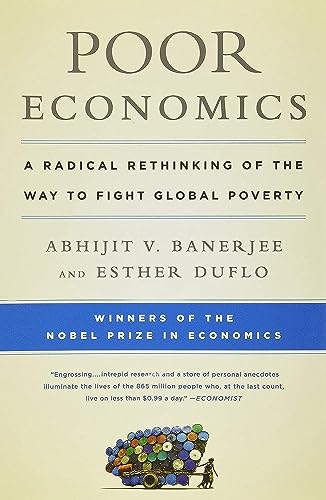
The winners of the Nobel Prize in Economics upend the most common assumptions about how economics works in this gripping and disruptive portrait of how poor people actually live.
Why do the poor borrow to save? Why do they miss out on free life-saving immunizations, but pay for unnecessary drugs? In Poor Economics, Abhijit V. Banerjee and Esther Duflo, two award-winning MIT professors, answer these questions based on years of field research from around the world. Called "marvelous, rewarding" by the Wall Street Journal, the book offers a radical rethinking of the economics of poverty and an intimate view of life on 99 cents a day. Poor Economics shows that creating a world without poverty begins with understanding the daily decisions facing the poor.
"synopsis" may belong to another edition of this title.
About the Author
Abhijit V. Banerjee is the Ford Foundation International Professor of Economics at the Massachusetts Institute of Technology. He lives in Cambridge, Massachusetts.
Esther Duflo is the Abdul Latif Jameel Professor of Poverty Alleviation and Development Economics in the Department of Economics at the Massachusetts Institute of Technology. She lives in Cambridge, Massachusetts.
Together, they are the winners of the 2019 Nobel Prize in Economics and coauthors of Good Economics for Hard Times. They have contributed to outlets as varied as Nature, NPR’s Planet Money, the New York Times, and Econometrica, among others, and are frequent contributors to the French and Indian press.
"About this title" may belong to another edition of this title.
Search results for Poor Economics: A Radical Rethinking of the Way to...

Stock Image
Poor Economics: A Radical Rethinking of the Way to Fight Global Poverty
Seller: World of Books (was SecondSale), Montgomery, IL, U.S.A.
Seller rating 5 out of 5 stars

Paperback. Condition: Good. Billions of government dollars, and thousands of charitable organizations and NGOs, are dedicated to helping the world s poor. But much of their work is based on assumptions that are untested generalizations at best, harmful misperceptions at worst.Abhijit Banerjee and Esther Duflo have pioneered the use of randomized control trials in development economics. Work based on these principles, supervised by the Poverty Action Lab, is being carried out in dozens of countries. Drawing on this and their 15 years of research from Chile to India, Kenya to Indonesia, they have identified wholly new aspects of the behavior of poor people, their needs, and the way that aid or financial investment can affect their lives. Their work defies certain presumptions: that microfinance is a cure-all, that schooling equals learning, that poverty at the level of 99 cents a day is just a more extreme version of the experience any of us have when our income falls uncomfortably low.This important book illuminates how the poor live, and offers all of us an opportunity to think of a world beyond poverty. Seller Inventory # 00108432076
Stock Image
Poor Economics: A Radical Rethinking of the Way to Fight Global Poverty
Seller: World of Books (was SecondSale), Montgomery, IL, U.S.A.
Seller rating 5 out of 5 stars
Paperback. Condition: Fair. Billions of government dollars, and thousands of charitable organizations and NGOs, are dedicated to helping the world s poor. But much of their work is based on assumptions that are untested generalizations at best, harmful misperceptions at worst.Abhijit Banerjee and Esther Duflo have pioneered the use of randomized control trials in development economics. Work based on these principles, supervised by the Poverty Action Lab, is being carried out in dozens of countries. Drawing on this and their 15 years of research from Chile to India, Kenya to Indonesia, they have identified wholly new aspects of the behavior of poor people, their needs, and the way that aid or financial investment can affect their lives. Their work defies certain presumptions: that microfinance is a cure-all, that schooling equals learning, that poverty at the level of 99 cents a day is just a more extreme version of the experience any of us have when our income falls uncomfortably low.This important book illuminates how the poor live, and offers all of us an opportunity to think of a world beyond poverty. Seller Inventory # CIN1610390938A
Stock Image
Poor Economics: A Radical Rethinking of the Way to Fight Global Poverty
Seller: World of Books (was SecondSale), Montgomery, IL, U.S.A.
Seller rating 5 out of 5 stars
Paperback. Condition: Very Good. Billions of government dollars, and thousands of charitable organizations and NGOs, are dedicated to helping the world s poor. But much of their work is based on assumptions that are untested generalizations at best, harmful misperceptions at worst.Abhijit Banerjee and Esther Duflo have pioneered the use of randomized control trials in development economics. Work based on these principles, supervised by the Poverty Action Lab, is being carried out in dozens of countries. Drawing on this and their 15 years of research from Chile to India, Kenya to Indonesia, they have identified wholly new aspects of the behavior of poor people, their needs, and the way that aid or financial investment can affect their lives. Their work defies certain presumptions: that microfinance is a cure-all, that schooling equals learning, that poverty at the level of 99 cents a day is just a more extreme version of the experience any of us have when our income falls uncomfortably low.This important book illuminates how the poor live, and offers all of us an opportunity to think of a world beyond poverty. Seller Inventory # 00109570765
Seller Image
Poor Economics: A Radical Rethinking of the Way to Fight Global Poverty
Seller: Zoom Books Company, Lynden, WA, U.S.A.
Seller rating 5 out of 5 stars
Condition: very_good. Book is in very good condition and may include minimal underlining highlighting. The book can also include "From the library of" labels. May not contain miscellaneous items toys, dvds, etc. . We offer 100% money back guarantee and 24 7 customer service. Seller Inventory # ZBV.1610390938.VG
Stock Image
Poor Economics: A Radical Rethinking of the Way to Fight Global Poverty
Seller: Indiana Book Company, Marion, IN, U.S.A.
Seller rating 5 out of 5 stars
Condition: Acceptable. The cover has been repaired with book tape Ships same or next business day with delivery confirmation. Acceptable condition. Contains highlighting. Expedited shipping available. Seller Inventory # 1000011108353-638
Stock Image
Poor Economics: A Radical Rethinking of the Way to Fight Global Poverty
Seller: Indiana Book Company, Marion, IN, U.S.A.
Seller rating 5 out of 5 stars
Condition: Good. Ships same or next business day with delivery confirmation. Good condition. May or may not contain highlighting. Expedited shipping available. Seller Inventory # 1000011108606-638
Stock Image
Poor Economics: A Radical Rethinking of the Way to Fight Global Poverty
Seller: Evergreen Goodwill, Seattle, WA, U.S.A.
Seller rating 5 out of 5 stars
paperback. Condition: Acceptable. Seller Inventory # mon0000149697
Stock Image
Poor Economics: A Radical Rethinking of the Way to Fight Global Poverty
Seller: World of Books Inc, Montgomery, IL, U.S.A.
Seller rating 4 out of 5 stars

Paperback. Condition: Good. Billions of government dollars, and thousands of charitable organizations and NGOs, are dedicated to helping the world s poor. But much of their work is based on assumptions that are untested generalizations at best, harmful misperceptions at worst.Abhijit Banerjee and Esther Duflo have pioneered the use of randomized control trials in development economics. Work based on these principles, supervised by the Poverty Action Lab, is being carried out in dozens of countries. Drawing on this and their 15 years of research from Chile to India, Kenya to Indonesia, they have identified wholly new aspects of the behavior of poor people, their needs, and the way that aid or financial investment can affect their lives. Their work defies certain presumptions: that microfinance is a cure-all, that schooling equals learning, that poverty at the level of 99 cents a day is just a more extreme version of the experience any of us have when our income falls uncomfortably low.This important book illuminates how the poor live, and offers all of us an opportunity to think of a world beyond poverty. Seller Inventory # CIN1610390938G
Stock Image
Poor Economics: A Radical Rethinking of the Way to Fight Global Poverty
Seller: World of Books Inc, Montgomery, IL, U.S.A.
Seller rating 4 out of 5 stars
Paperback. Condition: Very Good. Billions of government dollars, and thousands of charitable organizations and NGOs, are dedicated to helping the world s poor. But much of their work is based on assumptions that are untested generalizations at best, harmful misperceptions at worst.Abhijit Banerjee and Esther Duflo have pioneered the use of randomized control trials in development economics. Work based on these principles, supervised by the Poverty Action Lab, is being carried out in dozens of countries. Drawing on this and their 15 years of research from Chile to India, Kenya to Indonesia, they have identified wholly new aspects of the behavior of poor people, their needs, and the way that aid or financial investment can affect their lives. Their work defies certain presumptions: that microfinance is a cure-all, that schooling equals learning, that poverty at the level of 99 cents a day is just a more extreme version of the experience any of us have when our income falls uncomfortably low.This important book illuminates how the poor live, and offers all of us an opportunity to think of a world beyond poverty. Seller Inventory # CIN1610390938VG
Stock Image
Poor Economics: A Radical Rethinking of the Way to Fight Global Poverty
Seller: World of Books Inc, Montgomery, IL, U.S.A.
Seller rating 4 out of 5 stars
Paperback. Condition: Fair. Billions of government dollars, and thousands of charitable organizations and NGOs, are dedicated to helping the world s poor. But much of their work is based on assumptions that are untested generalizations at best, harmful misperceptions at worst.Abhijit Banerjee and Esther Duflo have pioneered the use of randomized control trials in development economics. Work based on these principles, supervised by the Poverty Action Lab, is being carried out in dozens of countries. Drawing on this and their 15 years of research from Chile to India, Kenya to Indonesia, they have identified wholly new aspects of the behavior of poor people, their needs, and the way that aid or financial investment can affect their lives. Their work defies certain presumptions: that microfinance is a cure-all, that schooling equals learning, that poverty at the level of 99 cents a day is just a more extreme version of the experience any of us have when our income falls uncomfortably low.This important book illuminates how the poor live, and offers all of us an opportunity to think of a world beyond poverty. Seller Inventory # CIN1610390938A