
Items related to School Library Makerspaces: Grades 6–12
Synopsis
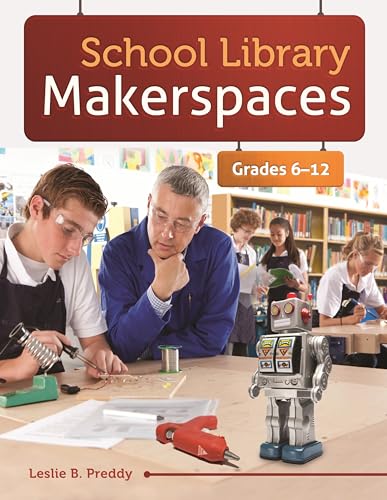
An essential resource for intermediate, middle, and high school librarians that guides the planning, learning, and implementation of a school library makerspace.
The roles of school library media specialists and school libraries themselves are ever changing in response to the needs of the community and the evolution of human thinking, interaction, and learning processes. A school library makerspace can provide patrons with a place for learning, doing, and creating. It offers a location for tackling inventions, fine arts, crafts, industrial technology, hobbies, e-textiles, foodcrafting, DIY couture, fabrication, upcycling, and STEM right in the middle of the information gateway―the library. This book completely explains the makerspace concept and supplies real-world implementation guidance and inexpensive programming ideas that can be used as-is or adapted to suit a specific library or community's needs. Readers will be able to hit the ground running to implement their own makerspace with practical project ideas they can put to use immediately.
"synopsis" may belong to another edition of this title.
About the Author
Leslie B. Preddy is the president of AASL and has been the school librarian at Perry Meridian Middle School in Indianapolis, IN, since 1992.
Reviews
This guide to setting up and justifying a maker space begins promisingly with practical and helpful information on topics such as space and setup, budgeting, necessary materials and equipment and safety rules. Preddy connects the idea of the school library maker space with the AASL Standards for the 21st Century Learner as well as the common core and the STEM movement. She outlines the possibility of rewarding the makers with digital badges and participatory recognition. She also suggests that some of the making should be done in the school community for the greater good, rather than simply the making itself. The bulk of this book is made up of potential projects to do in the school makerspace, ranging from making lip balm and soap to weaving and storyboarding. The focus is on analog rather than digital, with the only tech-based project being creating a video. While this book may be of use to the solo practitioner, it suffers from poor design. Dark and shadowy photographs vary from project to project, cluttered pathfinder pages, as well as the orientation of directions, change from vertical to horizontal for a single project (pg. 110), making the instructions hard to understand. Much of the information contained within is available online in a more attractive format. Indeed, one of the sources sited (makerspace.com) has a free "playbook" available on this very subject.—Stacy Dillon, LREI, New York City
"About this title" may belong to another edition of this title.
Search results for School Library Makerspaces: Grades 6–12

Stock Image
School Library Makerspaces
Published by
Bloomsbury Publishing Plc, 2013
ISBN 10: 1610694945
ISBN 13: 9781610694940
Used
Paperback
Seller: World of Books (was SecondSale), Montgomery, IL, U.S.A.
Seller rating 5 out of 5 stars

Paperback. Condition: Very Good. An essential resource for intermediate, middle, and high school librarians that guides the planning, learning, and implementation of a school library makerspace. Seller Inventory # 00094800878
Stock Image
School Library Makerspaces
Published by
Bloomsbury Publishing Plc, 2013
ISBN 10: 1610694945
ISBN 13: 9781610694940
Used
Paperback
Seller: World of Books (was SecondSale), Montgomery, IL, U.S.A.
Seller rating 5 out of 5 stars
Paperback. Condition: Good. An essential resource for intermediate, middle, and high school librarians that guides the planning, learning, and implementation of a school library makerspace. Seller Inventory # 00106651850
Seller Image
School Library Makerspaces: Grades 6â"12
Seller: Greenworld Books, Arlington, TX, U.S.A.
Seller rating 5 out of 5 stars
Condition: good. Fast Free Shipping â" Good condition. It may show normal signs of use, such as light writing, highlighting, or library markings, but all pages are intact and the book is fully readable. A solid, complete copy that's ready to enjoy. Seller Inventory # GWV.1610694945.G
Stock Image
School Library Makerspaces: Grades 6â"12
Seller: HPB Inc., Dallas, TX, U.S.A.
Seller rating 5 out of 5 stars
paperback. Condition: Very Good. Connecting readers with great books since 1972! Used books may not include companion materials, and may have some shelf wear or limited writing. We ship orders daily and Customer Service is our top priority! Seller Inventory # S_469809216
Stock Image
School Library Makerspaces
Published by
Bloomsbury Publishing Plc, 2013
ISBN 10: 1610694945
ISBN 13: 9781610694940
Used
Paperback
Seller: World of Books Inc, Montgomery, IL, U.S.A.
Seller rating 4 out of 5 stars

Paperback. Condition: Very Good. An essential resource for intermediate, middle, and high school librarians that guides the planning, learning, and implementation of a school library makerspace. Seller Inventory # CIN1610694945VG
Stock Image
School Library Makerspaces: Grades 6â 12
Seller: ThriftBooks-Dallas, Dallas, TX, U.S.A.
Seller rating 5 out of 5 stars
Paperback. Condition: Very Good. No Jacket. May have limited writing in cover pages. Pages are unmarked. ~ ThriftBooks: Read More, Spend Less. Seller Inventory # G1610694945I4N00
Stock Image
School Library Makerspaces: Grades 6â 12
Seller: ThriftBooks-Dallas, Dallas, TX, U.S.A.
Seller rating 5 out of 5 stars
Paperback. Condition: Good. No Jacket. Former library book; Pages can have notes/highlighting. Spine may show signs of wear. ~ ThriftBooks: Read More, Spend Less. Seller Inventory # G1610694945I3N10
Stock Image
School Library Makerspaces: Grades 6â"12
Seller: HPB-Ruby, Dallas, TX, U.S.A.
Seller rating 5 out of 5 stars
paperback. Condition: Very Good. Connecting readers with great books since 1972! Used books may not include companion materials, and may have some shelf wear or limited writing. We ship orders daily and Customer Service is our top priority! Seller Inventory # S_476160138
Stock Image
School Library Makerspaces: Grades 6â"12
Seller: GoldBooks, Denver, CO, U.S.A.
Seller rating 5 out of 5 stars
Paperback. Condition: new. New Copy. Customer Service Guaranteed. Seller Inventory # 84D37_47_1610694945
Stock Image
School Library Makerspaces, Grades 6-12
Seller: GreatBookPrices, Columbia, MD, U.S.A.
Seller rating 5 out of 5 stars
Condition: New. Seller Inventory # 19595677-n