
Items related to Opening the Treasure of the Profound: Teachings on...
Opening the Treasure of the Profound: Teachings on the Songs of Jigten Sumgon and Milarepa - Softcover
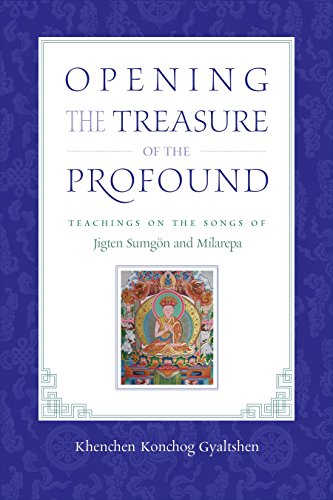
Synopsis
In Tibet, vajra songs became popular when Milarepa gave teachings in that style to his disciples. His example influenced all Tibetan Buddhist schools, particularly the Kagyu lineages. People commonly memorized such songs and sang them with beautiful melodies. But vajra songs are much more than pleasant tunes or ordinary poetry. A vajra song reflects the enlightened mind of its author by encapsulating precisely profound meaning in just a few words. Thus, it can be difficult for the unenlightened to penetrate their meaning.
Khenchen Konchog Gyaltshen learned to sing vajra songs at his mother's knee. Later in life, he learned of their profound meaning from masters of Tibetan Buddhism, which allowed him to finally experience their depth in solitary retreat. Rinpoche brings this tradition into a Western context by translating songs composed by iconic Buddhist figures and explaining them in contemporary terms.
Rinpoche presents the outer and inner meaning of nine vajra songs by Milarepa (ca. 1052–1135) and Jigten Sumgön (1143–1217). He describes the Buddhist path of wisdom and compassion that leads to ultimate peace and happiness, and shows how to develop our mental qualities. In ancient times, these teachings were given to help others reach spiritual maturity. Here, we are invited into the world of transmission from master to disciple in order to discover truth for ourselves—to open the eye of wisdom that reveals the mind that cannot be seen.
"synopsis" may belong to another edition of this title.
About the Author
Khenchen Könchog Gyaltshen, founder of several Buddhist centers worldwide, is respected and beloved as an accomplished scholar, meditation master, teacher, translator, and author. In 2001 he received the high honor of being enthroned as Khenchen (great abbot). He lives in Frederick, Maryland.
"About this title" may belong to another edition of this title.
Search results for Opening the Treasure of the Profound: Teachings on...

Stock Image
Opening the Treasure of the Profound: Teachings on the Songs of Jigten Sumgon and Milarepa
Seller: Orion Tech, Kingwood, TX, U.S.A.
Seller rating 5 out of 5 stars

paperback. Condition: Fair. Seller Inventory # 1611800706-4-34543340
Stock Image
Opening the Treasure of the Profound: Teachings on the Songs of Jigten Sumgon and Milarepa
Seller: HPB Inc., Dallas, TX, U.S.A.
Seller rating 5 out of 5 stars
paperback. Condition: Very Good. Connecting readers with great books since 1972! Used books may not include companion materials, and may have some shelf wear or limited writing. We ship orders daily and Customer Service is our top priority! Seller Inventory # S_480898427
Stock Image
Opening the Treasure of the Profound: Teachings on the Songs of Jigten Sumgon and Milarepa
Seller: mountain, GEORGETOWN, CO, U.S.A.
Seller rating 5 out of 5 stars
paperback. Condition: Acceptable. small piece of cover is missing. has some underlining throughout. softcover book light wear to cover and book edges, has some light reader wear. There is a signature and/or handwriting on the inside front cover. Seller Inventory # mon0000022845
Stock Image
Opening the Treasure of the Profound: Teachings on the Songs of Jigten Sumgon and Milarepa
Seller: Book Outpost, Blawnox, PA, U.S.A.
Seller rating 5 out of 5 stars
Condition: Like New. Never used! Light wear to corners/edges from shelving. Seller Inventory # IRBAKER-3-0017460
Stock Image
Opening the Treasure of the Profound: Teachings on the Songs of Jigten Sumgon and Milarepa [Paperback] Gyaltshen Rinpoche, Khenchen Konchog; Milarepa; Sumgon, Jigten; Chodron, Khenmo Trinlay and Chetsang Rinpoche, Drikung
Seller: Mercantile Books, Columbus, OH, U.S.A.
Seller rating 5 out of 5 stars
paperback. Condition: Very Good. Pages clean, unmarked. Cover has light wear. Shipped promptly with Tracking. 131. Seller Inventory # 33-YHSS-89XH
Seller Image
Opening the Treasure of the Profound : Teachings on the Songs of Jigten Sumgon and Milarepa
Seller: GreatBookPrices, Columbia, MD, U.S.A.
Seller rating 5 out of 5 stars
Condition: As New. Unread book in perfect condition. Seller Inventory # 19778223
Stock Image
Opening the Treasure of the Profound Format: Paperback
Seller: INDOO, Avenel, NJ, U.S.A.
Seller rating 5 out of 5 stars
Condition: As New. Unread copy in mint condition. Seller Inventory # RH9781611800708
Stock Image
Opening the Treasure of the Profound: Teachings on the Songs of Jigten Sumgon and Milarepa
Seller: Powell's Bookstores Chicago, ABAA, Chicago, IL, U.S.A.
Seller rating 5 out of 5 stars
Paperback. Condition: Used-Very Good. Pap. Light shelf-wear. Very sound. Seller Inventory # 1728737
Seller Image
Opening the Treasure of the Profound : Teachings on the Songs of Jigten Sumgon and Milarepa
Seller: GreatBookPrices, Columbia, MD, U.S.A.
Seller rating 5 out of 5 stars
Condition: New. Seller Inventory # 19778223-n
Stock Image
Opening the Treasure of the Profound Format: Paperback
Seller: INDOO, Avenel, NJ, U.S.A.
Seller rating 5 out of 5 stars
Condition: New. Brand New. Seller Inventory # 9781611800708