
Items related to The Duino Elegies
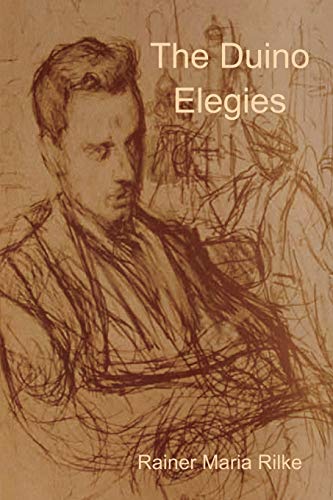
Synopsis
The Duino Elegies (German: Duineser Elegien) are a collection of ten elegies written by the Bohemian-Austrian poet Rainer Maria Rilke (1875-1926). Rilke, who is "widely recognized as one of the most lyrically intense German-language poets," began writing the elegies in 1912 while a guest of Princess Marie von Thurn und Taxis (1855-1934) at Duino Castle, near Trieste on the Adriatic Sea. The poems, 859 lines long in total, were dedicated to the Princess upon their publication in 1923. During this ten-year period, the elegies languished incomplete for long stretches of time as Rilke suffered frequently from severe depression--some of which was caused by the events of World War I and being conscripted into military service. Aside from brief episodes of writing in 1913 and 1915, Rilke did not return to the work until a few years after the war ended. With a sudden, renewed inspiration--writing in a frantic pace he described as a "boundless storm, a hurricane of the spirit"--he completed the collection in February 1922 while staying at Château de Muzot in Veyras, in Switzerland's Rhone Valley. After their publication in 1923 and Rilke's death in 1926, the Duino Elegies were quickly recognized by critics and scholars as his most important work. (wikipedia.org)
"synopsis" may belong to another edition of this title.
From the Publisher
David Oswald (b. 1953) is finishing his training in analytical psychology at the C.G. Jung Institute in Zrich, Switzerland, where he has been living for the past eight years. Raised in Owatonna, Minnesota, he has degrees in German from the University of Kansas and Mathematics from the University of Minnesota.
From the Back Cover
Named for the Castle of Duino, on a rocky headland of the Adriatic, the Duino Elegies speaks in a voice that is both intimate and majestic on the mysteries of human life and our attempt, in the words of the translator, 'to use our self-consciousness to some advantage: to transcend, through art and the imagination, our self-deception and our fear.'
"About this title" may belong to another edition of this title.
Search results for The Duino Elegies

Seller Image
The Duino Elegies
Seller: GreatBookPrices, Columbia, MD, U.S.A.
Seller rating 5 out of 5 stars

Condition: As New. Unread book in perfect condition. Seller Inventory # 29004277
Seller Image
The Duino Elegies
Seller: GreatBookPrices, Columbia, MD, U.S.A.
Seller rating 5 out of 5 stars
Condition: New. Seller Inventory # 29004277-n
Seller Image
The Duino Elegies
Seller: Rarewaves.com USA, London, LONDO, United Kingdom
Seller rating 5 out of 5 stars
Paperback. Condition: New. Seller Inventory # LU-9781618952288
Buy New
US$ 18.23
Free Shipping
Ships from United Kingdom to U.S.A.
Ships from United Kingdom to U.S.A.
Quantity: Over 20 available
Stock Image
The Duino Elegies
Print on DemandSeller: PBShop.store US, Wood Dale, IL, U.S.A.
Seller rating 5 out of 5 stars
PAP. Condition: New. New Book. Shipped from UK. THIS BOOK IS PRINTED ON DEMAND. Established seller since 2000. Seller Inventory # L0-9781618952288
Seller Image
The Duino Elegies
Seller: Goodwill Southern California, Los Angeles, CA, U.S.A.
Seller rating 5 out of 5 stars
Condition: good. Paperback Book. Seller Inventory # LACV.1618952285.G
Stock Image
The Duino Elegies
Print on DemandSeller: PBShop.store UK, Fairford, GLOS, United Kingdom
Seller rating 5 out of 5 stars
PAP. Condition: New. New Book. Delivered from our UK warehouse in 4 to 14 business days. THIS BOOK IS PRINTED ON DEMAND. Established seller since 2000. Seller Inventory # L0-9781618952288
Buy New
US$ 18.90
US$ 4.40 shipping
Ships from United Kingdom to U.S.A.
Ships from United Kingdom to U.S.A.
Quantity: Over 20 available
Stock Image
The Duino Elegies
Print on DemandSeller: Majestic Books, Hounslow, United Kingdom
Seller rating 4 out of 5 stars

Condition: New. Print on Demand pp. 38. Seller Inventory # 378091279
Buy New
US$ 16.78
US$ 8.70 shipping
Ships from United Kingdom to U.S.A.
Ships from United Kingdom to U.S.A.
Quantity: 4 available
Stock Image
The Duino Elegies
Print on DemandSeller: Books Puddle, Woodside, NY, U.S.A.
Seller rating 4 out of 5 stars
Condition: New. Print on Demand pp. 38. Seller Inventory # 26385779920
Stock Image
The Duino Elegies
Print on DemandSeller: Biblios, Frankfurt am main, HESSE, Germany
Seller rating 4 out of 5 stars
Condition: New. PRINT ON DEMAND pp. 38. Seller Inventory # 18385779930
Buy New
US$ 18.49
US$ 11.16 shipping
Ships from Germany to U.S.A.
Ships from Germany to U.S.A.
Quantity: 4 available
Stock Image
The Duino Elegies
Seller: Ria Christie Collections, Uxbridge, United Kingdom
Seller rating 5 out of 5 stars
Condition: New. In English. Seller Inventory # ria9781618952288_new
Buy New
US$ 18.88
US$ 12.53 shipping
Ships from United Kingdom to U.S.A.
Ships from United Kingdom to U.S.A.
Quantity: Over 20 available