
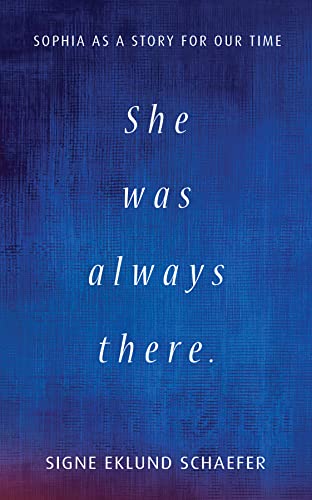
Items related to She Was Always There: Sophia as a Story for Our Time
Synopsis
“We should face that world not with our opinions but with our questions, indeed in a questioning mood and attitude.” ― Rudolf Steiner, The Fifth Gospel
“Who, or perhaps what, is she?” Signe Eklund Schaefer poses this question as she leads us into a heartfelt exploration of the great mystery that is Sophia. Her book does not take an academic or theological path but one that is personal and full of warmth and genuine interest in discovery that goes toward living reality, well beyond mere names and fixed ideas. As Schaefer says, she decided to “forego the idea of a straightforward narrative and instead interweave musings, poems, saved quotations, and other assorted notes from my many years of living with questions about and to her.” The author tells us,
“Questions of inner growth, of spiritual striving, of how to bear the suffering in the world without going under, and perhaps most of all, of how to love, often present themselves surrounded by veils. In acknowledging a question, the veil may begin to shift. Our questions matter; bringing them to consciousness, exploring them with others, waiting with an open heart for the spirit to speak―this is the ongoing work of unveiling.”Sophia is rightly seen as the living, moving being of universal wisdom and the archetypal feminine, but Schaefer helps us to see her as more―as an expression of what humanity must rightfully become.
“Another world is not only possible, she is on her way. On a quiet day, I can hear her breathing.” ― Arundhati Roy, author, The God of Small Things"synopsis" may belong to another edition of this title.
About the Author
Signe Schaefer has been a long-time adult educator and was for many years the Director of Foundation Studies at Sunbridge College. She was the founding Director of a professional development training in Biography and Social Art. Since retiring, she has published three books: Why on Earth? Biography and the Practice of Human Becoming, I Give You My Word: Women’s Letters as Life Support, and most recently, She Was Always There – Sophia as a Story for our Time. She also co-authored Ariadne’s Awakening: Taking up the Threads of Consciousness and co-edited More Lifeways. A mother, grandmother, and great-grandmother, she now lives in Great Barrington, MA, with her husband Christopher.
Excerpt. © Reprinted by permission. All rights reserved.
Chapter 1
Musings on Sophia (excerpt)
We must carefully distinguish between object and name. We must not allow ourselves to be deceived into thinking that by giving a certain name to a being we have at the same time experienced and felt this being in the right way.
―Rudolf Steiner
This is a book devoted to Sophia. Readers have a right to ask: Who, or perhaps what, is she? It is the difficulty of answering that question that has kept me from writing for many years, except in momentary musings that might catch a brief glimpse of her presence. Any concise answer about her feels inadequate. She is a great wisdom being who embraces human becoming in all its striving and suffering. She is known as a divine feminine reality from before the division into feminine and masculine. She is an archetypal maternal being bearing all that was, and is, and will be. And now she seems to be approaching our ongoing human story in new ways, calling us to a new step in our awakening consciousness.
It is difficult to talk about spiritual being(s) in our materialistic age. To some it can seem odd, or quaint, or even deluded. And yet, naming the reality around us matters; it is part of our human legacy. In everyday life, we ask quite naturally: What flower is that? What is the name of that river we floated down years ago? What is your baby’s name? We are not satisfied to remain with just flower, river, baby―much less to refer simply to a generic thing.
For as long as I can remember, I have had a feeling for―I would even say I have known―intangible sources of inspiration, comfort, and challenge. I know I am not alone with this experience. Raised outside of any religious tradition, I had no names for these realities, though I never doubted them. One I called “the Lady.” I do not remember when this started, but since I was young “she” was there, a knocking presence in my heart, an invisible part of my consciousness, wordlessly offering encouragement and support.
When I was twenty and in my last year of college, I heard about the Austrian scientist and spiritual teacher Rudolf Steiner and the work he called Anthroposophia, or in English, Anthroposophy. Something resounded deep within me. Later, as I began to read his descriptions of different spiritual beings, I remember thinking, “Oh, so this is what that is called.” I began to feel the possibility of discovering names for some of my inner experiences.
It did not take long for me to see how my deepening study of Anthroposophy aligned with my growing interest in the women’s movement―this was in the late 1960s and early ’70s. In particular, I found myself drawn to a divine feminine presence that both people interested in Steiner and women researching early matriarchal influences would sometimes refer to as Sophia. I learned through exploring different mythologies that this great wisdom being had borne many other names throughout the ages―The Great Mother, Isis, Tiamet, Gaia, Mary, Kuan Yin, Aditi, Ala, Skywoman, to mention only a few.
Names can clothe realities and give them strength, but they can also become binding. Identification can bring attention and understanding, but we can also fall asleep into what someone is called and forget that there is a living being who bears that name. We can rest too easily in fixed images. The wonderful thing about the word being―as in spiritual being or human being―is that it is not only a noun, the name of a particular entity, but it is also a verb, suggesting ongoing becoming.
When I think of spiritual beings, I remember a sentence by Rudolf Steiner in which he states, “Everyone resembles the god he (she/they) understands.” When people try to understand an invisible reality for which they have a living feeling, it is perhaps inevitable that what lives in their imaginations from the sense world will be brought to bear on their portrayals of divine beings. The resemblance goes both ways. Part of the dilemma of our materialistic times is that, when we have no understanding of a world beyond what can be measured, weighed and calculated, we are left with little to resemble that offers inspiration beyond what we already know about our sense-based selves.
I am aware that some readers will enter easily into a discussion of spiritual beings, while others may balk at this invitation. I can understand a resistance to the use of names that carry the weight of religious tradition that has become clouded through the centuries. And yet, these traditions, like the ancient myths before them, each speak a certain truth―however limited or one-sided―about how people at different times and in different parts of the world understood themselves and their relationship to what they perceived as a divine world.
"About this title" may belong to another edition of this title.
Search results for She Was Always There: Sophia as a Story for Our Time

Stock Image
She Was Always There: Sophia as a Story for Our Time
Seller: ThriftBooks-Dallas, Dallas, TX, U.S.A.
Seller rating 5 out of 5 stars

Paperback. Condition: As New. No Jacket. Pages are clean and are not marred by notes or folds of any kind. ~ ThriftBooks: Read More, Spend Less. Seller Inventory # G1621483312I2N00
Stock Image
She Was Always There: Sophia as a Story for Our Time
Seller: Books From California, Simi Valley, CA, U.S.A.
Seller rating 4 out of 5 stars

paperback. Condition: Very Good. Clean, unmarked copy. Seller Inventory # mon0003236314
Stock Image
She Was Always There: Sophia as a Story for Our Time
Seller: GreatBookPrices, Columbia, MD, U.S.A.
Seller rating 5 out of 5 stars
Condition: New. Seller Inventory # 45996781-n
Stock Image
She Was Always There
Seller: PBShop.store US, Wood Dale, IL, U.S.A.
Seller rating 5 out of 5 stars
PAP. Condition: New. New Book. Shipped from UK. Established seller since 2000. Seller Inventory # GB-9781621483311
Seller Image
She Was Always There
Published by
Anthroposophic Press Inc, US, 2023
ISBN 10: 1621483312
ISBN 13: 9781621483311
New
Paperback
Seller: Rarewaves USA, HEBRON, KY, U.S.A.
Seller rating 5 out of 5 stars
Paperback. Condition: New. Seller Inventory # LU-9781621483311
Stock Image
She Was Always There: Sophia as a Story for Our Time
Seller: GreatBookPrices, Columbia, MD, U.S.A.
Seller rating 5 out of 5 stars
Condition: As New. Unread book in perfect condition. Seller Inventory # 45996781
Stock Image
She Was Always There: Sophia as a Story for Our Time
Published by
SteinerBooks, Inc 2023-06-02, 2023
ISBN 10: 1621483312
ISBN 13: 9781621483311
New
Paperback
Seller: Chiron Media, Wallingford, United Kingdom
Seller rating 5 out of 5 stars
Paperback. Condition: New. Brand new book, sourced directly from publisher. Dispatch time is 4-5 days from our warehouse. Book will be sent in robust, secure packaging to ensure it reaches you securely. Seller Inventory # 6666-BSC-9781621483311
Buy New
US$ 17.71
US$ 5.96 shipping
Ships from United Kingdom to U.S.A.
Ships from United Kingdom to U.S.A.
Quantity: 11 available
Seller Image
She Was Always There
Published by
Anthroposophic Press Inc, US, 2023
ISBN 10: 1621483312
ISBN 13: 9781621483311
New
Paperback
Seller: Rarewaves.com USA, London, LONDO, United Kingdom
Seller rating 5 out of 5 stars
Paperback. Condition: New. Seller Inventory # LU-9781621483311
Buy New
US$ 23.85
Free Shipping
Ships from United Kingdom to U.S.A.
Ships from United Kingdom to U.S.A.
Quantity: 1 available
Stock Image
She Was Always There (Paperback)
Published by
Anthroposophic Press Inc, New York, 2023
ISBN 10: 1621483312
ISBN 13: 9781621483311
New
Paperback
Seller: Grand Eagle Retail, Bensenville, IL, U.S.A.
Seller rating 5 out of 5 stars
Paperback. Condition: new. Paperback. "We should face that world not with our opinions but with our questions, indeed in a questioning mood and attitude." -- Rudolf Steiner, The Fifth Gospel"Who, or perhaps what, is she?" Signe Eklund Schaefer poses this question as she leads us into a heartfelt exploration of the great mystery that is Sophia. Her book does not take an academic or theological path but one that is personal and full of warmth and genuine interest in discovery that goes toward living reality, well beyond mere names and xed ideas. As Schaefer says, she decided to "forego the idea of a straightforward narrative and instead interweave musings, poems, saved quotations, and other assorted notes from my many years of living with questions about and to her." The author tells us, "Questions of inner growth, of spiritual striving, of how to bear the suffering in the world without going under, and perhaps most of all, of how to love, often present themselves surrounded by veils. In acknowledging a question, the veil may begin to shift. Our questions matter; bringing them to consciousness, exploring them with others, waiting with an open heart for the spirit to speak--this is the ongoing work of unveiling."Sophia is rightly seen as the living, moving being of universal wisdom and the archetypal feminine, but Schaefer helps us to see her as more--as an expression of what humanity must rightfully become."Another world is not only possible, she is on her way. On a quiet day, I can hear her breathing." -- Arundhati Roy, author, The God of Small Things Shipping may be from multiple locations in the US or from the UK, depending on stock availability. Seller Inventory # 9781621483311
Stock Image
She Was Always There
Seller: PBShop.store UK, Fairford, GLOS, United Kingdom
Seller rating 5 out of 5 stars
PAP. Condition: New. New Book. Shipped from UK. Established seller since 2000. Seller Inventory # GB-9781621483311
Buy New
US$ 21.89
US$ 4.36 shipping
Ships from United Kingdom to U.S.A.
Ships from United Kingdom to U.S.A.
Quantity: 2 available