Items related to Flatland (Illustrated)
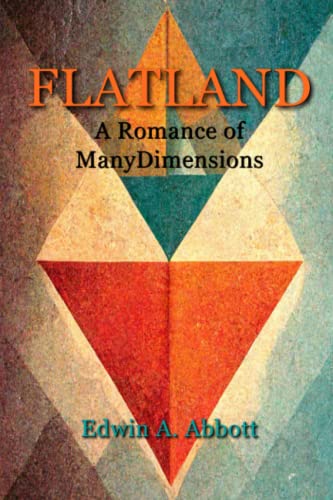

A classic of scientific and mathematical fiction, Flatland is the story of a Square as he journeys through new dimensions. He experiences Spaceland (a universe with three dimensions), Lineland (a universe of one dimension), and Pointland ( a universe no dimensions). This work of literature looks at the world through a purely mathematical lens to help us better understand the concepts of dimension as well as the sociological implications of hierarchies. Finally, the Square dares to dream of a land with four dimensions, an incredible idea which gets him banished from Spaceland.
"synopsis" may belong to another edition of this title.
Review:
Flatland is one of the very few novels about math and philosophy that can appeal to almost any layperson. Published in 1880, this short fantasy takes us to a completely flat world of two physical dimensions where all the inhabitants are geometric shapes, and who think the planar world of length and width that they know is all there is. But one inhabitant discovers the existence of a third physical dimension, enabling him to finally grasp the concept of a fourth dimension. Watching our Flatland narrator, we begin to get an idea of the limitations of our own assumptions about reality, and we start to learn how to think about the confusing problem of higher dimensions. The book is also quite a funny satire on society and class distinctions of Victorian England.
From the Back Cover:
Flatland (1884) is an influential mathematical fantasy that simultaneously provides an introduction to non-Euclidean geometry and a satire on the Victorian class structure, issues of science and faith, and the role of women. A classic of early science fiction, the novel takes place in a world of two dimensions where all the characters are geometric shapes. The narrator, A Square, is a naïve, respectable citizen who is faced with proof of the existence of three dimensions when he is visited by a sphere and is forced to see the limitations of his world.
The introduction to this Broadview Edition provides context for the book’s references to Victorian culture and religion, mathematical history, and the history of philosophy. The appendices contain contemporary reviews; extracts from the work of fellow mathematical fantasy writer/mathematician Charles Hinton; Hermann von Helmboltz’s “The Axioms of Geometry” (1870); and autobiographical passages from Abbott’s The Kernel and the Husk (1886).
"About this title" may belong to another edition of this title.
- PublisherMalachite Quills Publishing
- Publication date2012
- ISBN 10 1623750318
- ISBN 13 9781623750312
- BindingPaperback
- Number of pages126
- Rating
Buy New
Learn more about this copy
US$ 8.80
Shipping:
FREE
Within U.S.A.
Other Popular Editions of the Same Title
Top Search Results from the AbeBooks Marketplace
Stock Image
Flatland (Illustrated)
Published by
Malachite Quills Publishing
(2012)
ISBN 10: 1623750318
ISBN 13: 9781623750312
New
Softcover
Quantity: 1
Seller:
Rating

Book Description Condition: New. Book is in NEW condition. Seller Inventory # 1623750318-2-1
Buy New
US$ 8.80
Convert currency
Stock Image
Flatland (Illustrated)
Published by
Malachite Quills Publishing
(2012)
ISBN 10: 1623750318
ISBN 13: 9781623750312
New
Softcover
Quantity: 1
Seller:
Rating
Book Description Condition: New. New! This book is in the same immaculate condition as when it was published. Seller Inventory # 353-1623750318-new
Buy New
US$ 8.81
Convert currency
Stock Image
Flatland (Illustrated)
Published by
Malachite Quills Publishing
(2012)
ISBN 10: 1623750318
ISBN 13: 9781623750312
New
paperback
Quantity: 1
Seller:
Rating
Book Description paperback. Condition: New. Seller Inventory # 1623750318-11-31309751
Buy New
US$ 8.84
Convert currency
Stock Image
Flatland (Illustrated)
Published by
Malachite Quills Publishing
(2012)
ISBN 10: 1623750318
ISBN 13: 9781623750312
New
Paperback
Quantity: 1
Seller:
Rating
Book Description Paperback. Condition: Brand New. illustrated edition. 126 pages. 9.00x6.00x0.29 inches. In Stock. Seller Inventory # zk1623750318
Buy New
US$ 12.38
Convert currency
Stock Image
Flatland (Illustrated)
Published by
Malachite Quills Publishing
(2012)
ISBN 10: 1623750318
ISBN 13: 9781623750312
New
Paperback
Quantity: 1
Seller:
Rating
Book Description Paperback. Condition: new. New Copy. Customer Service Guaranteed. Seller Inventory # think1623750318
Buy New
US$ 68.81
Convert currency