
Items related to Meditations on Creation in an Era of Extinction (Ecology...
Synopsis
**2024 Australian Christian Book of the Year- Shortlist**
This book practices an ancient form of theological reflection―the hexameron―on creation and attends to current concerns for the wellbeing of creation amid changing climates, anthropogenic pollution, and, possibly, the next mass extinction event. Rigby takes each day of the Genesis 1 creation narrative as the launching point for critical theological engagement with early writers like Basil of Caesarea and Ambrose of Milan, with contemporary concerns about the state of our planet’s well-being, and with faith-based initiatives from around the world that are contributing to the healing and restoration of the world. By attending to planetary well-being, Rigby’s unique and striking approach to the hexameron captures both the devastation of current anthropogenic climate change and the precious hope for salvific healing in Shalom.
"synopsis" may belong to another edition of this title.
About the Author
Kate Rigby is Alexander von Humboldt Professor of Environmental Humanities, University of Cologne, where she directs the research hub Multidisciplinary Environmental Studies in the Humanities (MESH). Her interdisciplinary research interests include environmental literary and cultural studies, environmental philosophy, and religion and ecology.
From the Back Cover
US$36.00
RELIGION / Christian Theology / General
RELIGION / Religion & Science
RELIGION / Christian Rituals & Practice / General
Meditations on Creation in an Era of Extinction
Ecology & Justice Series
Cover design: Diane Mastrogiulio
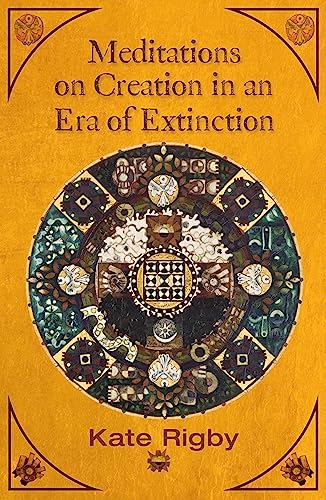
Cover art: Leonard French, Seven Days of Creation: The Seventh Day. Used with permission.
Cover photo: David Paterson, Dorian Photographics
[Orbis Logo]
ISBN 978-1-62698-550-6
Excerpt. © Reprinted by permission. All rights reserved.
Introduction
“How long will the land mourn?”
Jer. 12:4
The Road to Kunming
In April 2020, villagers in the southern Chinese province of Yunan were amazed by the appearance of a herd of elephants in their midst. These itinerant elephants, it turns out, had ventured forth sometime the previous month from the Xishuangbanna National Nature Reserve around sixty miles farther south on the border with Laos and Myanmar, and they were still set on heading north. By the time they reached Yuanjiang County, over 250 miles from the reserve, a couple had turned back, but more had been born. Traveling night and day, nourishing themselves on pilfered crops, raided grain stores, and subsequently, gifted food put out to steer them away from human habitations, in early June 2021 they arrived, stressed and exhausted, on the edge of the provincial capital Kunming, a city of over eight million residents nearly four hundred miles from their home. There, they were finally intercepted and coaxed to turn around to retrace their weary steps to the reserve.
By the time they entered the final leg of their homeward trek in August, China’s by now world-famous wandering elephants had consumed a whopping 180 tons of corn, bananas, and other food laid out for them; they had caused 150,000 people to be temporarily evacuated from their homes; and their damages bill was variously estimated at around $1 million.1 They had also focused the world’s attention on the precarious plight of Asian elephants and other endangered animals during the very year in which the UN’s fifteenth conference of the Parties to the Convention on Biological Diversity (COP 15) was due to meet in China. As it happened, the conference had to be postponed, first for one year, and then another, and was eventually relocated to Montreal, where it finally took place in December 2022. But COP 15 was originally to have been held in Kunming, and at the inaugural session held in October 2021, a short-film made by the Yunnan government TV station was screened, which celebrated the trek of the Short-Trunk Clan as a successful instance of human-animal conflict resolution.2
While Asian elephants are known to roam, none from the Xishuangbanna Reserve had ever traveled so far out of their terrain into more densely populated areas and toward a cooler climatic zone for which they are ill-suited. It would surely be unduly anthropomorphic to assume that this herd, led by one or more matriarchs, as is the way with elephants, had a specific destination in mind. Looking on remotely from my own human perspective, however, and with an eye for symbolism, their trek struck me as something like a protest march, perhaps even a pilgrimage of sorts: one that cried out for our attention. It was as if these elephants had come to Kunming as emissaries of the wider communion of creatures: making their presence felt at the city gates in the lead-up to the crucial conference at which the assembled delegates were to thrash out urgently needed measures to arrest the cascade of extinctions that is accelerating around the world as biomes are destroyed, the planet warms, and the abundance and diversity of Earth’s freeliving animals, plants, and fungi continue to dwindle.
Meanwhile, another entity was on the move. It too had set out from a location in China, probably the infamous Huanan Seafood Wholesale Market in Wuhan, Hubei Province. By the time the elephants from southern Yunan had started heading north, the novel coronavirus identified by Chinese medical authorities in January 2020 had gone global. And by the time they arrived back in the reserve, it had been decided to defer the major face-to-face meeting of COP 15 yet another year.
How are we to hear what Pope Francis has called the “cry of the earth” when we are enclosed within exclusively human worlds of concern, communication, and, all too often, conflict?3 How are we to apprehend the Earth’s cry when ever more of us live in proliferating cities that are remote from the places, people, and other beings who provide for our pressing daily needs? This is, to be sure, no easy feat for most of us. But once you have attuned your senses, opened your heart, and enlarged your mind, you will begin to hear this cry issuing ever more urgently from near and far, and in a variety of keys and media. The wandering elephants of Yunan might not have been intending to make their voices heard at COP 15: but their epic journey was, on one level, a cry of distress on the part of the elephants and a wake-up call for humans. Yet the story of their quest offers inspiration as well, for it also bears witness to the will to survive, the potential for ecological recovery, and the possibility of social reorientation.
Asian elephants have been doing it tough. Found across a variety of habitats, including grasslands, forests, and scrublands, from altitudes of nearly ten thousand feet down to sea level, they once ranged across about five million square miles, from the Middle East along the Iranian coast into the Indian subcontinent and China and beyond into Southeast Asia as far as Borneo. Thanks to the seeds that they distribute over large distances in their dung, they play an important role in maintaining plant diversity and shaping ecosystems. While the western populations in the Middle East had probably become extinct around 100 BCE, with those in China already largely eliminated some six hundred years ago, it is only in recent decades that increased human encroachment on their homeplaces and disruption of their lifeways―exacerbated by the illegal trade in their body parts―especially tusks and skin, has landed the Asian elephant on the Red List of Endangered Species of the International Union for Conservation of Nature (IUCN). Meanwhile, fragmentation of their habitat is bringing them into more frequent conflict with local communities, leading to human crop and property damage, injuries, and even deaths, in turn inciting revenge killing of elephants.4
Once widely distributed across southern China, by the mid1990s fewer than two hundred Asian elephants survived there, principally in the Meng yang section of the Xishuangbanna Reserve. Within this refuge, their population has begun to recover, and although they still only constitute less than 1 percent of the global population, free-living Asian elephants are now thought to number nearly three hundred individuals in China. Thanks to strictly enforced legal protections, the growing Mengyang population has also been recolonizing neighboring areas. During this same period, however, their forested habitat has declined by some 15 percent, while conservation policies favoring a denser canopy cover in that which remains have effectively reduced their food supply by shading out their preferred forage plants. Add to this a severe drought, almost certainly linked to climate change, and it appears likely that the troupe that headed to Kunming, like that which dispersed south from Mengyang around the same time, were in search of new territory to support their growing population. In a further twist to this tale, elephant experts surmise that it was the lull in human activity occasioned by the pandemic that initially lured them further afield.5
The case of the Kunming elephants, then, exemplifies many of the contradictions that currently beset human interrelationships with other living kinds. Their quest for new territory testifies, on the one hand, to a conservation success story, and, on the other, to ongoing pressure on wildlife habitat, not only from the expansion of agricultural, urban, and industrial land use, but also, increasingly, from human-caused global heating. Moreover, the expanding elephant population, not unlike that of wolves in parts of Europe and North America, in combination with habitat fragmentation, is leading to more frequent altercations with humans, with negative outcomes for all concerned. As a consequence of the global media attention garnered by their quest for new food sources, replete with endearing images of afternoon naps, mud baths, and play fights, the Kunming elephants made an engaging case for the need to make space for wildlife, while also ensuring protection for human communities who could be adversely affected by their potentially dangerous other-than-human neighbors: a case, that is, for protocols and practices for multispecies coexistence, entailing attitudinal changes as well as pragmatic measures.
Meanwhile, the fact that humans were holed up indoors to reduce the spread of COVID-19 evidently provided welcome affordances for these dispersing elephants, as it did for many freeliving animals around the world. Yet the emergence of the virus itself, arising as it appears to have done from a situation in which trafficked wildlife and domesticated animals were being held in cruelly cramped conditions awaiting consumption, also testifies to the hazards that are occasioned by human exploitation of other creatures and their environs. For while many politicians have found it convenient to demonize the virus, if we trace it back to its source, we discover, Oedipus-like, that the true culprit is our own kind. From this perspective, the COVID-19 pandemic is another manifestation of Earth’s cry―one that we ignore at our peril.
My goal in this book is to amplify Earth’s cry, as well as disclosing its entwinement with what Pope Francis calls the “cry of the poor”: the many ways, in other words, in which the diminishment of Earth’s other-than-human kinds and wildlife population numbers, the degradation of our shared earthly environs, and the disordering of the climate are entangled with forms of social exclusion, domination, and inequity. At the same time I uphold the voices of those who are seeking to redress these ills, opening pathways toward more just, compassionate, and life-affirming patterns of coexistence with one another and our fellow earthlings within the wider communion of creatures.
Creation Stories:
Revisiting the “Six Days Work”
One of the peculiarities of human beings is that we evidently pose a problem to ourselves. I am not just talking about our tendency to make trouble for ourselves (along with many others besides)― although that is also part of the picture. What I am referring to here, rather, is our propensity to puzzle over our very existence. Why are we here? What are we good for? What is our purpose? How should we relate to others? We might not be alone in this. As far as we can tell, though, humans are the only earthlings who are inclined to try to answer these questions with stories that get passed down from generation to generation―whether in oral, pictorial, or written form, getting told in new media, accreting new meanings, and shaping the self-understanding of entire cultures until such time as they are felt to no longer ring true and so lose their grip as an explanatory framework.
These narratives commonly take the form of creation stories. Unlike scientific accounts, such stories are concerned not so much with the physical processes of cosmogenesis as with questions of meaning, value, and purpose―questions that properly lie outside the remit of the natural sciences. In that respect, they are not rendered redundant by advances in scientific knowledge; science on its own is no good substitute for these older tales, although it might well inform how we categorize and interpret them. Traditional creation stories are wondrously many and varied, but they share one crucial feature: they all imagine human beings being brought into a world that was not of our own making.
What are we to make of such creation narratives in an epoch when that is no longer entirely the case: an epoch that geologists― not unproblematically―have named the “Anthropocene,” in which the consequences of human activities are likely to define Earth’s geology for millennia into the future?
Now, lest we fall prey to hubris, it is important to note that children being born today still find themselves in a wider world that precedes and exceeds human fashioning: one in which a supervolcanic eruption, for instance, or a massive meteor strike could put all the changes that human societies have wrought on this one planet very much in the shade. Yet these human-made changes run deep: they are extremely wide-ranging and mind-bogglingly longterm. Among them are the proliferation of novel materials, such as aluminum, steel, plastic, and concrete, with a corresponding diminution of naturally occurring land cover; a massive increase in the prevalence of humans and their domesticated plants and animals, and a startling decrease in other-than-human free-living species; and the mushrooming circulation of sundry potentially pesky chemicals, notably radioactive plutonium from nuclear reactions, phosphorus and nitrogen from chemical fertilizers, and carbon dioxide and methane, primarily from the combustion of fossil fuels, but also, in the case of the latter, from the aforementioned livestock.6.
For the most part, these industrial-era Earth system alterations, which began in England in the late eighteenth century but accelerated big-time from the 1950s, are also not good―at least not from the perspective of most living organisms, including ourselves. Just how bad they are shows up most clearly in two sets of statistics: extinction rates and economic disparity. The former charts the precipitous decline in the abundance and diversity of free-living animals, plants, and fungi. The extinction rate cannot be charted precisely, because most of the humbler kinds of critters, such as insects and soil microbiota, have been studied a lot less than more charismatic ones like birds and mammals. It is highly likely that many species are disappearing before they have even been identified by modern science. Nonetheless, the current estimate is that, in addition to those that have already been exterminated at human hands, albeit largely unintentionally, around 25 percent of Earth’s living kinds (totaling at least one million species) are currently endangered, largely as a consequence of habitat destruction, pollution, and overexploitation, but increasingly also due to climate change. Shockingly, wildlife populations have evidently plummeted by nearly 70 percent since the 1970s.7 While it is encouraging that the Montreal in the absence of effective policies to arrest climate change and redress unsustainable agriculture, fisheries, and forestry.8
The second set of statistics relating to economic disparity, which persists between regions of the Global South and the old industrial heartlands of the Global North and is actually growing in some of those nations (especially in the United States, Russia, and India),9 shows clearly that the benefits and costs of the anthropogenic alteration of the planet are extremely unequally shared. Moreover, it is apparent that those who have contributed least to cause these changes are thus far suffering first and worst from their adverse consequences. This is dramatically so in the case of climate change, which, above 1.5 degrees of global temperature rise, is set to submerge several Pacific Island nations with some of the lowest per capita carbon emissions in the world. Meanwhile, the increase in the frequency and intensity of extreme weather events, which are now beginning to hit home in the old industrial heartlands of the Global North, are causing carnage in many areas of the Global South, where people’s existence is frequently precarious for other reasons as well.10 Other forms of environmental adversity are also inequitably distributed, with those of lower socioeconomic standing, for example, more likely to be afflicted by various forms of pollution.11 Nor are the impacts of biodiversity loss felt equally. Extinction is an inherently bio-cultural phenomenon that is “experienced, resisted, measured, enunciated, performed and narrated” in a variety of ways by different communities in different contexts.12 For those who have strong affective ties, material dependence, or traditional kinship relations with specific species in decline, their dwindling and disappearance is bound to be particularly devastating.
For this reason I find the coinage “Anthropocene” misleading since it invokes an amorphous “humanity,” masking salient differences among humans in terms of both culpability for, and vulnerability to, the earth system changes to which it refers. What is revealed in both of these sets of statistics, I believe, are the profound injustices inherent in a social order in which the efforts of a minority of humans to make the world more congenial to themselves (or so they imagined) has rendered it a whole lot less congenial for the majority of humans (including future generations), together with a significant proportion of our fellow earthlings of other kinds. The “cry of the Earth” and the “cry of the poor” are not one and the same, but they are intimately interlinked with one another From this perspective of unevenly shared planetary imperilment, then, I revisit in this book one of the historically most influential creation narratives: the account of the six days of creation from Genesis 1. This text was taken from the Hebrew sacred Scripture known as Bereshit, “In the beginning,” in the Jewish Torah. However variously interpreted, it remains part of the religious inheritance of almost one-third of the world’s human population today. Moreover, aspects of this creation story― notably, the exalted place that it accords humans in relation to our fellow creatures―continues to resonate in secular assumptions that privilege human knowledge, agency, and interests over those of other beings.
There are now two millennia of commentaries on this narrative within both the Jewish and Christian traditions. In this book I respond primarily to the latter, largely because I lack the expertise to do justice to the former, and also because it is the Christian take on creation that has had such a powerful influence on the dominant culture of the Western world.
In form, this book is inspired in particular by an ancient and, until recently, long-neglected genre of Christian literature that became known, in Greek, as the “hexameron.” These were meditations on the biblical six (hexa) days (hemera) of creation, often in conversation with the natural philosophy of the time, and sometimes in the form of a sequence of homilies. The hexameral tradition took off in the fourth century with the remarkable homilies of Basil of Caesarea from 378 CE, although there were some important prior commentaries. The first recorded is “On the Account of the World’s Creation Given by Moses” by the classically educated Jewish scholar Philo of Alexandria (c. 20 BCE–c. 50 CE). Early Christian commentators include Theophilus of Antioch (died c. 184), a pagan convert to Christianity, whose hexameron is incorporated into a series of books defending the new faith to a pagan friend (Ad Autoctylus), and Origen of Alexandria (c. 184–253 CE). Origen’s unfinished Hexapla, a critical edition of the Hebrew Scriptures in the original with a transliteration, set alongside four different Greek translations, is regarded as the first work of Christian biblical scholarship. Following Basil’s lead in the Eastern Church was John Chrysostom, whose homilies on Genesis 1–17 are believed to have been delivered in Antioch in 388.13 The first Latin hexameron was composed by Ambrose, whose homilies on Genesis 1 were probably delivered during Holy Week in 387 in Milan, where he was then bishop. Ambrose’s homilies are closely modeled on Basil’s, as well as on the addendum written by Basil’s younger brother, Gregory of Nyssa, who was concerned that Basil had broken off before completing his meditations on the creation of humankind, and therefore dedicated a whole book to the subject in 379.14
While Augustine did not write a hexameron as such, his Unfinished Literal Commentary on Genesis (written c. 393 and published with revisions in 426), among his other writings on the biblical creation narrative (notably, On Creation: A Refutation of the Manichees [389], and Literal Meaning of Genesis [416]), was highly influential among medieval writers, beginning with Bede’s On Genesis c. 700) and continuing in a more philosophical and less orthodox vein in John the Scot’s (also known as Eriugena’s) Perephysion: On the Division of Nature (c. 867). Bede’s commentary, together with Basil’s, was taken up in turn by Aelfric (c. 955–c. 1010) in what is the first notable vernacular (Old English) hexameron. During the medieval period, the hexameron enjoyed a second heyday in the twelfth to thirteenth centuries. Among the major commentories of the High Middle Ages were those of Hugh of St. Victor (c. 1120), Thierry of Chartres (c. 1130–1140), Abelard (c. 1136/1137), Robert Grosseteste (c. 1232–1235), and Bonaventure (1267).15
In the following centuries, the hexameral tradition was transposed into poetic form in such works as Guillaume de Salluste Du Bartas’s Le Semaine ou creation du Monde (1594) and Torquato Tasso’s La sette giornata del mondo creatio (1594), but it had petered out entirely by the late seventeenth century: not coincidentally, in the wake of the scientific revolution. Milton smuggled a hexameron into Book VII of Paradise Lost (1674) in the voice of the archangel Gabriel. But the last prose hexameron, at least in English, was Thomas Traherne’s Meditations on the Six Days of Creation, probably penned for the wife of a friend in the midseventeenth century, and published erroneously under her name in 1717. Some modern poets subsequently picked it up, including Geoffrey Hill and James McAuley in the late twentieth century. And then, lo and behold, in early 2020, the archbishop of Canterbury recommended a book for use in Lenten reflections that takes the form of a hexameron: Ruth Valerio’s powerful call to ecological transformation, Saying Yes to Life. 16 The time has clearly come for a renaissance of the hexameral tradition.
Earlier hexameral writers commonly acknowledge that this narrative can be read through a variety of different interpretative lenses, and none can be claimed to be definitive or exhaustive. The line of interpretation that is most interesting from my perspective is what became known as the “literal” reading: not because it was literalistic in the modern sense, but rather because it was concerned with the work of creation as manifest in the natural world. Among those who take that approach, many acknowledge―and in the case of Grosseteste, for example, even contribute―to the science of the day. For most of these commentators, moreover, Genesis 1 afforded an opportunity for the celebration of the natural world. Basil was particularly effusive in this regard.
Addressing a congregation composed largely of artisans in the basilica of Cappadocia in 378, Basil exhorted his listeners to lift their gaze from things of merely human manufacture and behold instead the incomprehensible splendor and multitudinous marvels of earth, sea, and sky. Again and again, Basil remarked how his discourse had run away with him, yet also how far his words fell short of conveying the unspeakable wondrousness of the living world. Of the astonishing abundance and variety of living beings birthed by earth and sea in response to the divine call, he exclaimed, “What shall I say? What shall I leave unsaid? In the rich treasures of creation it is difficult to select what is most precious, the omission of which is most severe.” (BaH, 78) Summoned forth by a loving creator and “the object of [his] continual care” (148), all things, he proclaimed, appeared to be “united in one universal sympathy” (34). Together, they composed a “harmonious symphony” (24), in which even the waters of “the deeps sing in their language a harmonious hymn to the glory of the Creator” within the “universal choir of creation” (62).
Rereading the hexameral tradition launched by Basil in the horizon of mass species extinction and the dwindling of wildlife is a gut-wrenching experience―for where these earlier commentators celebrate the incredible abundance and variety of living beings, each delighting in their existence after their own kind, we look out upon depletion, diminishment, and unspeakable suffering. And where they rejoice in the rhythm of the seasons and the fecundity of sea and land, we are faced with weather patterns that are becoming ever weirder and the disabling of Earth’s capacity to sustain those complex connectivities that engender ecological flourishing.
Yet rereading this tradition is immensely painful for another reason as well. Basil was reluctant to speak of his own kind. He broke off his homilies after the making of the first humans, but prior to the verses that define their place in creation in terms of dominion and mastery. Other commentators, however, did not pull their punches on holding forth about humankind’s exalted place in the scheme of things. Among those, as already mentioned, was Basil’s younger brother, Gregory of Nyssa, who celebrated the making of man as the “king” for whom God had furnished on Earth a “royal lodging” (OMM, 168). Construing creation as culminating on day six with the making of our own kind, many are tempted to read all that went before as solely for the benefit of humanity. Even Traherne, who is second only to Basil in his evident delight in the natural world, felt drawn to declare that Man is the “Sum” and “End” of all Creatures: “the rest of the Creatures were without a Head. . . . They were worthless before, because they serv’d nothing, and were to no Purpose” (MoSDC, 84, 82).
Since Traherne’s day, and at an accelerating rate over the past fifty years, ever more participants in the “universal choir of creation” have been silenced as a consequence of the industrial exploitation of the Earth that kicked off with the triumph of “fossil capitalism” in Britain in the late eighteenth century.17 The mistreatment of Earth and its diverse denizens as a mere storehouse of “natural resources” to be extracted, transformed, and set to work for exclusively human benefit, moreover, was initially (and in some quarters still is today) granted religious legitimacy with reference to our biblical calling to “Be fruitful and multiply and fill the earth and conquer it, and hold sway over the fish of the sea and the fowl of the heavens and every beast that crawls upon the earth” (Gen. 1.28). In my view, a hexameron for the era of extinction has to confront this toxic legacy and advance a more democratic and decolonial account of the human vocation. In endeavoring to do this myself, I have found great inspiration in the case studies of faith-based environmental action that inform my meditations in this book.
Your Kin(g)dom Come:
Pathways of Transformation
Inspired by the example set by Basil, Chrysostom, and Ambrose, each of the meditations on the six days of creation that follow is composed along the lines of a homily or sermon. Each opens with a personal recollection before proceeding to a close consideration of the passage for that “day.” Here I bring my own response to the passage into conversation both with those of earlier commentators and with contemporary insights and understandings drawn from a range of sources, including modern sciences, ecological theologies, and Indigenous traditions. Turning my attention to today’s world, I am then drawn toward darker reflections, in the tradition of prophetic witness, upon what has become of the earthly creation, said to have been so generously and gratuitously summoned forth in the biblical narrative, under the impact of fossil-fueled capitalist industrialization. At the time of writing, wracked by war and pestilence along with ongoing ecological unraveling and climate chaos, when all the horsemen of the apocalypse seem to be well and truly in our midst, the outlook looks pretty dire. Yet, in keeping with the role of the homily to offer words of comfort and encouragement along with warning and correction, each of these meditations ends with one or more examples of faith-based initiatives from around the world, mainly Christian but some interfaith, that are helping to resist the forces of destruction and injustice, advancing healing and regeneration.
These varied initiatives, ranging from contemplative practices to activist interventions, biodiversity conservation to consciousness raising, and artistic experimentation to political engagement, might be seen as responding in diverse ways to the human vocation that is referred to in the Jewish tradition as “repair of the world” (tikkun olam). Oriented toward safeguarding and restoring the potential for collective more-than-human flourishing, they are holding open the pathway toward a “kindom” yet to come. This kindom is not restricted to our own flesh and blood, fellow humans, but is inclusive of the wider communion of creatures in Basil’s “universal choir of creation.” As such, it resonates with the more-than-human, or multispecies, kinship ethics found among many Indigenous peoples. But it is also consistent, in my reading, with the sense of participation in the fate of the Earth and its diverse denizens invoked by those Hebrew prophets who refer to the land as “mourning,” as its vegetation withers and animals dwindle, as a consequence of human wrongdoing. Using a verbal construction that can also mean “drying up” (‘ābal), Jeremiah, for instance, cries out in desperation, “How long will the land mourn, / and the grass of every field wither? / For the wickedness of those who live in it / the animals and the birds are swept away” ( Jer. 12:4). To this, the prophet discerns the Lord responding, “They [the people] made it a desolation; / desolate it mourns to me. / The whole land is made desolate, / but no one lays it to heart” ( Jer. 12:11). Jeremiah was probably bearing witness to a regional environmental crisis, probably related to natural variability, but possibly compounded by agricultural intensification under the late Israelite monarchy, and linked, in his analysis, with an unjust social order that neglected to “protect the cause of the orphan” and “defend the rights of the needy” ( Jer. 5:27–28), in which the ruling elite had grown “great and rich . . . fat and sleek” ( Jer. 5:23–24) at others’ expense through treacherous trading practices.18 Today, though, it is the entire Earth, the planet as a whole, that is “mourning”; and as its cries grow louder, mingling with those of the poor, ever more are laying it to heart.
To this end, my meditations end not with day six, as is conventional in the hexameral tradition, but with day seven―for the culmination of the biblical story is not, in fact, the making of humankind, but God’s day of rest and enjoyment of all that had come forth, with the collaboration of sea and land, at the divine summons: the Sabbath day, in which we, too, are invited to join with the creator in celebrating the communion of all creatures― even now, even still, within an Earth for which we are being called ever more urgently to care and repair.
China’s wandering elephants might not have made it to Kunming for COP 15. But what might it mean to consider that, as ambassadors of the diverse, more-than-human denizens of our common home, their eyes are upon us, not only at such crucial conventions, but in every hour of our everyday lives? How are we to truly hear and faithfully respond to the cry of the Earth and, comingled with it, the cry of the poor? And how might we reimagine our inherited creation narratives for a world in crisis?
Let us make a start, one day at a time.
"About this title" may belong to another edition of this title.
Search results for Meditations on Creation in an Era of Extinction (Ecology...

Stock Image
Meditations on Creation in an Era of Extinction (Ecology and Justice)
Seller: HPB-Diamond, Dallas, TX, U.S.A.
Seller rating 5 out of 5 stars

paperback. Condition: Very Good. Connecting readers with great books since 1972! Used books may not include companion materials, and may have some shelf wear or limited writing. We ship orders daily and Customer Service is our top priority! Seller Inventory # S_476180654
Stock Image
Meditations on Creation in an Era of Extinction (Ecology and Justice)
Seller: Bookmans, Tucson, AZ, U.S.A.
Seller rating 5 out of 5 stars
paperback. Condition: Good. Satisfaction 100% guaranteed. Seller Inventory # mon0002733262
Stock Image
Meditations on Creation in an Era of Extinction (Ecology and Justice)
Seller: Open Books, Chicago, IL, U.S.A.
Seller rating 5 out of 5 stars
paperback. Condition: Good. Book is bent from improper storage. Open Books is a nonprofit social venture that provides literacy experiences for thousands of readers each year through inspiring programs and creative capitalization of books. Seller Inventory # mon0000851402
Seller Image
Meditations on Creation in an Era of Extinction
Seller: GreatBookPrices, Columbia, MD, U.S.A.
Seller rating 5 out of 5 stars
Condition: New. Seller Inventory # 46510236-n
Stock Image
Meditations on Creation in an Era of Extinction (Ecology and Justice) [Paperback] Rigby, Kate
Seller: Lakeside Books, Benton Harbor, MI, U.S.A.
Seller rating 5 out of 5 stars
Condition: New. Brand New! Not Overstocks or Low Quality Book Club Editions! Direct From the Publisher! We're not a giant, faceless warehouse organization! We're a small town bookstore that loves books and loves it's customers! Buy from Lakeside Books! Seller Inventory # OTF-S-9781626985506
Seller Image
Meditations on Creation in an Era of Extinction (Paperback or Softback)
Published by
Orbis Books 9/28/2023, 2023
ISBN 10: 1626985502
ISBN 13: 9781626985506
New
Paperback or Softback
Seller: BargainBookStores, Grand Rapids, MI, U.S.A.
Seller rating 5 out of 5 stars
Paperback or Softback. Condition: New. Meditations on Creation in an Era of Extinction. Book. Seller Inventory # BBS-9781626985506
Seller Image
Meditations on Creation in an Era of Extinction
Seller: Rarewaves USA, HEBRON, KY, U.S.A.
Seller rating 5 out of 5 stars
Paperback. Condition: New. Seller Inventory # LU-9781626985506
Stock Image
Meditations on Creation in an Era of Extinction
Seller: Michener & Rutledge Booksellers, Inc., Baldwin City, KS, U.S.A.
Seller rating 5 out of 5 stars
Paperback. Condition: Very Good+. Letters and number in pen on half-title page, otherwise text clean and tight ; Ecology And Justice; 8vo 8" - 9" tall; 240 pages. Seller Inventory # 250057
Seller Image
Meditations on Creation in an Era of Extinction
Seller: GreatBookPrices, Columbia, MD, U.S.A.
Seller rating 5 out of 5 stars
Condition: As New. Unread book in perfect condition. Seller Inventory # 46510236
Stock Image
Meditations on Creation in an Era of Extinction (Ecology and Justice)
Seller: California Books, Miami, FL, U.S.A.
Seller rating 5 out of 5 stars
Condition: New. Seller Inventory # I-9781626985506