
Items related to No Gods, No Masters, No Peripheries: Global Anarchisms
Synopsis
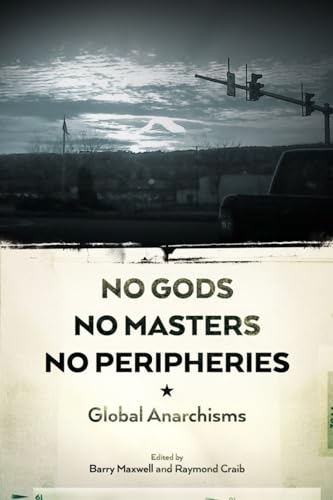
Was anarchism in areas outside of Europe an import and a script to be mimicked? Was it perpetually at odds with other currents of the Left? The authors in this collection take up these questions of geographical and political peripheries. Building on recent research that has emphasized the plural origins of anarchist thought and practice, they reflect on the histories and cultures of the antistatist mutual aid movements of the last century beyond the boundaries of an artificially coherent Europe. At the same time, they reexamine the historical relationships between anarchism and communism without starting from the position of sectarian difference (Marxism versus anarchism). Rather, they look at how anarchism and communism intersected; how the insurgent Left could appear—and in fact was—much more ecumenical, capacious, and eclectic than frequently portrayed; and reveal that such capaciousness is a hallmark of anarchist practice, which is prefigurative in its politics and antihierarchical and antidogmatic in its ethics.
Copublished the with Institute for Comparative Modernities, this collection includes contributions by Gavin Arnall, Mohammed Bamyeh, Bruno Bosteels, Raymond Craib, Silvia Rivera Cusicanqui, Geoffroy de Laforcade, Silvia Federici, Steven J. Hirsch, Adrienne Carey Hurley, Hilary Klein, Peter Linebaugh, Barry Maxwell, David Porter, Maia Ramnath, Penelope Rosemont, and Bahia Shehab.
"synopsis" may belong to another edition of this title.
About the Authors
Raymond Craib teaches in the Department of History at Cornell University. He is the author of Cartographic Mexico: A History of State Fixations and Fugitive Landscapes. Recent essays include “Sedentary Anarchists,” in Bert Altena and Constance Bantman, eds., Reassessing the Transnational Turn: Scales of Analysis in Anarchist and Syndicalist Studies and “The Firecracker Poet: Three Poems of José Domingo Gómez Rojas” (with original translations of Gómez Rojas’s poetry) in New Letters: A Magazine of Writing & Art.
Barry Maxwell teaches Comparative Literature and American Studies at Cornell University, where he helped to put together the Institute for Comparative Modernities. He has written about Frederick Douglass, Walt Whitman, Kenneth Burke, Ernst Bloch, Walter Benjamin, David Hammons, Sun Ra, Miles Davis, Gwendolyn Brooks, and Nathaniel Mackey.
Excerpt. © Reprinted by permission. All rights reserved.
No Gods, No Masters, No Peripheries: Global Anarchisms
By Barry Maxwell, Raymond CraibPM Press
Copyright © 2015 PM Press
All rights reserved.
ISBN: 978-1-62963-098-4All rights reserved.
Contents
Acknowledgments,
Raymond Craib A Foreword,
LEARNING FROM INDIGENOUS EXPERIENCE: ANARCHISM AND INDIGENEITY,
Silvia Rivera Cusicanqui The Ch'ixi Identity of a Mestizo: Regarding an Anarchist Manifesto of 1929,
Hilary Klein The Zapatista Movement: Blending Indigenous Traditions with Revolutionary Praxis,
Maia Ramnath No Gods, No Masters, No Brahmins: An Anarchist Inquiry on Caste, Race, and Indigeneity in India,
INTERVENTION Peter Linebaugh Ypsilanti Vampire May Day,
A THOUSAND LINKS: TRANSNATIONAL LINES IN AN ANARCHIST AGE,
Adrienne Hurley Let's Ditch School and Be Unmanageable,
David Porter Kabylia's 2001 Horizontalist Insurrection,
THE HORIZON AT THE CENTRE: NO PERIPHERIES,
Raymond Craib Anarchism and Alterity: The Expulsion of Casimiro Barrios from Chile in 1920,
Geoffroy de Laforcade The Ghosts of Insurgencies Past: Waterfront Labor, Working-Class Memory, and the Contentious Emergence of the National-Popular State in Argentina,
Steven J. Hirsch Anarchism, the Subaltern, and Repertoires of Resistance in Northern Peru, 1898–1922,
INTERVENTION Bahia Shehab Spraying NO,
THE BLACK MIRROR: ANARCHISM, SURREALISM, AND THE SITUATIONISTS,
Penelope Rosemont Surrealism and Situationism: An attempt at a comparison and critique by an Admirer and Participant, including a brief look at a seemingly faraway place in space and time; or, King Kong meets Godzilla ... How New Thoughts are let loose in the World,
Barry Maxwell Blackened Syllabus: Will Alexander's Figure of the King,
Gavin Arnall Masters without Slaves: Raoul Vaneigem's Détournement of Nietzsche,
BLACK, RED, AND GREY: ANARCHISM, COMMUNISM, AND POLITICAL THEORY,
Mohammed A. Bamyeh Anarchist Method, Liberal Intention, Authoritarian Lesson: The Arab Spring between Three Enlightenments,
Bruno Bosteels Neither Proletarian nor Vanguard: On a Certain Underground Current of Anarchist Socialism in Mexico,
Silvia Federici Global Anarchism: Provocations,
Barry Maxwell Afterword, Beginning with "A",
Notes on Contributors,
Index,
CHAPTER 1
THE CH'IXI IDENTITY OF A MESTIZO: REGARDING AN ANARCHIST MANIFESTO OF 1929
Silvia Rivera Cusicanqui
The document I will analyze here, La Voz del Campesino, is a notable example of the particularities of anarchist thought and action in Bolivia before the Chaco War (1932–1935). Its author, the mechanic Luis Cusicanqui, was one of the most creative and persevering libertarian ideologues of La Paz. Together with anarchist seamstress Domitila Pareja, he gave life to the group La Antorcha (The Torch) that existed in La Paz from the early 1920s. In 1927 Cusicanqui became part of the Local Worker Federation (FOL) and became their general secretary in 1940, when the libertarians had already suffered the buffeting of state repression, forced recruitment, and the corporatist policies of cooptation and neutralization by the postwar governments of David Toro and Germán Busch. For her part, Domitila did not live to see the founding of the FOL, dying of tuberculosis in La Paz at twenty-six years of age.
Cusicanqui's trajectory does not seem to have been an exception. In the anarchist archive that survives, we find texts of philosophical and doctrinal reflection, journalistic chronicles, essays, and plays. Like Cusicanqui, many men and women of the cholo/a urban working class linked manual labor with a broad humanistic self-education and the daily work of agitation and propaganda. They wrote philosophy and dabbled in essays and the theater without ceasing to work in their respective manual jobs or becoming armchair ideologues or politicians. Rather, their political philosophy and critical writing were closely intertwined with their daily work of manual labor and solidarity organizing. They were determined in their desire to reveal the arrogance and arbitrariness of the misti (now we would say q'ara), elite, with its lack of authentic culture and its illegitimate hold on wealth and power. The continuity between the colonial oppressor and the bourgeois oligarchy nurtured the memory of suffering and violence, and denoted a qhipnayra sense of historical time. In these brief notes I will try to elucidate these aspects of the history and thought of the La Paz anarchist movement, considering this singular text and the personal seal of its author in the context of the intense mass participation of the cholo and indigenous populations of the hills of La Paz and El Alto.
I
Even though we do not know the exact context that surrounded the manifesto's diffusion, recent research by historian Roberto Choque (2009) shows that La Voz del Campesino had widespread distribution in the countryside, in rural regions, and among the urban artisan cholo class, bearer of the labor energy that gave life to the city. The La Paz anarchists' verbal and written style, which combines a Spanish full of archaisms and distortions with a metaphorical and politicized Aymara, resembles a ch'ixi fabric interwoven with their reflections and experiences. This is a dialect that threads its doctrine through the twisting crosshatch of castimillano (Aymarainflected) Spanish: an intercultural lingua franca that permitted the anarchists to adapt and re-create libertarian and indigenous metaphors through a dense testimonial fabric.
La Voz del Campesino is directed at the countryside and written in the first person. In this we see the first contradiction, since the author wrote it in the city rather than the country. Is this a calculated gesture, a paternalist approximation of the reality of an Aymara free communies and hacienda colonos by an urban mestizo artisan in an attempt at demagoguery or impersonation? Or was the document really written by an Indian, in which case it is only the urban anarchist translation of an Indian's thought? As any middle-class vanguardist or rearguard Indianist could affirm, seeing the color of his skin next to Domitila's: you just have to see his face to know he is an Indian! But things are never so simple. Because of his education, because of the imbrication of two languages that permanently battled in his brain, because of his family trajectory, Cusicanqui was what we would call a ch'ixi mestizo, an Indian spotted with white, transculturated in an agonizing, ambivalent, and unruly manner.
Throughout the manifesto, the "I" and the "we" — more frequently the first person plural — refers to the Indian, even though a few times he uses the word "peasant." The title, rather than denoting the real content of the text, actually obscures it. In the subtitle the identification is clearer, but it moves along an oppositional path; this reads: "our challenge to the great mistes of the State ..." Miste, misti, State = misti; a term that denotes caste. It means we, the Indians, face our enemies, the mistis and the State.
It is worth clarifying that in the 1920s the term "peasant" did not carry the ideological khumunta it was later given during the era of revolutionary nationalism of the post-Chaco period. Between the misti classes it was simply a term used as a euphemistic synonym for Indian — which is largely the way it continues to be used today — perhaps due to the shame of the elites who, faced with these others, realized their own position in such an ostensibly colonial relationship. In any case, it is likely that such shame weighed on them as a hidden motivation for the post-1952 official incorporation of the term, and for the khumunta or linguistic servitude the term has carried from that point forward.
But Cusicanqui does not speak or construct his sentences like a "misti." Within him the two languages live and intertwine, as two categorical ways of defining reality. His use of the term "peasant" seems to have a rationalizing and ordering sense. It speaks of an attempt at precision, one made clear by its context. For example, when he says "comunarios peasants of the hacienda" he refers to Indians (comunarios), workers of the land (peasants), subject to the dominion of a patron or landowner. Indian would be the broadest generic identification, which would obviate the need to provide skin-color or differentiations in location or labor activity. "Peasant," on the other hand, alludes to the Indians of the countryside, in contrast with the Indians of the city, and refers specifically to those who live and work in communities that are free or controlled by the hacienda. The same is true when he speaks of herders in an exemplary ch'ixi construction:
The animal herders enter and at the end of the year all the animals the poor peasant possesses will be captured.
Here the word "peasant" is accompanied by "poor" in a paternalistic sense. When he talks about the "Indian," however, the resignation and the everyday nature of the oppression that go along with his use of "peasant" disappear. He chooses the term "Indian" at the moment he presents the heroic features of subjects in action:
More than a hundred thirty years ago we came from suffering the cruelest slavery imaginable to the republican moment that offered us independence, costing us Indian blood and lives to free us from the Spanish yoke that made us wail during more than 400 years, or four centuries.
The colonial horizon, including the decades of republican life, condenses into a present of vivid oppression shared by dwellers of the Andean altiplano and the cities in their territory.
The creoles in pants insult us, whip in hand — woman, man, child, ancient, how they enslave us. What will we say of the doctors, lawyers, and other Kellkeris? Oh! Those are the worst thieves and outlaws who rob us with the Law in hand; and, if we say something, they beat us and for good measure, send us to jail for ten years, and during all this, throw out our woman and children, and top it off with the burning of our houses, and we are chased with the bullets of those men so honorably enlightened.
Apart from the burning of the houses — which alludes to a habitual practice employed by those "so honorably enlightened" to expand their haciendas — the "Indian workers" in the cities suffered identical abuses (see THOA 1984, Mamani 1991, Rivera 1992). As Cusicanqui notes:
This year the thing has taken on a more anguished tone. With the motive of threatening war with Paraguay, numerous Indian workers rebelled against a conflict that they guessed was intentionally provoked by capitalists and politicians. The consequence is the repression in Oruro, Cochabamba, and Potosí, with some indigenous communists shot by Siles' executioners, and others made prisoners: Cusicanqui, confined at the foot of the majestic Illimani, in the corner of Cohoni, and M.O. Quispe, detained in Yungas.
The inclusivity of Cusicanqui's community-in-rebellion alludes not only to colonial oppression abstracted as a memory, but also to real connections between La Paz artisans and Indian communities: one is deported to Cohoni — where his comrade had relatives and lands — and the other to the coca-farming zone of the Yungas. This wide territorial circulation had, however, a nucleus: the city of La Paz. It also had a doctrinary head: the libertarian communists. They formed an exclusive but inclusive nanaka ("we"), which is universal and particular at the same time, and which proposes an "avant-garde" identity of Indian libertarians, mutually contaminated in the process of anticolonial struggle.
II
The grammatical structure of Aymara recognizes two types of first person plural: the inclusive "we" (jiwasa), and the exclusive "we" (nanaka). The first can also have a plural form (jiwasanaka). Jiwasa refers to situations in which the subject includes the interlocutor, and in plural includes everyone. Nanaka alludes to a "we" that excludes the interlocutor. The collective identity attributed throughout the text to the urban artisan class includes the indigenous community-members, but also speaks from a distinctly urban location. The context of this act of communication is one of emergency. The increasingly radical mobilizations of the Andean communities and of the multihued sectors of urban cholos intertwined their struggles, until they were pushed together to the precipice of a war that cost Bolivia fifty thousand victims, most of them coming from rural communities and urban popular neighborhoods.
Another distinctive mark of the Spanish Cusicanqui employs is his use of time. Written three years before the war, his long memorial of aggravation expresses an anticipatory conscience that continually builds bridges between the future and the past (qhipnayra). His denunciation is the subjective expression of this dual movement in which two collectivities unite and separate facing a common oppressor: the misti State, whose modes of power are degradation, disdain, and contempt, from which even the most qualified artisan and the most lettered Indian cannot escape. The interpellatory force of anarchism's egalitarian and anti-state doctrine derives from the shared experience of those motley, oppressed collectivities who "ride between two worlds" and traverse multiple borders. History, remote or recent, thus articulates a long anti-fiscal communitarian memory with the exclusions and violence of the present. But this does not imply that Andean communities were perceived as ideally anarchist, or "societies against the State" as theorized by Clastres (1974). The Andean communities had previously possessed their own state, which had been beheaded and dispossessed of its structure of leadership and meaning. In the republican era, this reality had been obscured, and it was precisely the most iconic emblem of citizenship that revealed the critical potential of that erasure. As Cusicanqui writes:
The Identity card, what does it do for us Indians? Since we are beasts of burden and nothing more. ... Why do we now pay twenty centavos for a box of matches? Since now we find ourselves without warm clothing, without bread, and now without light, and we see ourselves reduced to returning to the primitive era, so-called by our governors and legislators. Why do you, the civilized, force us to return to savagery?
This passage presents a complex traverse between nanaka and jiwasa, first person plural and fourth person singular, and between colloquial and formal forms of Spanish. The nanaka questions the State, and the negation of the other is transformed into an affirmation of the self through the memory of that very alterity. "Was it the work of our civilization?" Here he refers to a distant past in which there was no slavery, although there was "civilization" (and the State). The box of matches refers to the mercantile-capitalist present, to the sale of labor power to obtain clothing, light, and bread (the typical urban food). The central point, however, comes in the conclusion, written in an "enlightened" tone, perhaps to make more intelligible the prosaic truth it conveys: that the civilized leaders make the present archaic, returning not only Indians to the colonial past, but themselves as well. The mistis and q'aras who degrade and enslave are the most archaic, as they don't debate with argument, but simply murder.
In this way, it becomes clear that Cusicanqui's broader identity, the one that challenges "the mistis and their state," is his identity as an Indian. This identification produces the most heartfelt words of the manifesto: "Take heed, my Indian brothers of the American race, that bloodshed will be the sign of the revolution that will topple this vile society, a thousand times cursed." This moral indignation, the creative rage of the text, emerges from such broad identification (jiwasanaka), now not only with his brothers of the Altiplano, but rather with the whole "American race," that which battled for centuries against European colonizers, Indians of the country and the city identified as collective subjects. But this "long-term memory" is always tied to the denunciation of the modern republican paradox, which makes citizens of the Indians only in order to continue by other means pillaging their lands and exploiting their labor. The lettered circles of the anarchist movement, as much as the caciques-apoderados movement led by Santos Marka T'ula, forcefully perceived the parodic and twisted character of the republic's laws, labeling them "illegitimate, criminal" and "cynical."
Here we see a new overlap between anarchist doctrine and the experience of Aymara communities: a vision of the law as a fictional and deceitful discourse, of judicial power as a tentacle of the State, and of official language as a duplicitous and immoral plot. This melds the doctrinaire notion of the existence of a moral law embodied by individual freedom with the action of the Aymara caciquesapoderados movement, which also approached the linguistic and ethical contradictions of colonialism as a battle against an other who is pä chuyma, or two-faced.
With this in mind, let us return to the chronological order of the document, which blends episodes of communal rural resistance and mobilizations of urban artisans into a single sequence. For example, it describes the "recent" event of the 1920 assassination of Prudencio Callisaya at the orders of the powerful hacendado of Guaqui, Benedicto Goytia, "... and the recent events of Cochabamba, Potosí, and Sucre, and the martyr of Guaqui, it is clearly soldiers who have fractured the limbs of our brother Prudencio Callisaya. Like savage fiends, you soldiers have no right to call yourselves civilized, you are barbarous criminals of the twentieth century, mutilators and destroyers of humanity."
Relatives of Prudencio Callisaya, in the trial they held for many years against the landowner Benedicto Goytia, denounced that Callisaya's body was not dismembered; rather, he was "found" hanged by his own rope. The fracturing of his limbs that Cusicanqui notes thus most likely refers to a longer memory: the dismemberment of Tupak Katari. Events throughout the narrative occur with this kind of apparent temporal disorder. Is this about imprecision or irrelevant lapses? Clearly not. The image of the indigenous martyr is reactivated in the body of any victim assassinated by the colonial powers: through each death, the social body of the oppressed is again fractured.
Beyond this, however, this "long" memory had been reactivated more recently in a meeting between Cusicanqui and Santos Marka T'ula, in the city of La Paz in 1928. The philosophy of La Voz del Campesino was strongly influenced by this direct contact between the libertarian leaders and the indigenous authorities, resulting in a worldview that, in the case of Cusicanqui, is rooted in previous experiences and convictions. Not only the writing style — which reveals the influence of his native tongue — but also the chronological disruption of the document allows us to think in a logic of quipnayra, an indigenous way of perceiving time and expressing it in writing.
(Continues...)
Excerpted from No Gods, No Masters, No Peripheries: Global Anarchisms by Barry Maxwell, Raymond Craib. Copyright © 2015 PM Press. Excerpted by permission of PM Press.
All rights reserved. No part of this excerpt may be reproduced or reprinted without permission in writing from the publisher.
Excerpts are provided by Dial-A-Book Inc. solely for the personal use of visitors to this web site.
"About this title" may belong to another edition of this title.
Search results for No Gods, No Masters, No Peripheries: Global Anarchisms

Stock Image
No Gods, No Masters, No Peripheries: Global Anarchisms
Seller: World of Books (was SecondSale), Montgomery, IL, U.S.A.
Seller rating 5 out of 5 stars

Paperback. Condition: Very Good. Was anarchism in areas outside of Europe an import and a script to be mimicked? Was it perpetually at odds with other currents of the Left? The authors in this collection take up these questions of geographical and political peripheries. Building on recent research that has emphasised the plural origins of anarchist thought and practice, they reflect on the histories and cultures of the anti-statist mutual aid movements of the last century beyond the boundaries of an artificially coherent Europe. Seller Inventory # 00106737473
Stock Image
No Gods, No Masters, No Peripheries Format: Paperback
Seller: INDOO, Avenel, NJ, U.S.A.
Seller rating 5 out of 5 stars
Condition: As New. Unread copy in mint condition. Seller Inventory # PG9781629630984
Stock Image
No Gods, No Masters, No Peripheries Format: Paperback
Seller: INDOO, Avenel, NJ, U.S.A.
Seller rating 5 out of 5 stars
Condition: New. Brand New. Seller Inventory # 9781629630984
Seller Image
No Gods, No Masters, No Peripheries
Seller: Rarewaves USA, HEBRON, KY, U.S.A.
Seller rating 5 out of 5 stars
Paperback. Condition: New. Seller Inventory # LU-9781629630984
Seller Image
No Gods, No Masters, No Peripheries : Global Anarchisms
Seller: GreatBookPrices, Columbia, MD, U.S.A.
Seller rating 5 out of 5 stars
Condition: New. Seller Inventory # 23473587-n
Seller Image
No Gods, No Masters, No Peripheries
Seller: Rarewaves.com USA, London, LONDO, United Kingdom
Seller rating 5 out of 5 stars
Paperback. Condition: New. Seller Inventory # LU-9781629630984
Buy New
US$ 32.06
Free Shipping
Ships from United Kingdom to U.S.A.
Ships from United Kingdom to U.S.A.
Quantity: 4 available
Stock Image
No Gods, No Masters, No Peripheries
Seller: PBShop.store US, Wood Dale, IL, U.S.A.
Seller rating 5 out of 5 stars
PAP. Condition: New. New Book. Shipped from UK. Established seller since 2000. Seller Inventory # EB-9781629630984
Stock Image
No Gods, No Masters, No Peripheries: Global Anarchisms
Seller: Earthlight Books, Walla Walla, WA, U.S.A.
Seller rating 4 out of 5 stars

Paperback. Condition: New. Brand new trade paperback. Was anarchism in areas outside of Europe an import and a script to be mimicked? Was it perpetually at odds with other currents of the Left? The authors in this collection take up these questions of geographical and political peripheries. Building on recent research that has emphasized the plural origins of anarchist thought and practice, they reflect on the histories and cultures of the antistatist mutual aid movements of the last century beyond the boundaries of an artificially coherent Europe. At the same time, they reexamine the historical relationships between anarchism and communism without starting from the position of sectarian difference (Marxism versus anarchism). Rather, they look at how anarchism and communism intersected; how the insurgent Left could appear?and in fact was?much more ecumenical, capacious, and eclectic than frequently portrayed; and reveal that such capaciousness is a hallmark of anarchist practice, which is prefigurative in its politics and antihierarchical and antidogmatic in its ethics.Copublished the with Institute for Comparative Modernities, this collection includes contributions by Gavin Arnall, Mohammed Bamyeh, Bruno Bosteels, Raymond Craib, Silvia Rivera Cusicanqui, Geoffroy de Laforcade, Silvia Federici, Steven J. Hirsch, Adrienne Carey Hurley, Hilary Klein, Peter Linebaugh, Barry Maxwell, David Porter, Maia Ramnath, Penelope Rosemont, and Bahia Shehab. Seller Inventory # SKU1031299
Stock Image
No Gods, No Masters, No Peripheries
Seller: PBShop.store UK, Fairford, GLOS, United Kingdom
Seller rating 5 out of 5 stars
PAP. Condition: New. New Book. Shipped from UK. Established seller since 2000. Seller Inventory # EB-9781629630984
Buy New
US$ 30.84
US$ 5.56 shipping
Ships from United Kingdom to U.S.A.
Ships from United Kingdom to U.S.A.
Quantity: 2 available
Seller Image
No Gods, No Masters, No Peripheries
Seller: Librería Oeste, MADRID, M, Spain
Seller rating 5 out of 5 stars
Condition: Muy Bueno. Pm Press, 2015. TAPA BLANDA. . Seller Inventory # 000000163433
Buy Used
US$ 11.56
US$ 27.50 shipping
Ships from Spain to U.S.A.
Ships from Spain to U.S.A.
Quantity: 1 available