
Items related to Math Games Lab for Kids: 24 Fun, Hands-On Activities...
Math Games Lab for Kids: 24 Fun, Hands-On Activities for Learning with Shapes, Puzzles, and Games (Volume 10) - Softcover
Book 18 of 33: Lab for Kids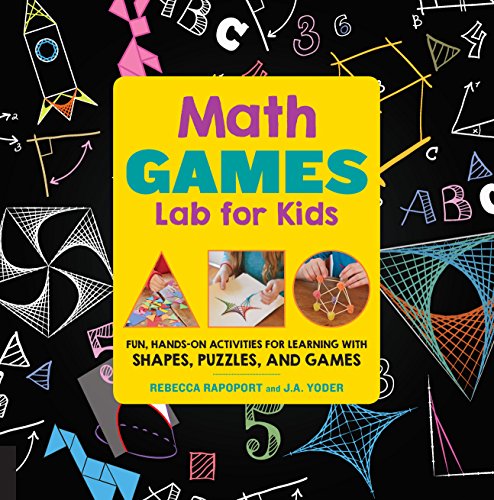
Synopsis
Make learning math fun by sharing these hands-on labs with your child. Math Lab for Kids presents more than 50 activities that incorporate coloring, drawing, games, and items like prisms to make math more than just numbers. With Math Lab for Kids, kids can:
- Explore geometry and topology with hands-on examples like prisms, antiprisms, Platonic solids, and Möbius strips.
- Build logic skills by playing and strategizing through tangrams, toothpick puzzles, and the game of Nim.
- Draw graphs to learn the language of connections.
- Discover how to color maps like a mathematician by using the fewest colors possible.
- Create mind bending fractals with straight lines and repeat shapes.
And don't worry about running to the store for expensive supplies! Everything needed to complete the activities can be found in the book or around the house. Math is more important in schools than ever. Give your children a great experience and solid foundation.
- Explore geometry and topology with hands-on examples like prisms, antiprisms, Platonic solids, and Möbius strips.
- Build logic skills by playing and strategizing through tangrams, toothpick puzzles, and the game of Nim.
- Draw graphs to learn the language of connections.
- Discover how to color maps like a mathematician by using the fewest colors possible.
- Create mind bending fractals with straight lines and repeat shapes.
And don't worry about running to the store for expensive supplies! Everything needed to complete the activities can be found in the book or around the house. Math is more important in schools than ever. Give your children a great experience and solid foundation.
"synopsis" may belong to another edition of this title.
About the Author
Rebecca Rapoport holds degrees in mathematics from Harvard University and Michigan State. From her first job out of college, as one of the pioneers of Harvard’s Internet education offerings, she has been passionate about encouraging her love for math in others. As an early contributor to both retail giant Amazon.com and Akamai Technologies, the number one firm in cloud computing, Rapoport played a key role in several elements of the Internet revolution. She then returned to her first love, education, as an innovator of new methods to introduce children and adults to the critically important world of STEAM education as COO of an enrichment center dedicated to helping kids explore the creative side of science, technology, engineering, art, and math, and is currently developing and teaching innovative math curricula in the Boston area. Rapoport is also the co-author of Math Games Lab for Kids (published by Quarry Books), a book of fun, hands-on math activities designed to introduce elementary and middle-school students to several areas of higher math; and the calendars Mathematics: Your Daily Epsilon of Math 2021, Mathematics: Your Daily Epsilon of Math 2020, Mathematics 2019: Your Daily Epsilon of Math, and The Mathematics Calendar 2018, all published by Rock Point. She has an Erdös number of 2.
J.A. Yoder is an educator and engineer who has a lifetime love of puzzles and patterns. Her educational philosophy is that hands-on creative work is both the most fun and the most effective way to learn. She developed and taught the original hands-on-math lessons for an after-school program that eventually inspired this book. Some of her happiest memories come from "eureka moments"—either from learning something that makes a dozen other things suddenly make sense, or the sense of accomplishment that comes from solving a clever puzzle. The only thing better is sharing this joy with others.
Reviews
Gr 2–6—Harvard mathematics graduate Rapoport and engineer Yoder have provided exciting enrichment opportunities to bring elementary math to life. This compilation of fresh, hands-on STEM activities explores a variety of mathematical concepts, from basic geometric shapes to parabolas, fractals, and puzzles. An introduction explains how the book is designed and meant to be used. While much of the text is written for children, librarians and educators could easily incorporate this work into their curricula or programs. For instance, the "Think About It" section at the start of each chapter would work well as essential questions for educators to gauge student understanding prior to lessons. The chapters are easy to follow and clearly identify each step of the process. The labs require inexpensive materials (toothpicks, gumdrops, balloons, thread) as well as ones likely already in the classroom (rulers, graph paper, pushpins). Illustrations, definitions, and detailed procedures are included for every lab. While chapters build on previous experiments, each is also presented with a stand-alone work-around so educators can make modifications to best suit their students. Occasionally chapters also offer a collaborative exercise for a small group. The book concludes with pullouts (reproducible items for some of the labs), as well as "Hints and Solutions" for the puzzles. VERDICT Recommended for libraries and educators seeking a tactile approach to elementary mathematics.—Doneanne Soult, Westampton Middle School, NJ
"About this title" may belong to another edition of this title.
Search results for Math Games Lab for Kids: 24 Fun, Hands-On Activities...

Stock Image
Math Lab for Kids Fun HandsOn
Seller: World of Books (was SecondSale), Montgomery, IL, U.S.A.
Seller rating 5 out of 5 stars

Condition: Acceptable. Item in acceptable condition! Textbooks may not include supplemental items i.e. CDs, access codes etc. Seller Inventory # 00102253745
Stock Image
Math Lab for Kids Fun HandsOn
Seller: World of Books (was SecondSale), Montgomery, IL, U.S.A.
Seller rating 5 out of 5 stars
Condition: Very Good. Item in very good condition! Textbooks may not include supplemental items i.e. CDs, access codes etc. Seller Inventory # 00101570272
Stock Image
Math Lab for Kids Fun HandsOn
Seller: World of Books (was SecondSale), Montgomery, IL, U.S.A.
Seller rating 5 out of 5 stars
Condition: Good. Item in good condition. Textbooks may not include supplemental items i.e. CDs, access codes etc. Seller Inventory # 00095774377
Seller Image
Math Games Lab for Kids: 24 Fun, Hands-On Activities for Learning with Shapes, Puzzles, and Games (Volume 10)
Seller: Zoom Books Company, Lynden, WA, U.S.A.
Seller rating 5 out of 5 stars
Condition: very_good. Book is in very good condition and may include minimal underlining highlighting. The book can also include "From the library of" labels. May not contain miscellaneous items toys, dvds, etc. . We offer 100% money back guarantee and 24 7 customer service. Seller Inventory # ZBV.1631592521.VG
Stock Image
Math Games Lab for Kids: 24 Fun, Hands-On Activities for Learning with Shapes, Puzzles, and Games (Volume 10)
Published by
Quarry Books (edition Illustrated), 2017
ISBN 10: 1631592521
ISBN 13: 9781631592522
Used
Flexibound
Seller: BooksRun, Philadelphia, PA, U.S.A.
Seller rating 5 out of 5 stars
Flexibound. Condition: Very Good. Illustrated. It's a well-cared-for item that has seen limited use. The item may show minor signs of wear. All the text is legible, with all pages included. It may have slight markings and/or highlighting. Seller Inventory # 1631592521-8-1
Seller Image
Math Games Lab for Kids: 24 Fun, Hands-On Activities for Learning with Shapes, Puzzles, and Games (Volume 10)
Seller: Greenworld Books, Arlington, TX, U.S.A.
Seller rating 5 out of 5 stars
Condition: good. Fast Free Shipping â" Good condition. It may show normal signs of use, such as light writing, highlighting, or library markings, but all pages are intact and the book is fully readable. A solid, complete copy that's ready to enjoy. Seller Inventory # GWV.1631592521.G
Seller Image
Math Games Lab for Kids: 24 Fun, Hands-On Activities for Learning with Shapes, Puzzles, and Games (Volume 10)
Seller: Greenworld Books, Arlington, TX, U.S.A.
Seller rating 5 out of 5 stars
Condition: very_good. Fast Free Shipping â" Very Good condition book with a firm cover and clean pages. Shows normal use and some light wear or limited notes markings. A solid, nice copy to enjoy. Seller Inventory # GWV.1631592521.VG
Stock Image
Math Games Lab for Kids: 24 Fun, Hands-On Activities for Learning with Shapes, Puzzles, and Games (Volume 10)
Published by
Quarry Books (edition Illustrated), 2017
ISBN 10: 1631592521
ISBN 13: 9781631592522
Used
Flexibound
Seller: BooksRun, Philadelphia, PA, U.S.A.
Seller rating 5 out of 5 stars
Flexibound. Condition: Very Good. Illustrated. It's a well-cared-for item that has seen limited use. The item may show minor signs of wear. All the text is legible, with all pages included. It may have slight markings and/or highlighting. Seller Inventory # 1631592521-11-1
Stock Image
Math Games Lab for Kids: 24 Fun, Hands-On Activities for Learning with Shapes, Puzzles, and Games (Volume 10)
Seller: Evergreen Goodwill, Seattle, WA, U.S.A.
Seller rating 5 out of 5 stars
flexibound. Condition: Good. Seller Inventory # mon0000255176
Stock Image
Math Games Lab for Kids: 24 Fun, Hands-On Activities for Learning with Shapes, Puzzles, and Games
Published by
Quarto Publishing Group USA Inc, 2017
ISBN 10: 1631592521
ISBN 13: 9781631592522
Used
Softcover
Seller: World of Books Inc, Montgomery, IL, U.S.A.
Seller rating 4 out of 5 stars

Condition: Good. Provides 52 fun labs to teach children basic math concepts through activities and games. Seller Inventory # CIN1631592521G