
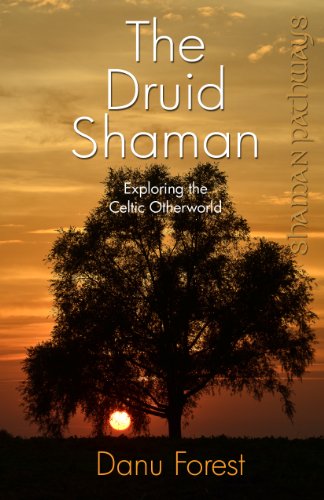
Synopsis
Covering the basics of Celtic shamanism, with reference to traditional lore and source materials through the lens of both ancient and modern Druidry and shamanic practice, The Druid Shaman is a well rounded guide, showing the seamless cross over between Druidry and shamanism in the Celtic tradition. It covers topics such as how to attain and work with guides and allies, understanding the spirit realm and interaction with spirits of all kinds, accessing powers of place, traveling the world tree and working with the seven directions and exploring and navigating within the Celtic Otherworld. With practical techniques, exercises and core skills, The Druid Shaman can be used as a practical manual as well as a valuable resource for practicing shamans and druids as well as those new to the subject.
,
"synopsis" may belong to another edition of this title.
About the Author
Danu Forest is a Celtic Shaman, Witch and Druid Priestess with over 20 years working in the Celtic Mysteries. Danu runs the Druid group 'Grove of the Avalon Sidhe' and teaches workshops and successful online courses on Natural magic, Celtic shamanism, Faery tradition and Seasonal Celebrations. She also runs a magical and shamanic consultancy in Glastonbury, UK.
,
Excerpt. © Reprinted by permission. All rights reserved.
Shaman Pathways - The Druid Shaman
Exploring the Celtic Otherworld
By Danu ForestJohn Hunt Publishing Ltd.
Copyright © 2013 Danu Forest
All rights reserved.
ISBN: 978-1-78099-615-8All rights reserved.
Contents
Introduction,
Chapter 1: The First Signposts, 3,
Chapter 2: Preparing for Voyage, 10,
Chapter 3: Circle Time,
Chapter 4: Setting Out, 31,
Chapter 5: Genius Loci and the Powers of Place, 39,
Chapter 6: Climbing the Tree, 54,
Chapter 7: Seeking the Radiant Brow – Druid Shamanic Divination, 73,
Conclusion, 82,
Endnotes and References, 83,
CHAPTER 1
The First Signposts
Who were the Celts?
In order to explore the practices of the druid shaman, we mustfirst briefly clarify our definition of some familiar terms. Thepeople from whom we get the term 'Celt', the 'Keltoi' were firstmentioned by the Greek historian Herodotus, as a group ofpeople living in the region of the river Danube around 550BC.These people were distinctive in their incredible art, highlysophisticated culture, and material wealth. They were especiallyrich in gold. By this time it is believed that these people were apoint of interchange with the Greeks, while also being part of awider culture sharing common languages, customs and beliefs.These 'Celts' were an ethno-linguistic group of tribal Iron Agesocieties that spanned a large part of northern and westernEurope as far as Britain and Ireland. They shared common valuesand traditions, with variations over time and from region toregion. Contrary to popular belief, they were not a distinctgenetic race, although some 'Celtic' customs and linguisticsimilarities survive today in most Celtic areas.
Britain, Cornwall, Wales, Scotland, the Isle of Man andIreland are all considered to remain Celtic heartlands to this day,together with Brittany, and are often described with the term'Insular Celts', as opposed to the 'Continental Celts'. These'Insular Celts' diverged into the Gaelic Celts, of Ireland, Scotlandand the Isle of Man, and the Brythonic Celts of Brittany, Cornwalland Wales. Scholars in the 19th and 20th centuries often arguedthat the Celts arrived in Britain via an invasion or succession ofinvasions around the 6th century BC from Continental Europe,but this has now been largely overturned due to a lack of archaeologicalevidence, and the work of archaeologists such as BarryCunliffe. The British Celts were for the most part probably theindigenous Britons, arriving in the early Bronze Age (2500BC) oreven earlier, adopting and adapting Celtic culture due to theirextensive relations and trading connections along the Atlanticseaboard and beyond.
These people are notoriously hard to pin down, although theircultural effects have been profound on later generations, creatinga 'Celtic consciousness' and traditions that have spannedmillennia, so that today much of Wales, Scotland and Irelandwould still call themselves proudly 'Celtic' and often maintainedpractices which are distinctly Celtic in nature well into themodern era, such as those recorded by Alexander Carmichael inhis Carmina Gadelica in the latter part of the 19th century.
For the purposes of this book, the term Celtic is used in itswidest and most common usage sense; primarily to refer to theseBritish and Irish 'Celts' of the Iron Age as well as later Celts andCeltic practices spanning from them through Celtic Christianityto this day, with minor references to Iron Age Celtic Europe. Thisexploration of shamanic druidry, therefore, relates primarily tothe traces of shamanic traditions as found in the British Isles andIreland, translating their practice into forms applicable to today.
What is druidry? Who were and are the druids?
Druidry to some is a nature-based religion, to others it is aphilosophy, a gentle way of life, focusing upon our relationshipwith nature. One thing that unites a lot of druids is a distrust oflabels and categories; for some it is about researching, and reconstructingour Celtic past, for others it is about finding ways now,in the modern era, to reinvigorate our connection to the spirit innature ... and there are infinite variations. The druids of antiquitywere Celtic priests, healers, seers and lore keepers, whoworshipped the Celtic gods, and performed a wide variety ofroles within the community. Today, not all druids worship godsof any kind, or do so outside of the Celtic tradition. However, awide consensus would consider druidry today to find its roots,and certainly its spiritual aspirations, in the Celtic religiousleaders of the Iron Age.
Most of what we know about the Celtic druids comes fromClassical writers, although much can sensibly be gleaned fromarchaeological evidence as well. Caesar tells us that the home ofthe druid religion was in Britain although traces of druidicpractice are found across Celtic Europe, particularly in theirsacred enclosures known as nemetons or groves. While someargue that druidry came to Britain via Europe, it is equallyarguable that the spiritual beliefs of the indigenous tribes ofBritain evolved and developed over time into the druidry of theIron Age which expanded into the lands of the Continental Celts.Certainly great importance was placed upon the sacred spirit ofthe British landscape, which was honoured long before thearrival of Celtic culture.
The druids were divided into three groups, the bards of Walesand the fili of Ireland performing as oral historians and storytellersof great magical significance, as well as the ovates, and thedruid class themselves. Some of the greatest bardic works areattributed to the Welsh bard Taliesin, a deeply shamaniccharacter, whose works reveal an ability to access the supernaturaland knowledge of the spirit world. Both the bards andthe Irish fili often appeared to perform tasks that werecommonly held to be in the realm of the ovates, or soothsayers;uttering prophecy, giving advice or healings after going intotrance states or forms of spiritual ecstasy, while the druid classthemselves – who were judges, philosophers and astronomers,also appear to at times perform what may be understood todayas shamanic practices ... Their relationship with spirit, whetherthe gods, the ancestors or the spirits of the landscape, beingcentral to their beliefs and activities, and the source of theirknowledge and ability.
The word druid comes from the Indo-European root of theword for oak, 'dru' with that of the word for knowledge orwisdom 'wid', thus meaning 'those with the knowledge of the oaktree'. It is also argued to come from 'deru-weid' meaning someonewith strong and steadfast wisdom and insight. It is possible thatboth these meanings are in fact closely entwined, having thesteadfast strength of the oak, and the knowledge of 'seeing' orseership – a shamanic source of knowledge from spirit. The wordsurvived into the Old Irish period giving us druidecht meaning'magic' and in the Welsh as dryw meaning seer, which was a termused well into the 13th century.
What is a shaman?
A shaman is someone who reaches altered states of consciousnessin order to encounter and interact with the spirit world. The termoriginates from the Tungusic and Samoyedic speaking peoples ofNorth Asia, used to describe their magico-religious practitioners;but the term has spread today to describe those from cultures allaround the world who act as intermediaries between the mortalworld and the infinite, or the realm of spirit. Scholars now believethat most world religions have a basis in shamanic practice, goingback as far as the Palaeolithic. Historian and philosopher MirceaEliade called shamanism a 'technique of religious ecstasy'; theshaman while encountering the world of spirit becomes a conduitfor vast amounts of energy, direct from the Otherworld, orSource, to be used and applied in the mortal realm, for healing,guidance and to effect real change.
Shamanic practice
Central to shamanic practice is the interaction with spirits, bothmortal and supernatural. Shamans believe we are all spirits mademanifest in the mortal world, our wellbeing, health andwholeness stem from our connection with Source, and our ownsouls, just as a tree reaches upwards and outwards from theearth. When we are in a good state of wellness, we are continuallyrenewed and strengthened by this connection. However, whenthis connection is weakened or partially disconnected (it cannever be wholly severed) illness and imbalance result, our liveswander without a sense of purpose or fulfilment. Often in lifesomeone will have a sense that something is 'missing' and thiscan be a sign that our connection to the deeper world of spirit viaour own souls is not in a state of health. Often shamans talk ofsoul or power loss, which can result from all sorts of negativeexperiences. This has a profound effect on our lives and sense ofself ... we become disconnected and 'lost'; sometimes sufferingillness or misfortune, or we find we feel we are lacking vitality,enthusiasm or inspiration. The shaman can restore thisconnection, returning lost soul parts, and vital power or lifeforce. All illness and imbalance can be understood as stemmingfrom the pre-manifest state of spirit, reaching manifestation in aperson's body or general wellbeing, and the shaman may repairany damage by going direct to the source of the problem, withthe resulting ripples in the manifest world returning health andwellbeing to the person in their everyday life.
Yet shamanic work goes far beyond this, as someone who isprimarily in service with spirit, shamanic work also entailscaring for nature and all beings, our environment andcommunity, as well as the pursuit of health, wholeness andspiritual evolution within ourselves. This is not separate fromshamanic healing, but in fact all part of the same tasks and activities.By interacting with the spirit world and aligning and reconnectingoneself with the whole of creation, we naturally heal andeffect healing in others, as well as grow and develop along ourown soul's journey. The end result of this is enlightenment,expressed in the Celtic tradition as the attainment of bardicinspiration, revealed as the 'radiant brow' of shaman poets suchas Taliesin and the expansive knowledge of all things he shareswith key characters of Celtic myth, such as Finn Mac Cumhailland Tuan Mac Cairill. Prioritising care for all beings, especiallynature, is also key to most druidic practice today.
Celtic shamans
The term 'Celtic shaman' is a modern one, utilising the modernunderstanding of both 'Celtic' and 'shaman' and thus viewing thepractices of the Iron Age druids and earlier, through a 21stcentury lens. However, while it is impossible to ever know theIron Age druids and their beliefs and practices from their point ofview, we can draw sensible and logical conclusions extrapolatingfrom what we do know, even if we are aware they may have useddifferent names and terms of reference for their activities. If weturn ourselves away from historical reconstruction and archaeologyfor a moment, and also consider that our relationship withthe unseen and the world of spirit is just as much our birthrightas theirs, then we may also access the spirits of our lands, thegods, and the Otherworld, and using their examples, experienceit through our own senses, through our own eyes. The old roadsmay be less trodden today, but they still remain, for thoseprepared to follow the trail once again.
A guide on the path ... Taliesin
Taliesin, meaning 'radiant brow', was perhaps the greatestshaman poet of Britain. Taliesin Pen Beirdd is a historical character,living in Wales in the 6th century, composing many songs andpoems which survive in various forms to this day. Many wererediscovered in the 18th century and translated from Welsh intoEnglish with varying forms of success. However, the title 'radiantbrow' was for a time often misunderstood, and it is now acommon belief that while some poems are the work of the 6thcentury poet, others are part of an oral history recorded at thattime, but originating centuries earlier, referring to beliefs andpractices of a far older date. 'Radiant brow' is thus a descriptionor title, rather than a personal name.
The figure of Taliesin has a mythical beginning, recorded inthe 16th century manuscript Hanes Taliesin as the boy GwionBach, who was set to serve the Lady/Goddess Ceridwen byattending to her Cauldron of Inspiration, which was brewing amagical potion to give her son, Morfran, knowledge and wisdombeyond all men. Yet three drops of the brew spilled out and burntGwion, who sucked at his fingers, and received the potion'smagic instead. (This is also a key feature in the tale of Finn andthe salmon of knowledge.) He is then pursued by the terrible andfearsome Goddess, both Gwion and Ceridwen undergoingnumerous shape-changes, until he becomes a grain of wheat, andshe a hen who eats him. Ceridwen is then pregnant with the boyGwion, and when she gives birth to him, this being Gwion'ssecond birth, she is so struck by his beauty that she cannot bearto hurt him, but places him inside a leather bag upon the sea.Gwion is finally found, by the Lord Elffin on the shore of theriver Conwy, while he is fishing for salmon (a symbol ofwisdom). Thus Gwion is reborn a third time when he is broughtforth from the bag, Elffin naming him Taliesin upon seeing hisgreat radiance. Able to utter prophecy, and recite poetry withmagical effect from birth, Taliesin is one of many 'wondrouschildren' in Celtic myth, marking them out as beings of both themortal realm and the Otherworld.
Here we see Taliesin is three times born, as a mortal, thenfrom the womb of the Goddess, before a final birth out into theworld where he serves as chief poet and magical ally (shaman) toElffin, and later at King Arthur's court. This is a shamanic initiationseen through the eyes of myth, with its shape-changing,animal embodiments, and divine interactions before being castupon the great ocean of spirit, to come into relationship with thewhole of creation itself. This is every shaman's task andobjective.
CHAPTER 2Preparing for Voyage
Within the crane skin bag – a druid'sshamanic tools
The crane skin bag is a perennial motif in several Celtic myths.Originally it was made from the magical skin of the GoddessAoife, who spent many years as a crane – a bird able to travelbetween the worlds. When she died, her husband, the sea GodMannanan, made the special bag in order to store the greattreasures of the land, known as the hallows, within it. This can beunderstood as symbolising the great powers of the land, and thetools of the soul, as residing within the womb of the Goddess,Lady Sovereignty herself, who goes under many names.
The crane skin bag was then passed to the hero Cumhail, andthen to his son, the shaman hero Fionn mac Cumhail, who heldthese talismans of the earth's power in protection andguardianship of the land and its sacred soul, after tasting the'salmon of knowledge' which gave him almost super humanpowers. Later traditions used the motif of the crane skin bag, as apouch or container in which to store magical tools, herbs andother items of spiritual or magical significance.
This is still a term used by druids today, and it is possible tobuy or make your own 'crane skin' bag, of cloth or leather, inwhich to store things which you use in your practice – stones,feathers, herbs, as well as other druidic or shamanic tools. Wewill now look over some 'shamanic' tools which may help you inyour practice. While none of them are necessary, they arenonetheless very helpful in assisting your gentle change ofconsciousness, and should not be immediately overlooked.
A druid shaman doesn't need a lot of equipment. There is atemptation to go out and buy lovely tools, indeed there are somebeautiful drums, rattles and other tools on the market these days,but it should be said that these objects, over time, become just asmuch your allies and power sources as your spirit guides andguardians. For this reason it is always best to make your owntools if you can, or at least customise, decorate, bless and consecratethem yourself. The aim is to build a relationship with thespirit of your tools, and to empower and energise them throughrespect and good use. This is much easier done when you haveput your own energy into its construction or birth.
The shaman's drum
A drum is an excellent and really versatile shamanic tool. It canbe used to help you and others reach into meditative or trancestates for journeying, and the skill of drumming a regularrhythm for a length of time teaches presence, intent and the kindof relaxed focus that is central to shamanic work of all kinds.Drumming can be used in ceremony, as an energy raiser, as avoice of spirit, as an invoker and as a gift to the spirits. It can beused in healing, to shake and raise the vibration of a person orarea, to clear and energise, dislodging stuck or negative energy.It can create atmospheres and assist in directing will andintention, by beating fast or slow, it can motivate a climb to theupperworld, or echo a flock of birds taking flight, it can slow andrelax, and become the heartbeat of the earth.
The drum is the shaman's friend, almost more than any other.They come in so many shapes and sizes; the traditional Irishbodhran is great for Celtic shamanic use, but you needn't feelthat an Irish drum is compulsory. Take your time, and find adesign that works well for you, that feels right, that excites yourenthusiasm.
Rattles
Rattles are another excellent shamanic tool. Like the drum, therattle can be used to alter consciousness, build energy, evoke,banish negative energy, and for healing, but its energy is quitedifferent, faster and lighter, its effects are often subtler. Rattlesare particularly useful when working with nature spirits, windand rain. Gourds make excellent natural rattles, and ones filledwith seeds are very good for blessing new growth, or encouragingthe patter of rain upon dry ground. Antlers, sticks andbones are also useful percussive tools, and can be very powerful,often drawing upon the spirit of the material used to constructthem.
(Continues...)
Excerpted from Shaman Pathways - The Druid Shaman by Danu Forest. Copyright © 2013 Danu Forest. Excerpted by permission of John Hunt Publishing Ltd..
All rights reserved. No part of this excerpt may be reproduced or reprinted without permission in writing from the publisher.
Excerpts are provided by Dial-A-Book Inc. solely for the personal use of visitors to this web site.
"About this title" may belong to another edition of this title.
Search results for Shaman Pathways The Druid Shaman: Exploring the Celtic...

Stock Image
The Druid Shaman: Exploring the Celtic Otherworld
Seller: ThriftBooks-Atlanta, AUSTELL, GA, U.S.A.
Seller rating 5 out of 5 stars

Paperback. Condition: Good. No Jacket. Former library book; Pages can have notes/highlighting. Spine may show signs of wear. ~ ThriftBooks: Read More, Spend Less. Seller Inventory # G1780996152I3N10
Stock Image
Shaman Pathways - The Druid Shaman: Exploring the Celtic Otherworld
Seller: World of Books (was SecondSale), Montgomery, IL, U.S.A.
Seller rating 5 out of 5 stars
Condition: Good. Item in good condition. Textbooks may not include supplemental items i.e. CDs, access codes etc. Seller Inventory # 00103380629
Stock Image
Shaman Pathways - The Druid Shaman: Exploring the Celtic Otherworld
Seller: Half Price Books Inc., Dallas, TX, U.S.A.
Seller rating 5 out of 5 stars
Paperback. Condition: Very Good. Connecting readers with great books since 1972! Used books may not include companion materials, and may have some shelf wear or limited writing. We ship orders daily and Customer Service is our top priority! Seller Inventory # S_472553538
Stock Image
Shaman Pathways - The Druid Shaman: Exploring the Celtic Otherworld
Seller: HPB-Emerald, Dallas, TX, U.S.A.
Seller rating 5 out of 5 stars
Paperback. Condition: Very Good. Connecting readers with great books since 1972! Used books may not include companion materials, and may have some shelf wear or limited writing. We ship orders daily and Customer Service is our top priority! Seller Inventory # S_473373137
Seller Image
Shaman Pathways - The Druid Shaman: Exploring the Celtic Otherworld
Seller: Goodwill of Silicon Valley, SAN JOSE, CA, U.S.A.
Seller rating 5 out of 5 stars
Condition: good. Supports Goodwill of Silicon Valley job training programs. The cover and pages are in Good condition! Any other included accessories are also in Good condition showing use. Use can include some highlighting and writing, page and cover creases as well as other types visible wear. Seller Inventory # GWSVV.1780996152.G
Stock Image
Druid Shaman : Exploring the Celtic Otherworld
Seller: GreatBookPrices, Columbia, MD, U.S.A.
Seller rating 5 out of 5 stars
Condition: As New. Unread book in perfect condition. Seller Inventory # 20390902
Seller Image
Shaman Pathways - The Druid Shaman: Exploring the Celtic Otherworld
Seller: WeBuyBooks, Rossendale, LANCS, United Kingdom
Seller rating 5 out of 5 stars
Condition: Like New. Most items will be dispatched the same or the next working day. An apparently unread copy in perfect condition. Dust cover is intact with no nicks or tears. Spine has no signs of creasing. Pages are clean and not marred by notes or folds of any kind. Seller Inventory # rev2289331200
Buy Used
US$ 6.57
US$ 6.33 shipping
Ships from United Kingdom to U.S.A.
Ships from United Kingdom to U.S.A.
Quantity: 1 available
Stock Image
Druid Shaman : Exploring the Celtic Otherworld
Seller: GreatBookPrices, Columbia, MD, U.S.A.
Seller rating 5 out of 5 stars
Condition: New. Seller Inventory # 20390902-n
Stock Image
Shaman Pathways - The Druid Shaman: Exploring the Celtic Otherworld
Seller: Lakeside Books, Benton Harbor, MI, U.S.A.
Seller rating 5 out of 5 stars
Condition: New. Brand New! Not Overstocks or Low Quality Book Club Editions! Direct From the Publisher! We're not a giant, faceless warehouse organization! We're a small town bookstore that loves books and loves it's customers! Buy from Lakeside Books! Seller Inventory # OTF-S-9781780996158
Seller Image
Shaman Pathways - the Druid Shaman
Seller: Rarewaves USA, OSWEGO, IL, U.S.A.
Seller rating 5 out of 5 stars
Paperback. Condition: New. Covering the basics of Celtic shamanism, with reference to traditional lore and source materials through the lens of both ancient and modern Druidry and shamanic practice, The Druid Shaman is a well rounded guide, showing the seamless cross over between Druidry and shamanism in the Celtic tradition. It covers topics such as how to attain and work with guides and allies, understanding the spirit realm and interaction with spirits of all kinds, accessing powers of place, traveling the world tree and working with the seven directions and exploring and navigating within the Celtic Otherworld. With practical techniques, exercises and core skills, The Druid Shaman can be used as a practical manual as well as a valuable resource for practicing shamans and druids as well as those new to the subject. Seller Inventory # LU-9781780996158