
Items related to US Cold War Aircraft Carriers: Forrestal, Kitty Hawk...
US Cold War Aircraft Carriers: Forrestal, Kitty Hawk and Enterprise Classes (New Vanguard, 211) - Softcover
Book 197 of 328: New Vanguard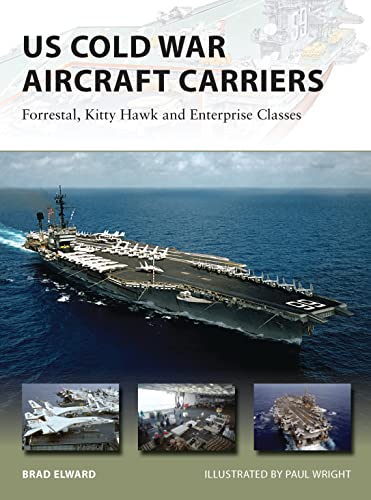
Synopsis
Supercarriers became the ultimate in aircraft carrier design after World War II. Naval aviation allows fleets to project mobile power across vast distances, and these floating cities epitomize this mission design.
The Forrestal class (Forrestal, CV-59; Saratoga, CV-60; Ranger, CV-61 and Independence, CV-62) was the first completed class of US Navy supercarriers, so-named for their 25 percent size increase over the World War II-era carriers such as the Midway class, and the strength of their air wings (80-100 aircraft, compared to 65-75 for the Midway, and fewer than 50 for the Essex class). Design-wise, the Forrestals were a huge improvement over their predecessors, being more stable and comfortable, while maintaining advancements such as the armored flight decks that had been introduced with the Midway. The Kitty Hawk class was an improvement on the Forrestal-class designs, and four were built in the 1960s - Kitty Hawk (CV-63), Constellation (CV-64), America (CV-66) and John F. Kennedy (CV-67). These were even longer than the Forrestals, and fitted with advanced defensive weapons systems and an improved elevator layout. John F. Kennedy, while originally intended as one of the Kitty Hawk class, received so many modifications during construction that she essentially formed her own class, and was originally planned to become the US Navy's first nuclear-powered carrier. This plan never came to fruition, however, and that honor was left to her successor, USS Enterprise (CVN-65). The only ship of her class, Enterprise holds several other distinctions - the longest naval vessel in the world, the second-oldest commissioned vessel in the US Navy (after the USS Constitution), and, when retired in 2013, will have served 51 years - far longer than any other US carrier. All nine of the carriers covered by this volume are icons, and hold a much-respected place in US naval history. They are also some of the more well-known vessels outside of the military, for their long service histories, as well as for some of the more unfortunate events that seem to follow them - from Kitty Hawk's infamous 1972 "grilled cheese" race riot, to the fires that ravaged Forrestal in 1967 and Enterprise in 1969. Though swiftly superseded, first by each other, then by the Nimitz class, these vessels were the US Navy's backbone during the Cold War.
"synopsis" may belong to another edition of this title.
About the Authors
Brad Elward is an aviation journalist and author, having had work published in such periodicals as 'World Air Power Journal'. He has written more than ten books on military aviation, including several for Osprey.
Paul Wright has painted ships of all kinds for most of his career, specializing in steel and steam warships from the late 19th century to the present day. Paul's art has illustrated the works of Patrick O'Brian, Dudley Pope and C.S. Forester amongst others, and hangs in many corporate and private collections all over the world. A Member of the Royal Society of Marine Artists, Paul lives and works in Surrey.
"About this title" may belong to another edition of this title.
Search results for US Cold War Aircraft Carriers: Forrestal, Kitty Hawk...

Stock Image
US Cold War Aircraft Carriers: Forrestal, Kitty Hawk and Enterprise Classes (New Vanguard, 211)
Seller: HPB-Diamond, Dallas, TX, U.S.A.
Seller rating 5 out of 5 stars

paperback. Condition: Very Good. Wright, Paul (illustrator). Connecting readers with great books since 1972! Used books may not include companion materials, and may have some shelf wear or limited writing. We ship orders daily and Customer Service is our top priority! Seller Inventory # S_467733084
Stock Image
US Cold War Aircraft Carriers: Forrestal, Kitty Hawk and Enterprise Classes (New Vanguard Series No.211)
Published by
Osprey Publishing, 2014
ISBN 10: 1782003800
ISBN 13: 9781782003809
Used
Soft cover
First Edition
Seller: Jeff Stark, Barstow, CA, U.S.A.
Seller rating 5 out of 5 stars
Soft cover. Condition: Fine. Wright, Paul (illustrator). 1st Edition. Bright and fine with no wear or markings - looks new. 1st printing indicated on copyright page. Seller Inventory # 064266
Stock Image
US Cold War Aircraft Carriers: Forrestal, Kitty Hawk and Enterprise Classes: 211 (New Vanguard)
Published by
Osprey Publishing, 2014
ISBN 10: 1782003800
ISBN 13: 9781782003809
Used
Soft cover
First Edition
Seller: Lewes Book Centre, LEWES East Sussex, ES, United Kingdom
Seller rating 4 out of 5 stars

Soft cover. Condition: As New. Wright, Paul (illustrator). 1st Edition. As new soft cover.2014,1st edition.NEW VANGUARD.211. Seller Inventory # 33305
Buy Used
US$ 10.25
US$ 5.44 shipping
Ships from United Kingdom to U.S.A.
Ships from United Kingdom to U.S.A.
Quantity: 1 available
Stock Image
US Cold War Aircraft Carriers Format: Paperback
Seller: INDOO, Avenel, NJ, U.S.A.
Seller rating 5 out of 5 stars
Condition: As New. Wright, Paul (illustrator). Unread copy in mint condition. Seller Inventory # VH9781782003809
Seller Image
US Cold War Aircraft Carriers
Published by
Bloomsbury Publishing PLC, GB, 2014
ISBN 10: 1782003800
ISBN 13: 9781782003809
New
Paperback
Seller: Rarewaves USA, HEBRON, KY, U.S.A.
Seller rating 5 out of 5 stars
Paperback. Condition: New. Wright, Paul (illustrator). An in-depth look at the first US super carriers - from the design and development of the Forrestal, Kitty Hawk and Enterprise classes, to their operational history during the Cold War and beyond.The Forrestal class (Forrestal, Saratoga, Ranger, and Independence) was the first completed class of US Navy supercarriers, so-named for their 25 percent size increase over the World War II-era carriers such as the Midway class. Design-wise, the Forrestals were a huge improvement over their predecessors, being more stable and comfortable, while maintaining advancements such as the armored flight decks that had been introduced with the Midway.Brad Elward examines the history of this class of carrier and its successors. The Kitty Hawk class was an improvement on the Forrestal-class designs, and four were built in the 1960s - Kitty Hawk, Constellation, America and John F. Kennedy. These were even longer than the Forrestals, and fitted with advanced defensive weapons systems and an improved elevator layout.Featuring special illustrations, this is a history of nine iconic carriers that hold a much-respected place in US naval history. Seller Inventory # LU-9781782003809
Stock Image
US Cold War Aircraft Carriers Format: Paperback
Seller: INDOO, Avenel, NJ, U.S.A.
Seller rating 5 out of 5 stars
Condition: New. Wright, Paul (illustrator). Seller Inventory # 9781782003809
Stock Image
US Cold War Aircraft Carriers : Forrestal, Kitty Hawk and Enterprise Classes
Published by
Bloomsbury Publishing Plc, 2014
ISBN 10: 1782003800
ISBN 13: 9781782003809
Used
Softcover
Seller: Better World Books, Mishawaka, IN, U.S.A.
Seller rating 5 out of 5 stars
Condition: Good. Wright, Paul (illustrator). Pages intact with minimal writing/highlighting. The binding may be loose and creased. Dust jackets/supplements are not included. Stock photo provided. Product includes identifying sticker. Better World Books: Buy Books. Do Good. Seller Inventory # 68610289-6
Seller Image
US Cold War Aircraft Carriers - Forrestal, Kitty Hawk and Enterprise Classes (New Vanguard)
Seller: Blue Mountain Collectibles, LLC, Front Royal, VA, U.S.A.
Seller rating 4 out of 5 stars
Softcover. Condition: New. Wright, Paul (illustrator). Seller Inventory # BK11647
Stock Image
US Cold War Aircraft Carriers: Forrestal, Kitty Hawk and Enterprise Classes: 211 (New Vanguard)
Seller: AwesomeBooks, Wallingford, United Kingdom
Seller rating 5 out of 5 stars
Paperback. Condition: Very Good. Wright, Paul (illustrator). US Cold War Aircraft Carriers: Forrestal, Kitty Hawk and Enterprise Classes: 211 (New Vanguard) This book is in very good condition and will be shipped within 24 hours of ordering. The cover may have some limited signs of wear but the pages are clean, intact and the spine remains undamaged. This book has clearly been well maintained and looked after thus far. Money back guarantee if you are not satisfied. See all our books here, order more than 1 book and get discounted shipping. Seller Inventory # 7719-9781782003809
Buy Used
US$ 17.72
US$ 5.46 shipping
Ships from United Kingdom to U.S.A.
Ships from United Kingdom to U.S.A.
Quantity: 2 available
Stock Image
US Cold War Aircraft Carriers: Forrestal, Kitty Hawk and Enterprise Classes: 211 (New Vanguard)
Seller: Bahamut Media, Reading, United Kingdom
Seller rating 4 out of 5 stars
Paperback. Condition: Very Good. Wright, Paul (illustrator). This book is in very good condition and will be shipped within 24 hours of ordering. The cover may have some limited signs of wear but the pages are clean, intact and the spine remains undamaged. This book has clearly been well maintained and looked after thus far. Money back guarantee if you are not satisfied. See all our books here, order more than 1 book and get discounted shipping. Seller Inventory # 6545-9781782003809
Buy Used
US$ 17.42
US$ 9.26 shipping
Ships from United Kingdom to U.S.A.
Ships from United Kingdom to U.S.A.
Quantity: 2 available