
Items related to OpenCV 3 Computer Vision with Python Cookbook: Leverage...
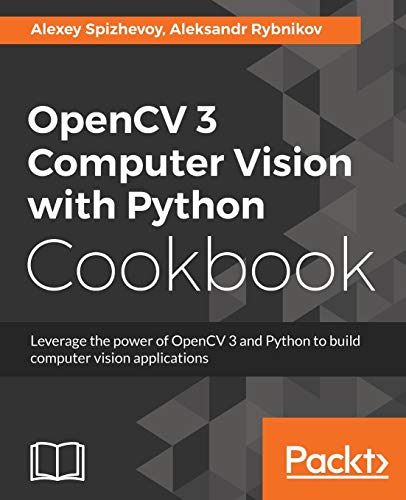
OpenCV 3 Computer Vision with Python Cookbook: Leverage the power of OpenCV 3 and Python to build computer vision applications - Softcover
Synopsis
Key Features
- Build computer vision applications with OpenCV functionality via Python API
- Get your hands dirty with image processing, image/video analysis, multiple view geometry, and machine learning
- Learn how to use state-of-the-art deep learning models for image classification, object detection, and face recognition
Book Description
OpenCV 3 is a native cross-platform library for computer vision, machine learning, and image processing. OpenCV's convenient high-level APIs hide very powerful internals designed for computational efficiency and with a strong focus on real-time applications that can take advantage of multicore and GPU processing. This book will help you tackle increasingly challenging computer vision problems by providing number of recipes that you can improvise in your existing applications.
In this book, you will learn how to process an image by manipulating pixels and analyze an image using histograms. It will guide you on how to segment images into homogeous regions and extract meaningful objects. Then you will learn how to apply image filters to enhance image content and exploit the image geometry in order to relay different views of a pictured scene. Techniques to achieve camera calibration and perform multiple-view analysis will also be explained. You will be presented with various recipes on how to reconstruct a 3D scene from images. Later you will work on conversion of low level pixel information to high level concepts for applications such as object detection and recognition and scene monitoring and you'll discover how to process video from files or cameras, as well as how to detect and track moving objects. Finally, you'll also get acquainted with recent approaches in deep learning, object classification, and neural networks.
By the end of the book, you will be able to apply skills in OpenCV to create and explore computer vision applications in various domains.
What you will learn
- Build OpenCV from sources with Python API support
- Get familiar with low-level image processing methods
- Learn common linear algebra tools needed in computer vision
- Implement camera models and epipolar geometry tools
- Find out how to detect interesting points in images and compare them
- Binarize images and common image masks functionality
- Detect objects and track them in video
- Apply state-of-the-art deep learning models for image classification, object detection, and face recognition
"synopsis" may belong to another edition of this title.
About the Author
Alexey Spizhevoy has more than 7 years of experience in computer vision R&D. He has worked for 5 years at Itseez, the main OpenCV contributor before having been acquired by Intel. He has contributed video stabilization and photo stitching modules into OpenCV library. He has successfully participated (both as an engineer and a tech leader) in numerous computer vision projects (involving machine/deep learning) in areas such as 3D reconstruction, video conferencing, object detection and tracking, gaze direction estimation, semantic segmentation, driving assistance, path planning, and others. He holds a master's degree in computer science, and is currently pursuing PhD.
Aleksandr Rybnikov has more than 5 years of experience in C++ programming, including 3 years in computer vision domain. He was an engineer at Itseez, a company which supported and developed OpenCV. After Itseez's acquisition, he brought OpenCV's dnn module to a new level by adding support of another two DL frameworks and many features along with improving and enriching the existing functionality. He was involved as an engineer in several computer vision and deep learning projects including iris recognition, object detection, semantic segmentation, and autonomous navigation. He took part in holograms reconstruction scientific project. He has a master's degree in Physics.
"About this title" may belong to another edition of this title.
Search results for OpenCV 3 Computer Vision with Python Cookbook: Leverage...

Stock Image
OpenCV 3 Computer Vision with Python Cookbook: Leverage the power of OpenCV 3 and Python to build computer vision applications
Seller: HPB-Diamond, Dallas, TX, U.S.A.
Seller rating 5 out of 5 stars

paperback. Condition: Very Good. Connecting readers with great books since 1972! Used books may not include companion materials, and may have some shelf wear or limited writing. We ship orders daily and Customer Service is our top priority! Seller Inventory # S_470318630
Stock Image
OpenCV 3 Computer Vision with Python Cookbook: Leverage the power of OpenCV 3 and Python to build computer vision applications
Seller: AwesomeBooks, Wallingford, United Kingdom
Seller rating 5 out of 5 stars
Paperback. Condition: Very Good. OpenCV 3 Computer Vision with Python Cookbook: Leverage the power of OpenCV 3 and Python to build computer vision applications This book is in very good condition and will be shipped within 24 hours of ordering. The cover may have some limited signs of wear but the pages are clean, intact and the spine remains undamaged. This book has clearly been well maintained and looked after thus far. Money back guarantee if you are not satisfied. See all our books here, order more than 1 book and get discounted shipping. . Seller Inventory # 7719-9781788474443
Buy Used
US$ 40.48
US$ 5.51 shipping
Ships from United Kingdom to U.S.A.
Ships from United Kingdom to U.S.A.
Quantity: 1 available
Seller Image
OpenCV 3 Computer Vision with Python Cookbook: Leverage the power of OpenCV 3 and Python to build computer vision applications
Seller: WeBuyBooks, Rossendale, LANCS, United Kingdom
Seller rating 5 out of 5 stars
paperback. Condition: Very Good. Most items will be dispatched the same or the next working day. A copy that has been read, but is in excellent condition. Pages are intact and not marred by notes or highlighting. The spine remains undamaged. Seller Inventory # rev2859779589
Buy Used
US$ 37.78
US$ 9.35 shipping
Ships from United Kingdom to U.S.A.
Ships from United Kingdom to U.S.A.
Quantity: 1 available
Stock Image
OpenCV 3 Computer Vision with Python Cookbook: Leverage the power of OpenCV 3 and Python to build computer vision applications
Published by
Packt Publishing 01/r /23 M, 2018
ISBN 10: 1788474449
ISBN 13: 9781788474443
Used
Paperback
Seller: Bahamut Media, Reading, United Kingdom
Seller rating 4 out of 5 stars

Paperback. Condition: Very Good. Shipped within 24 hours from our UK warehouse. Clean, undamaged book with no damage to pages and minimal wear to the cover. Spine still tight, in very good condition. Remember if you are not happy, you are covered by our 100% money back guarantee. Seller Inventory # 6545-9781788474443
Buy Used
US$ 40.48
US$ 9.34 shipping
Ships from United Kingdom to U.S.A.
Ships from United Kingdom to U.S.A.
Quantity: 1 available
Seller Image
OpenCV 3 Computer Vision with Python Cookbook
Seller: GreatBookPrices, Columbia, MD, U.S.A.
Seller rating 5 out of 5 stars
Condition: As New. Unread book in perfect condition. Seller Inventory # 32446700
Seller Image
OpenCV 3 Computer Vision with Python Cookbook
Seller: GreatBookPrices, Columbia, MD, U.S.A.
Seller rating 5 out of 5 stars
Condition: New. Seller Inventory # 32446700-n
Stock Image
OpenCV 3 Computer Vision with Python Cookbook: Leverage the power of OpenCV 3 and Python to build computer vision applications
Seller: California Books, Miami, FL, U.S.A.
Seller rating 5 out of 5 stars
Condition: New. Seller Inventory # I-9781788474443
Stock Image
OpenCV 3 Computer Vision with Python Cookbook
Print on DemandSeller: PBShop.store US, Wood Dale, IL, U.S.A.
Seller rating 5 out of 5 stars
PAP. Condition: New. New Book. Shipped from UK. THIS BOOK IS PRINTED ON DEMAND. Established seller since 2000. Seller Inventory # L0-9781788474443
Stock Image
OpenCV 3 Computer Vision with Python Cookbook : Leverage the power of OpenCV 3 and Python to build computer vision applications
Print on DemandSeller: Chiron Media, Wallingford, United Kingdom
Seller rating 5 out of 5 stars
PF. Condition: New. This item is printed on demand. Brand new book, sourced directly from publisher. Dispatch time is 6-7 days from our warehouse. Book will be sent in robust, secure packaging to ensure it reaches you securely. Seller Inventory # 6666-IUK-9781788474443
Buy New
US$ 57.21
US$ 8.68 shipping
Ships from United Kingdom to U.S.A.
Ships from United Kingdom to U.S.A.
Quantity: 20 available
Stock Image
OpenCV 3 Computer Vision with Python Cookbook
Print on DemandSeller: PBShop.store UK, Fairford, GLOS, United Kingdom
Seller rating 5 out of 5 stars
PAP. Condition: New. New Book. Delivered from our UK warehouse in 4 to 14 business days. THIS BOOK IS PRINTED ON DEMAND. Established seller since 2000. Seller Inventory # L0-9781788474443
Buy New
US$ 62.15
US$ 6.72 shipping
Ships from United Kingdom to U.S.A.
Ships from United Kingdom to U.S.A.
Quantity: Over 20 available