
Items related to The Stuff of Thought.
Synopsis
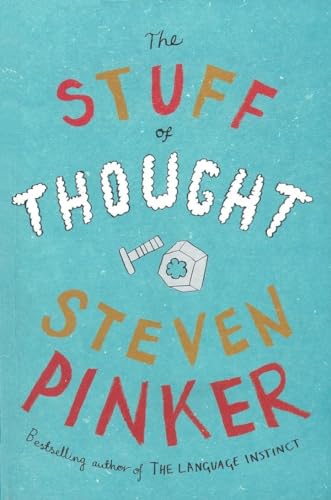
The Stuff of Thought: Language as a Window into Human Nature By Steven Pinker
"synopsis" may belong to another edition of this title.
About the Author
Steven Pinker is the Johnstone Family professor of Psychology and Harvard College Professor of Psychology at Harvard University. A two-time Pulitzer Prize finalist and the winner of many awards for his research, teaching, and books, he has been named one of Time's 100 Most Influential People in the World Today and Foreign Policy's 100 Global Thinkers. His other books include The Better Angels of our Nature and The Blank Slate.
Reviews
Reviewed by Jonah Lehrer
Language comes so naturally to us that it's easy to believe there's some sort of intrinsic logic connecting the thing and its name, the signifier and the signified. In one of Plato's dialogues, a character named Cratylus argues that "a power more than human gave things their first names."
But Cratylus was wrong. Human language is an emanation of the human mind. A thing doesn't care what we call it. Words and their rules don't tell us about the world; they tell us about ourselves.
That's the simple premise behind Steven Pinker's latest work of popular science. According to the Harvard psychologist, people are "verbivores, a species that lives on words." If you want to understand how the brain works, how it thinks about space and causation and time, how it processes emotions and engages in social interactions, then you need to plunge "down the rabbit hole" of language. The quirks of our sentences are merely a portal to the mind.
In The Stuff of Thought, Pinker pitches himself as the broker of a scientific compromise between "linguistic determinism" and "extreme nativism." The linguistic determinists argue that language is a prison for thought. The words we know define our knowledge of the world. Because Eskimos have more nouns for snow, they are able to perceive distinctions in snow that English speakers cannot. While Pinker deftly discredits extreme versions of this hypothesis, he admits that "boring versions" of linguistic determinism are probably accurate. It shouldn't be too surprising that our choice of words can frame events, or that our vocabulary reflects the kinds of things we encounter in our daily life. (Why do Eskimos have so many words for snow? Because they are always surrounded by snow.) The language we learn as children might not determine our thoughts, but it certainly influences them.
Extreme nativism, on the other hand, argues that all of our mental concepts -- the 50,000 or so words in the typical vocabulary -- are innate. We are born knowing about carburetors and doorknobs and iPods. This bizarre theory, most closely identified with the philosopher Jerry Fodor, begins with the assumption that the meaning of words cannot be dissected into more basic parts. A doorknob is a doorknob is a doorknob. It only takes Pinker a few pages to prove the obvious, which is that each word is not an indivisible unit. The mind isn't a blank slate, but it isn't an overstuffed filing cabinet either.
So what is Pinker's solution? He advocates the middle ground of "conceptual semantics," in which the meaning of our words depends on an underlying framework of basic cognitive concepts. (As Pinker admits, he owes a big debt to Kant.) The tenses of verbs, for example, are shaped by our innate sense of time. Nouns are constrained by our intuitive notions about matter, so that we naturally parcel things into two different categories, objects and substances (pebbles versus applesauce, for example, or, as Pinker puts it, "hunks and goo"). Each material category comes with a slightly different set of grammatical rules. By looking at language from the perspective of our thoughts, Pinker demonstrates that many seemingly arbitrary aspects of speech, like that hunk and goo distinction, aren't arbitrary at all: They are byproducts of our evolved mental machinery.
Pinker tries hard to make this tour of linguistic theory as readable as possible. He uses the f-word to explore the topic of transitive and intransitive verbs. He clarifies indirect speech by examining a scene from "Tootsie," and Lenny Bruce makes so many appearances that he should be granted a posthumous linguistic degree. But profanity from Lenny Bruce can't always compensate for the cryptic vocabulary and long list of competing 'isms. Sometimes, the payoff can be disappointing. After a long chapter on curse words -- this book deserves an "explicit content" warning -- Pinker ends with the banal conclusion that swearing is "connected with negative emotion." I don't need conceptual semantics to tell me that.
The Stuff of Thought concludes with an optimistic gloss on the power of language to lead us out of the Platonic cave, so that we can "transcend our cognitive and emotional limitations." It's a nice try at a happy ending, but I don't buy it. The Stuff of Thought, after all, is really about the limits of language, the way our prose and poetry are bound by innate constraints we can't even comprehend. Flaubert was right: "Language is a cracked kettle on which we beat out tunes for bears to dance to, while all the time we long to move the stars to pity."
Copyright 2007, The Washington Post. All Rights Reserved.
By examining our words, we can learn a lot about who we are. So argues Harvard academic and popular science writer Steven Pinker in The Stuff of Thought, a logical extension of his previous books. Pinker once again caters to a popular (though scientifically literate) audience, using accessible examples from jokes, Shakespeare, pop songs, and films to understand the science. One fascinating chapter explores the value of metaphors; another covers swearing (did you know that "gee whiz" is derived from "Jesus"?). A few critics tired of the myriad examples and pointed out a lack of unifying threads; others wanted more concrete answers; a couple challenged Pinker’s entire thesis that language is an accurate guide to our mind. According to them, it is as if Pinker was determined to combine his broad-based, popular science acumen with his in-depth linguistics expertiseâ€""the perfect storm" of his work. But if this book is not food for thought, then no other book of its kind is.
Copyright © 2004 Phillips & Nelson Media, Inc.
Unless you have a reasonably good background in linguistics, you'll find this excellent book much easier to read than to listen to. Olsher is not to blame; he reads clearly and at a (slightly rapid) conversational speed. Pinker aims for the educated lay reader, using wit and popular metaphor to clarify his meanings and bring abstruse linguistic concepts to life. But his sentences are dense; you need to reread them and think them through. And the jargon, though clearly defined, requires time and thought to absorb: Though hypernyms are not really examples of polysemy the way metonyms are, their use in emotionally tinged speech is another illustration of how choice among words can make a psychological difference. Such sentences are followed by clarifying illustrations, but they require cogitation—work that is well rewarded by a deeper and more complex understanding of language as a window into the mind. The chapter on the semantics of swearing is particularly fun and enlightening. In every culture swear words concern gods, diseases, excretions and sex, and Pinker tells us why. A person with some knowledge of linguistic theory will enjoy this audio enormously; a person without it will be enriched and delighted by the book, but have great difficulties with the audio version.
Copyright © Reed Business Information, a division of Reed Elsevier Inc. All rights reserved.
THE STUFF OF THOUGHT is a wonderful book, but you might not want to listen to it in public without headphones. Its not the delivery. Dean Olsher does a great job narrating. Experimental psychologist (Harvard) Steven Pinker blends philosophical speculation with personal anecdotes as he analyzes the role of language in thought. Olsher matches these wide-ranging needs. He is confident and moderately paced when introducing new concepts and seems as tickled as Pinker when recounting linguistic silliness. However, at one point Pinker analyzes the nature of obscenity. This is completely on topic--Pinker examines the roots of obscenity and shares what neurobiology has to say on the matter--but it may take some explaining if anyone should overhear the requisite cursing. G.T.B. © AudioFile 2008, Portland, Maine-- Copyright © AudioFile, Portland, Maine
Experimental psychologist and cognitive scientist Pinker is fascinated by the symbiosis between language and thought. In this stimulating volume, a continuation of the discussion found in The Language Instinct (1994), he argues for the "real-world importance" of "the relation of language to our inner and outer worlds." Anchoring his discussion of why semantics matter to 9/11 and other momentous public events, Pinker teases apart the gap between the literal meanings of words and their elaborate connotations, which leads to fresh explanations of humor, the importance of metaphors, and the significance of swearing. Some of the most mind-expanding chapters involve the subtlest, most taken-for-granted aspects of mind, namely our sense of time, space, and causality. Drawing on philosophy, evolutionary psychology, physics, neurology, anthropology, and jokes, Pinker presents a convincing theory of conceptual semantics, itemizing the "fundamental ideas" that form the "language of thought." From politics to poetry, children's wonderful malapropisms to slang, Pinker's fluency in the nuances of words and syntax serves as proof of his faith in language as "a window into human nature." Seaman, Donna
Excerpt. © Reprinted by permission. All rights reserved.
1
WORDS AND WORLDS
On September 11, 2001, at 8:46 A.M., a hijacked airliner crashed into the north tower of the World Trade Center in New York. At 9:03 A.M. a second plane crashed into the south tower. The resulting infernos caused the buildings to collapse, the south tower after burning for an hour and two minutes, the north tower twenty-three minutes after that. The attacks were masterminded by Osama bin Laden, leader of the Al Qaeda terrorist organization, who hoped to intimidate the United States into ending its military presence in Saudi Arabia and its support for Israel and to unite Muslims in preparation for a restoration of the caliphate.
9/11, as the happenings of that day are now called, stands as the most significant political and intellectual event of the twenty-first century so far. It has set off debates on a vast array of topics: how best to memorialize the dead and revitalize lower Manhattan; whether the attacks are rooted in ancient Islamic fundamentalism or modern revolutionary agitation; the role of the United States on the world stage before the attacks and in response to them; how best to balance protection against terrorism with respect for civil liberties.
But I would like to explore a lesser-known debate triggered by 9/11. Exactly how many events took place in New York on that morning in September?
It could be argued that the answer is one. The attacks on the buildings were part of a single plan conceived in the mind of one man in service of a single agenda. They unfolded within a few minutes and yards of each other, targeting the parts of a complex with a single name, design, and owner. And they launched a single chain of military and political events in their aftermath.
Or it could be argued that the answer is two. The north tower and the south tower were distinct collections of glass and steel separated by an expanse of space, and they were hit at different times and went out of existence at different times. The amateur video that showed the second plane closing in on the south tower as the north tower billowed with smoke makes the twoness unmistakable: in those horrifying moments, one event was frozen in the past, the other loomed in the future. And another occurrence on that day—a passenger mutiny that brought down a third hijacked plane before it reached its target in Washington—presents to the imagination the possibility that one tower or the other might have been spared. In each of those possible worlds a distinct event took place, so in our actual world, one might argue, there must be a pair of events as surely as one plus one equals two.
The gravity of 9/11 would seem to make this entire discussion frivolous to the point of impudence. It’s a matter of mere “semantics,” as we say, with its implication of picking nits, splitting hairs, and debating the number of angels that can dance on the head of a pin. But this book is about semantics, and I would not make a claim on your attention if I did not think that the relation of language to our inner and outer worlds was a matter of intellectual fascination and real-world importance.
Though “importance” is often hard to quantify, in this case I can put an exact value on it: three and a half billion dollars. That was the sum in dispute in a set of trials determining the insurance payout to Larry Silverstein, the leaseholder of the World Trade Center site. Silverstein held insurance policies that stipulated a maximum reimbursement for each destructive “event.” If 9/11 comprised a single event, he stood to receive three and a half billion dollars. If it comprised two events, he stood to receive seven billion. In the trials, the attorneys disputed the applicable meaning of the term event. The lawyers for the leaseholder defined it in physical terms (two collapses); those for the insurance companies defined it in mental terms (one plot). There is nothing “mere” about semantics!
Nor is the topic intellectually trifling. The 9/11 cardinality debate is not about the facts, that is, the physical events and human actions that took place that day. Admittedly, those have been contested as well: according to various conspiracy theories, the buildings were targeted by American missiles, or demolished by a controlled implosion, in a plot conceived by American neoconservatives, Israeli spies, or a cabal of psychiatrists. But aside from the kooks, most people agree on the facts. Where they differ is in the construal of those facts: how the intricate swirl of matter in space ought to be conceptualized by human minds. As we shall see, the categories in this dispute permeate the meanings of words in our language because they permeate the way we represent reality in our heads.
Semantics is about the relation of words to thoughts, but it is also about the relation of words to other human concerns. Semantics is about the relation of words to reality—the way that speakers commit themselves to a shared understanding of the truth, and the way their thoughts are anchored to things and situations in the world. It is about the relation of words to a community—how a new word, which arises in an act of creation by a single speaker, comes to evoke the same idea in the rest of a population, so people can understand one another when they use it. It is about the relation of words to emotions: the way in which words don’t just point to things but are saturated with feelings, which can endow the words with a sense of magic, taboo, and sin. And it is about words and social relations—how people use language not just to transfer ideas from head to head but to negotiate the kind of relationship they wish to have with their conversational partner.
A feature of the mind that we will repeatedly encounter in these pages is that even our most abstract concepts are understood in terms of concrete scenarios. That applies in full force to the subject matter of the book itself. In this introductory chapter I will preview some of the book’s topics with vignettes from newspapers and the Internet that can be understood only through the lens of semantics. They come from each of the worlds that connect to our words—the worlds of thought, reality, community, emotions, and social relations.
WORDS AND THOUGHTS
Let’s look at the bone of contention in the world’s most expensive debate in semantics, the three-and-a-half-billion-dollar argument over the meaning of “event.” What, exactly, is an event? An event is a stretch of time, and time, according to physicists, is a continuous variable—an inexorable cosmic flow, in Newton’s world, or a fourth dimension in a seamless hyperspace, in Einstein’s. But the human mind carves this fabric into the discrete swatches we call events. Where does the mind place the incisions? Sometimes, as the lawyers for the World Trade Center leaseholder pointed out, the cut encircles the change of state of an object, such as the collapse of a building. And sometimes, as the lawyers for the insurers pointed out, it encircles the goal of a human actor, such as a plot being executed. Most often the circles coincide: an actor intends to cause an object to change, the intent of the actor and the fate of the object are tracked along a single time line, and the moment of change marks the consummation of the intent.
The conceptual content behind the disputed language is itself like a language (an idea I will expand in chapters 2 and 3). It represents an analogue reality by digital, word-sized units (such as “event”), and it combines them into assemblies with a syntactic structure rather than tossing them together like rags in a bag. It’s essential to our understanding of 9/11, for example, not only that bin Laden acted to harm the United States, and that the World Trade Center was destroyed around that time, but that it was bin Laden’s act that caused the destruction. It’s the causal link between the intention of a particular man and a change in a particular object that distinguishes the mainstream understanding of 9/11 from the conspiracy theories. Linguists call the inventory of concepts and the schemes that combine them “conceptual semantics.”1 Conceptual semantics—the language of thought—must be distinct from language itself, or we would have nothing to go on when we debate what our words mean.
The fact that rival construals of a single occurrence can trigger an extravagant court case tells us that the nature of reality does not dictate the way that reality is represented in people’s minds. The language of thought allows us to frame a situation in different and incompatible ways. The unfolding of history on the morning of September 11 in New York can be thought of as one event or two events depending on how we mentally describe it to ourselves, which in turn depends on what we choose to focus on and what we choose to ignore. And the ability to frame an event in alternative ways is not just a reason to go to court but also the source of the richness of human intellectual life. As we shall see, it provides the materials for scientific and literary creativity, for humor and wordplay, and for the dramas of social life. And it sets the stage in countless arenas of human disputation. Does stem-cell research destroy a ball of cells or an incipient human? Is the American military incursion into Iraq a case of invading a country or of liberating a country? Does abortion consist of ending a pregnancy or of killing a child? Are high tax rates a way to redistribute wealth or to confiscate earnings? Is socialized medicine a program to protect citizens’ health or to expand government power? In all these debates, two ways of framing an event are pitted against each other, and the disputants struggle to show that their framing is more apt (a criterion we will explore in chapter 5). In the past decade prominent linguists have been advising American Democrats on how the Republican Party has outframed them in recent elections and on how they might regain control of the semantics of political debate by reframing, for example, taxes as membership fees and activist judges as freedom judges.2
The 9/11 cardinality debate highlights another curious fact about the language of thought. In puzzling over how to count the events of that day, it asks us to treat them as if they were objects that can be tallied, like poker chips in a pile. The debate over whether there was one event or two in New York that day is like a disagreement over whether there is one item or two at an express checkout lane, such as a pair of butter sticks taken out of a box of four, or a pair of grapefruits selling at two for a dollar. The similar ambiguity in tallying objects and tallying events is one of the many ways in which space and time are treated equivalently in the human mind, well before Einstein depicted them as equivalent in reality.
As we shall see in chapter 4, the mind categorizes matter into discrete things (like a sausage) and continuous stuff (like meat), and it similarly categorizes time into discrete events (like to cross the street) and continuous activities (like to stroll). With both space and time, the same mental zoom lens that allows us to count objects or events also allows us to zoom in even closer on what each one is made of. In space, we can focus on the material making up an object (as when we say I got sausage all over my shirt); in time, we can focus on an activity making up an event (as when we say She was crossing the street). This cognitive zoom lens also lets us pan out in space and see a collection of objects as an aggregate (as in the difference between a pebble and gravel), and it allows us to pan out in time and see a collection of events as an iteration (as in the difference between hit the nail and pound the nail). And in time, as in space, we mentally place an entity at a location and then shunt it around: we can move a meeting from 3:00 to 4:00 in the same way that we move a car from one end of the block to the other. And speaking of an end, even some of the fine points of our mental geometry carry over from space to time. The end of a string is technically a point, but we can say Herb cut off the end of the string, showing that an end can be construed as including a snippet of the matter adjacent to it. The same is true in time: the end of a lecture is technically an instant, but we can say I’m going to give the end of my lecture now, construing the culmination of an event as including a small stretch of time adjacent to it.3
As we shall see, language is saturated with implicit metaphors like EVENTS ARE OBJECTS and TIME IS SPACE. Indeed, space turns out to be a conceptual vehicle not just for time but for many kinds of states and circumstances. Just as a meeting can be moved from 3:00 to 4:00, a traffic light can go from green to red, a person can go from flipping burgers to running a corporation, and the economy can go from bad to worse. Metaphor is so widespread in language that it’s hard to find expressions for abstract ideas that are not metaphorical. What does the concreteness of language say about human thought? Does it imply that even our wispiest concepts are represented in the mind as hunks of matter that we move around on a mental stage? Does it say that rival claims about the world can never be true or false but can only be alternative metaphors that frame a situation in different ways? Those are the obsessions of chapter 5.
WORDS AND REALITY
The aftermath of 9/11 spawned another semantic debate, one with consequences even weightier than the billions of dollars at stake in how to count the events on that day. This one involves a war that has cost far more money and lives than 9/11 itself and that may affect the course of history for the rest of the century. The debate hinges on the meaning of another set of words—sixteen of them, to be exact:
The British government has learned that Saddam Hussein recently sought significant quantities of uranium from Africa.
This sentence appeared in George W. Bush’s State of the Union address in January 2003. It referred to intelligence reports suggesting that Saddam may have tried to buy five hundred tons of a kind of uranium ore called yellowcake from sources in Niger in West Africa. For many Americans and Britons the possibility that Saddam was assembling nuclear weapons was the only defensible reason to invade Iraq and depose Saddam. The United States led the invasion in the spring of that year, the most despised American foreign policy initiative since the war in Vietnam. During the occupation it became clear that Saddam had had no facilities in place to manufacture nuclear weapons, and probably had never explored the possibility of buying yellowcake from Niger. In the words of placards and headlines all over the world, “Bush Lied.”
"About this title" may belong to another edition of this title.
Search results for The Stuff of Thought.

Stock Image
The Stuff of Thought.
Published by
Penguin Books Ltd (edition First Edition), 2007
ISBN 10: 1846140501
ISBN 13: 9781846140501
Used
Paperback
First Edition
Seller: BooksRun, Philadelphia, PA, U.S.A.
Seller rating 5 out of 5 stars

Paperback. Condition: Fair. First Edition. The item might be beaten up but readable. May contain markings or highlighting, as well as stains, bent corners, or any other major defect, but the text is not obscured in any way. Seller Inventory # 1846140501-7-1
Stock Image
The Stuff of Thought.
Seller: ThriftBooks-Dallas, Dallas, TX, U.S.A.
Seller rating 5 out of 5 stars
Paperback. Condition: Very Good. No Jacket. May have limited writing in cover pages. Pages are unmarked. ~ ThriftBooks: Read More, Spend Less. Seller Inventory # G1846140501I4N00
Seller Image
The Stuff of Thought: Language as a Window Into Human Nature
Seller: WeBuyBooks, Rossendale, LANCS, United Kingdom
Seller rating 5 out of 5 stars
paperback. Condition: Very Good. Most items will be dispatched the same or the next working day. A copy that has been read, but is in excellent condition. Pages are intact and not marred by notes or highlighting. The spine remains undamaged. Seller Inventory # rev6077239169
Buy Used
US$ 7.10
US$ 11.09 shipping
Ships from United Kingdom to U.S.A.
Ships from United Kingdom to U.S.A.
Quantity: 1 available
Stock Image
The Stuff of Thought: Language as a Window Into Human Nature
Seller: Sell Books, Elland, YORKS, United Kingdom
Seller rating 5 out of 5 stars
paperback. Condition: Good. Our good condition books are generally good for reading but not for gifting or collecting. They could have imperfections such as creasing, fanning, inscriptions, margin notes, yellowing, staining on edge or cover or pages, bumps, scuffs, etc etc (sometimes multiple of these). It's a wide category that encompasses anything that isn't almost-new down to anything that is slightly better than poor. We would NOT recommend gifting Good books - these should be considered reading copies. Our books are dispatched from a Yorkshire former cotton mill. We list via barcode/ISBN so please note that the images are stock images and may not be the exact copy you receive, furthermore the details about edition and year might not be accurate as many publishers reuse the same ISBN for multiple editions and as we simply scan a barcode or enter an ISBN we do not check the validity of the edition data when listing. If you're looking for an exact edition please don't order (at least not without checking with us first, although we don't always have time to check). We aim to dispatch prompty, the service used will depend on order value and book size. We can ship to most countries, see our shipping policies. Payment is via Abe only. Seller Inventory # SBAB-mon0000053889
Buy Used
US$ 6.62
US$ 15.21 shipping
Ships from United Kingdom to U.S.A.
Ships from United Kingdom to U.S.A.
Quantity: 1 available