
Items related to Infectious Greed: How Deceit and Risk Corrupted the...
Synopsis
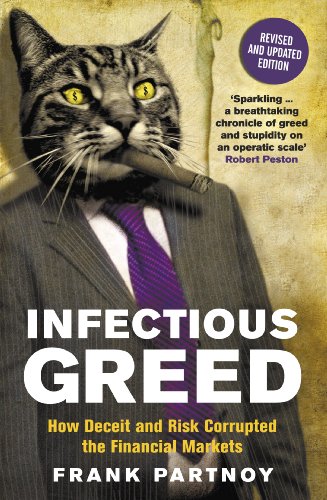
As the global financial crisis unfolds people everywhere are seeking to understand how markets devolved to this perilous, volatile state. In this dazzling and meticulously researched work of financial history, first published in 2003, and now thoroughly revised and updated, law professor and financial expert Frank Partnoy tells the story of how “classical” Wall Street securities like stocks and bonds were quietly eclipsed by ever more “quantum” products like derivatives. He documents how, starting in the mid-1980s, each new level of financial risk and complexity obscured the sickness of corporate America, and how Wall Street's evlving paradigm moved farther and farther beyond the understanding—and regulation—of ordinary investors and government overseers, leading inevitably to disaster.
"synopsis" may belong to another edition of this title.
About the Author
Frank Partnoy is the author of The Match King: Ivar Kreuger, The Financial Genius Behind a Century of Wall Street Scandals, and F.I.A.S.C.O.: Blood in the Water on Wall Street. A graduate of Yale Law School, he is currently the George E. Barrett professor of law and finance at the University of San Diego.
Excerpt. © Reprinted by permission. All rights reserved.
From Infectious Greed:
By 2002, the closing bell of the New York Stock Exchange was barely relevant, as securities traded 24 hours a day, around the world. The largest markets were private, and didn't involve regulated exchanges at all. Financial derivatives were as prevalent as stocks and bonds, and nearly as many assets and liabilities were off balance sheets as on. Companies' reported earnings were a fiction, and financial reports were chock full of disclosures that would shock the average investor if she ever even glanced at them, not that anyone—including financial journalists and analysts—ever did. Trading volatilities were sky high, with historically unrelated markets moving in lock step, increasing the risk of systemic collapse.
In just a few years, regulators had lost what limited control they had over market intermediaries, market intermediaries had lost what limited control they had over corporate managers, and corporate managers had lost what limited control they had over employees. This loss-of-control daisy chain had led to exponential risk-taking at many companies, largely hidden from public view. Simply put, the appearance of control in financial markets was a fiction.
"About this title" may belong to another edition of this title.
Search results for Infectious Greed: How Deceit and Risk Corrupted the...

Seller Image
Infectious Greed: How Deceit and Risk Corrupted the Financial Markets
Seller: WeBuyBooks, Rossendale, LANCS, United Kingdom
Seller rating 5 out of 5 stars

paperback. Condition: Like New. Most items will be dispatched the same or the next working day. An apparently unread copy in perfect condition. Dust cover is intact with no nicks or tears. Spine has no signs of creasing. Pages are clean and not marred by notes or folds of any kind. Seller Inventory # rev4874808433
Buy Used
US$ 88.67
US$ 7.42 shipping
Ships from United Kingdom to U.S.A.
Ships from United Kingdom to U.S.A.
Quantity: 1 available