
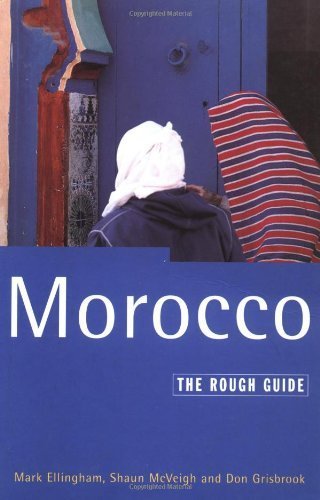
Items related to Morocco: The Rough Guide, Sixth Edition
Synopsis
INTRODUCTION
For Westerners, Morocco holds an immediate and enduring fascination. Though just an hour's ride on the ferry from Spain, it seems at once very far from Europe, with a culture - Islamic and deeply traditional - that is almost wholly unfamiliar. Throughout the country, despite the years of French and Spanish colonial rule and the presence of modern and cosmopolitan cities like Rabat or Casablanca, a more distant past constantly makes its presence felt. Fes, perhaps the most beautiful of all Arab cities, maintains a life still rooted in medieval times, when a Moroccan empire stretched from Senegal to northern Spain; while in the mountains of the Atlas and the Rif, it is still possible to draw up tribal maps of the Berber population. As a backdrop to all this, the country's physical make-up is also extraordinary: from a Mediterranean coast, through four mountain ranges, to the empty sand and scrub of the Sahara.
All of which makes travel here an intense and rewarding - if not always easy - experience. Certainly, there can be problems in coming to terms with your privileged position as tourist in a nation that, for the most part, would regard such activities as those of another world. And the northern cities especially have a reputation for hustlers: self-appointed guides whose eagerness to offer their services - and whose attitude to tourists as being a justifiable source of income (and to women as something much worse) - can be hard to deal with. If you find this to be too much of a struggle, then it would probably be better to keep to low-key resorts like Essaouira or Asilah, or to the more cosmopolitan holiday destination of Agadir, built very much in the image of its Spanish counterparts, or even a packaged sightseeing tour.
But you'd miss a lot that way. Morocco is at its best well away from such trappings. A week's hiking in the Atlas; a journey through the southern oases or into the pre-Sahara; or leisured strolls around Tangier, Fes or Marrakesh - once you adapt to a different way of life, all your time will be well spent. And it is difficult for any traveller to go for long without running into Morocco's equally powerful tradition of hospitality, generosity and openness. This is a country people return to again and again.
Regions
Geographically, the country divides into five basic zones: the coast, Mediterranean and Atlantic; the great cities of the plains; the Rif and Atlas mountains; and the oases and desert of the pre- and fully-fledged Sahara. With two or three weeks - even two or three months - you can't expect to cover all of this, though it's easy enough (and highly recommended) to take in something of each aspect.
You are unlikely to miss the mountains, in any case. The three ranges of the Atlas, with the Rif a kind of extension in the north, cut right across the interior - physical and historical barriers, and inhabited for the most part by the indigenous Moroccan Berbers. Contrary to general preconceptions, it is actually the Berbers who make up most of the population; only around ten percent of Moroccans are "pure" Arabs, although with the shift to the industrialized cities, such distinctions are becoming less and less significant.
A more current distinction, perhaps, is the legacy of Morocco's colonial occupation over the fifty-odd years before it reasserted its independence in 1956. The colonized country was divided into Spanish and French zones - the former contained Tetouan and the Rif, the Mediterranean and the northern Atlantic coasts, and parts of the Western Sahara; the latter comprised the plains and the main cities (Fes, Marrakesh, Casablanca and Rabat), as well as the Atlas. It was the French, who ruled their "protectorate" more closely, who had the most lasting effect on Moroccan culture, Europeanizing the cities to a strong degree and firmly imposing their language, which is spoken today by all educated Moroccans (after Moroccan Arabic or the three local Berber languages).
"synopsis" may belong to another edition of this title.
Excerpt. © Reprinted by permission. All rights reserved.
Highlights
The attractions of the individual regions are discussed in the chapter introductions. Broadly speaking, the coast is best enjoyed in the north at Tangier, beautiful and still shaped by its old "international" port status, Asilah and Larache; in the south at El Jadida; at Essaouira, perhaps the most easy-going resort; or at remote Sidi Ifni. Agadir, the main package tour resort, is less worthwhile - but a functional enough base for exploration.
Inland, where the real interest of Morocco lies, the outstanding cities are Fes and Marrakesh. The great imperial capitals of the country's various dynasties, they are almost unique in the Arab world for the chance they offer to witness some city life that, in patterns and appearance, remains in large part medieval. For monuments, Fes is the highlight, though Marrakesh, the "beginning of the south", is for most visitors the more enjoyable and exciting.
Travel in the south - roughly beyond a line drawn between Casablanca and Meknes - is, on the whole, easier and more relaxing than in the sometimes frenetic north. This is certainly true of the mountain ranges. The Rif, which can feel disturbingly anarchic, is really for hardened travellers; only Chaouen, on its periphery, could be counted a "holiday spot". But the Atlas ranges (Middle, High and Anti-) are beautiful and accessible.
Hiking in the High Atlas, especially around North Africa's highest peak, Djebel Toubkal, is in fact something of a growth industry. Even if you are no more than a casual walker, it is worth considering, with summer treks possible at all levels of experience and altitude. And, despite inroads made by commercialization, it remains essentially "undiscovered" - like the Alps must have been in the last century.
Equally exploratory in mood are the great southern routes beyond - and across - the Atlas, amid the oases of the pre-Sahara. Major routes here can be travelled by bus; minor ones by rented car or local taxi; the really remote ones by four-wheel-drive vehicles or by getting lifts on local camions (lorries), sharing space with the market produce and livestock.
The oases, around Tinerhir, Zagora and Erfoud, or (for the committed) Tata or Figuig, are classic images of the Arab world, vast palmeries stretching into desert horizons. Equally memorable is the architecture that they share with the Atlas - bizarre and fabulous mud (or pis ) kasbahs and ksour, with Gothic-looking turrets and multi-patterned walls.
Climate
As far as the climate goes, it would be better to visit the south - or at least the desert routes - outside midsummer, when for most of the day it's far too hot for casual exploration, especially if you're dependent on public transport. But July and August, the hottest months, can be wonderful on the coast and in the mountains; there are no set rules.
Spring, which comes late by European standards (around April to May), is perhaps the best overall time, with a summer climate in the south and in the mountains, and water warm enough to swim in on both the Mediterranean and Atlantic coasts. Winter can be perfect by day in the south, though be warned that desert nights can get very cold - a major consideration if you're staying in the cheaper hotels, which rarely have heating. If you're planning to hike in the mountains, it's best to keep to the months from April to October unless you have some experience of snow conditions.
Weather conditions apart, the Islamic religious calendar, and its related festivals, will have the most seasonal effect on your travel. The most important factor is Ramadan, the month of daytime fasting; this can be a problem for transport, and especially hiking, though the festive evenings do much to compensate. See "Festivals" in the Basics section following for details of its timing, as well as that of other festivals.
"About this title" may belong to another edition of this title.
Search results for Morocco: The Rough Guide, Sixth Edition

Stock Image
Morocco: The Rough Guide
Seller: World of Books (was SecondSale), Montgomery, IL, U.S.A.
Seller rating 5 out of 5 stars

Paperback. Condition: Very Good. Features of this guide to Morrocco include: practical tips on everything from the best-value hotels and restaurants to transport and the state of the road; lively accounts of the monuments and sites, with informed treatment of Morroccan culture, past and present; descriptions of the routes and landscapes, from mountain pistes to the age-old caravan trails of the desert; and comprehensive coverage of the trekking in the High Atlas, windsurfing on the Atlantic coast and birdwatching among the lakes and estuaries. Seller Inventory # 00103342305
Stock Image
Morocco
Published by
Dorling Kindersley Publishing, Incorporated, 1998
ISBN 10: 1858281695
ISBN 13: 9781858281698
Used
Softcover
Seller: Better World Books, Mishawaka, IN, U.S.A.
Seller rating 5 out of 5 stars
Condition: Good. Pages intact with minimal writing/highlighting. The binding may be loose and creased. Dust jackets/supplements are not included. Stock photo provided. Product includes identifying sticker. Better World Books: Buy Books. Do Good. Seller Inventory # 1595583-6
Stock Image
Morocco the Rough Guide
Published by
Rough Guides 01/01/1998, 1998
ISBN 10: 1858281695
ISBN 13: 9781858281698
Used
Softcover
Seller: AwesomeBooks, Wallingford, United Kingdom
Seller rating 5 out of 5 stars
Condition: Very Good. This book is in very good condition and will be shipped within 24 hours of ordering. The cover may have some limited signs of wear but the pages are clean, intact and the spine remains undamaged. This book has clearly been well maintained and looked after thus far. Money back guarantee if you are not satisfied. See all our books here, order more than 1 book and get discounted shipping. . Seller Inventory # 7719-9781858281698
Buy Used
US$ 3.88
US$ 5.51 shipping
Ships from United Kingdom to U.S.A.
Ships from United Kingdom to U.S.A.
Quantity: 2 available
Stock Image
Morocco: The Rough Guide
Seller: World of Books Inc, Montgomery, IL, U.S.A.
Seller rating 4 out of 5 stars

Paperback. Condition: Very Good. Features of this guide to Morrocco include: practical tips on everything from the best-value hotels and restaurants to transport and the state of the road; lively accounts of the monuments and sites, with informed treatment of Morroccan culture, past and present; descriptions of the routes and landscapes, from mountain pistes to the age-old caravan trails of the desert; and comprehensive coverage of the trekking in the High Atlas, windsurfing on the Atlantic coast and birdwatching among the lakes and estuaries. Seller Inventory # CIN1858281695VG
Seller Image
Morocco: The Rough Guide (Rough Guide Travel Guides)
Seller: WeBuyBooks, Rossendale, LANCS, United Kingdom
Seller rating 5 out of 5 stars
Condition: Good. Most items will be dispatched the same or the next working day. A copy that has been read but remains in clean condition. All of the pages are intact and the cover is intact and the spine may show signs of wear. The book may have minor markings which are not specifically mentioned. Seller Inventory # rev4478624656
Buy Used
US$ 1.59
US$ 9.19 shipping
Ships from United Kingdom to U.S.A.
Ships from United Kingdom to U.S.A.
Quantity: 2 available
Seller Image
Morocco: The Rough Guide, Sixth Edition
Seller: Goodwill of Greater Milwaukee and Chicago, Racine, WI, U.S.A.
Seller rating 5 out of 5 stars
Condition: acceptable. Book is considered to be in acceptable condition. The actual cover image may not match the stock photo. Book may have one or more of the following defects: noticeable wear on the cover dust jacket or spine; curved, dog eared or creased page s ; writing or highlighting inside or on the edges; sticker s or other adhesive on cover; CD DVD may not be included; and book may be a former library copy. Seller Inventory # SEWV.1858281695.A
Stock Image
Morocco: The Rough Guide (Rough Guide Travel Guides)
Published by
APA Publications, United Kingdom, London, 1998
ISBN 10: 1858281695
ISBN 13: 9781858281698
Used
Paperback
Seller: WorldofBooks, Goring-By-Sea, WS, United Kingdom
Seller rating 5 out of 5 stars
Paperback. Condition: Very Good. Features of this guide to Morrocco include: practical tips on everything from the best-value hotels and restaurants to transport and the state of the road; lively accounts of the monuments and sites, with informed treatment of Morroccan culture, past and present; descriptions of the routes and landscapes, from mountain pistes to the age-old caravan trails of the desert; and comprehensive coverage of the trekking in the High Atlas, windsurfing on the Atlantic coast and birdwatching among the lakes and estuaries. The book has been read, but is in excellent condition. Pages are intact and not marred by notes or highlighting. The spine remains undamaged. Seller Inventory # GOR001767456
Buy Used
US$ 4.91
US$ 7.49 shipping
Ships from United Kingdom to U.S.A.
Ships from United Kingdom to U.S.A.
Quantity: 3 available
Stock Image
Morocco the Rough Guide
Published by
Rough Guides 01/01/1998, 1998
ISBN 10: 1858281695
ISBN 13: 9781858281698
Used
Softcover
Seller: Bahamut Media, Reading, United Kingdom
Seller rating 4 out of 5 stars
Condition: Very Good. Shipped within 24 hours from our UK warehouse. Clean, undamaged book with no damage to pages and minimal wear to the cover. Spine still tight, in very good condition. Remember if you are not happy, you are covered by our 100% money back guarantee. Seller Inventory # 6545-9781858281698
Buy Used
US$ 3.93
US$ 9.34 shipping
Ships from United Kingdom to U.S.A.
Ships from United Kingdom to U.S.A.
Quantity: 2 available
Stock Image
Morocco the Rough Guide
Seller: Victoria Bookshop, BERE ALSTON, DEVON, United Kingdom
Seller rating 3 out of 5 stars

Paperback. Condition: Very Good. 5th Edition. 12mo. Book. Seller Inventory # 500013352
Buy Used
US$ 4.94
US$ 13.18 shipping
Ships from United Kingdom to U.S.A.
Ships from United Kingdom to U.S.A.
Quantity: 1 available
Stock Image
Morocco: The Rough Guide, Sixth Edition
Seller: Robinson Street Books, IOBA, Binghamton, NY, U.S.A.
Seller rating 4 out of 5 stars
Paperback. Condition: Very Good. Prompt Shipment, shipped in Boxes, Tracking PROVIDEDVery good. Some creasing. Vintage travel guide. Seller Inventory # lower7bckr479