
Items related to Spectrum: From Right to Left in the World of Ideas
Synopsis
The focus of Spectrum is the range of contemporary ideas that runs from conservative to liberal to radical conceptions of state and society, rarely considered in the same optic. It looks at the theories of major minds of the twentieth-century Right, including Carl Schmitt, Leo Strauss and Friedrich von Hayek; liberal philosophers such as John Rawls, Jurgen Habermas and Norberto Bobbio; and significant figures in the culture of the Left: the historians Edward Thompson, Robert Brenner and Eric Hobsbawm; the classicist Sebastiano Timpanaro; the sociologist Goran Therborn; the novelist Gabriel Garcia Marquez. The book concludes with some comparative observations on the two leading intellectual periodicals of the UK and USA, the London Review of Books and New York Review of Books; and a piece of family history.
"synopsis" may belong to another edition of this title.
About the Author
Perry Anderson is the author of, among other books, Spectrum, Lineages of the Absolutist State, Passages from Antiquity to Feudalism, Considerations on Western Marxism, English Questions, The Origins of Postmodernity, and The New Old World. He teaches history at UCLA and is on the editorial board of New Left Review.
Reviews
What are the meanings, boundaries and relevance of the categories Right, Center, and Left in our world's current political climate? In this book, Anderson-the eminent historian and former editor of New Left Review-takes a "panning shot" across the modern intellectual landscape, critically examining these issues in 15 essays, 14 of which were previously published in The London Review of Books or New Left Review. Anderson possesses both a magisterial intelligence and an abstruse vocabulary, which can make his work appear unapproachable to even the most erudite readers. However, one of Anderson's central themes is refreshingly simple: he continually echoes Carl Schmitt's claim that "dividing friend from foe...is the opposition that defines the nature of the political as such." This concept is illustrated most clearly in essays on "the Center," such as when Anderson demarcates Timothy Garton Ash's allegiances to Poland, Hungary and Czechoslovakia as compared to the rest of "Eastern Europe." In effect, everyone has to come down on one side of the political fence at some point. Through the lens of this binary opposition, Anderson appraises a gamut of philosophers, political theorists and writers of various subgenres, wielding both his sharp intellect and pen to elucidate-and rebuke-their ideas. Although Anderson's own far-left political views are occasionally visible, he creates a successful overview of contemporary intellectual thought, reinforcing the idea that all life inevitably revolves around politics.
Copyright © Reed Business Information, a division of Reed Elsevier Inc. All rights reserved.
"About this title" may belong to another edition of this title.
Search results for Spectrum: From Right to Left in the World of Ideas

Stock Image
Spectrum: From Right to Left in the World of Ideas
Seller: ThriftBooks-Atlanta, AUSTELL, GA, U.S.A.
Seller rating 5 out of 5 stars

Hardcover. Condition: Very Good. No Jacket. Missing dust jacket; May have limited writing in cover pages. Pages are unmarked. ~ ThriftBooks: Read More, Spend Less. Seller Inventory # G1859845274I4N01
Seller Image
Spectrum: From Right to Left in the World of Ideas
Seller: Goodwill Books, Hillsboro, OR, U.S.A.
Seller rating 5 out of 5 stars
Condition: acceptable. Fairly worn, but readable and intact. If applicable: Dust jacket, disc or access code may not be included. Seller Inventory # GICWV.1859845274.A
Stock Image
Spectrum: From Right to Left in the World of Ideas
Seller: HPB-Ruby, Dallas, TX, U.S.A.
Seller rating 5 out of 5 stars
hardcover. Condition: Very Good. Connecting readers with great books since 1972! Used books may not include companion materials, and may have some shelf wear or limited writing. We ship orders daily and Customer Service is our top priority! Seller Inventory # S_484432838
Stock Image
Spectrum: From Left to Right in the World of Ideas
Seller: A Cappella Books, Inc., Atlanta, GA, U.S.A.
Seller rating 5 out of 5 stars
Hardcover. Condition: Good. Dust Jacket Condition: Very Good. Some inked underlining. Seller Inventory # 394394
Stock Image
Spectrum: From Right to Left in the World of Ideas
Published by
Verso / New Left Books, London / New York, 2005
ISBN 10: 1859845274
ISBN 13: 9781859845271
Used
Hardcover
First Edition
Seller: Theoria Books, Andover, MA, U.S.A.
Seller rating 5 out of 5 stars
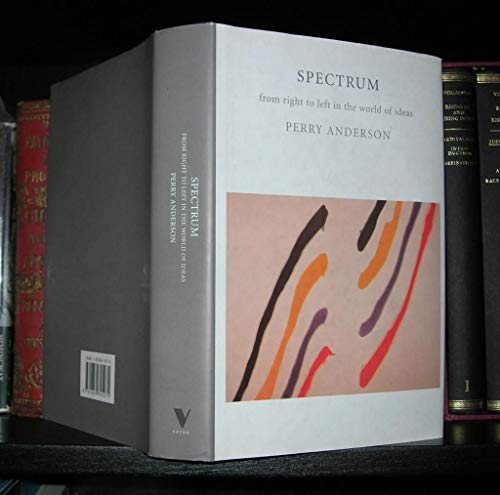
Hardcover. Condition: Very Good. Dust Jacket Condition: Near Fine. 1st Edition. 398pp., vxvii. Stated: "First published by Verso 2005" with '1' in number line. Black boards with brilliant silver lettering on spine. White dustwrapper not price-clipped ($35) with title lettering in dark gray at top center front cover, above subtitle and author name lettering in medium gray; large illustration of abstract art on lower half front cover, Morris Louis' "Theta Gamma". Dustwrapper hasThin line of wear across top spine and hint of wear at cover corners, else Fine. Artifact looks As New, unopened, unused, but belied by 12 pages (of 398 pp.) (between p. xii of Foreword and only within Chs. 1 and 2, up to p. 36) having small amounts of ink underlining (4 pp a single small check-mark (1 p has 2 check-marks); 7 pp. have underlining, with worst case having 9 lines underlined and 1 p with 8, else very short, scant): Describes much worse than it is, but there you have it: pp. 37-398 are Clean, Unmarked. Tight binding (NO cracks); sharp corners (NO bumps or curls); NO remainder marks; NO rubbing wear (dustwrapper did its job); NO previous owner names. Seller Inventory # 001957
Stock Image
Spectrum: From Right to Left in the World of Ideas
Seller: Powell's Bookstores Chicago, ABAA, Chicago, IL, U.S.A.
Seller rating 5 out of 5 stars
Hardcover. Condition: Used-Very Good. Minimal shelf wear, clean internals. May have remainder mark. Seller Inventory # 2038621
Stock Image
Spectrum
Seller: Powell's Bookstores Chicago, ABAA, Chicago, IL, U.S.A.
Seller rating 5 out of 5 stars
Hardcover. Condition: Very Good. Minimal shelf wear, clean internals. May have remainder mark. Seller Inventory # 2046521
Stock Image
Spectrum: From Right to Left in the World of Ideas
Seller: Sell Books, Elland, YORKS, United Kingdom
Seller rating 5 out of 5 stars
hardcover. Condition: Acceptable. Please see the condition note after this for details, if this is missing please consider Acceptable to mean poor quality that could include major staining, water damage, writing, missing dustjacket, etc etc. Our books are dispatched from a Yorkshire former cotton mill. We list via barcode/ISBN so please note that the images are stock images and may not be the exact copy you receive, furthermore the details about edition and year might not be accurate as many publishers reuse the same ISBN for multiple editions and as we simply scan a barcode or enter an ISBN we do not check the validity of the edition data when listing. If you're looking for an exact edition please don't order (at least not without checking with us first, although we don't always have time to check). We aim to dispatch prompty, the service used will depend on order value and book size. We can ship to most countries, see our shipping policies. Payment is via Abe only. Seller Inventory # P-BGJ00405-RAG-20250611-A
Buy Used
US$ 7.54
US$ 16.03 shipping
Ships from United Kingdom to U.S.A.
Ships from United Kingdom to U.S.A.
Quantity: 1 available
Stock Image
Spectrum: From Right to Left in the World of Ideas
Seller: Webster's Bookstore Cafe, Inc., State College, PA, U.S.A.
Seller rating 5 out of 5 stars
hardcover. Condition: Very Good. Dust Jacket Condition: Includes dust jacket. 2nd printing. DJ with mild edgewear or bumping. Light shelf wear. Else clean and tight. Seller Inventory # mon0000154492
Stock Image
Spectrum: From Right to Left in the World of Ideas
Published by
Verso / New Left Books, London New York, 2005
ISBN 10: 1859845274
ISBN 13: 9781859845271
Used
Hardcover
First Edition
Seller: Theoria Books, Andover, MA, U.S.A.
Seller rating 5 out of 5 stars
Hardcover. Condition: Fine. Dust Jacket Condition: Fine. 1st Edition. 398 pp., xxvii. Stated: "First published by Verso 2005" with '1' in number line. Black boards with brilliant silver lettering on spine. White dustwrapper not price-clipped ($35) with title lettering in dark gray at top center front cover, above subtitle and author name lettering in medium gray; large illustration of abstract art on lower half front cover, Morris Louis' "Theta Gamma". Ensemble looks virtually As New, unopened, unused, but for very superficial, 1 1/4" linear indent at lower left front cover in dw gutter (NO tear or penetration through dw; NO impact on book itself); top right corner front cover and top left rear cover corners were gently bumped, still virtually square with 1/2" crease on the hypotenuse of front cover corner and 1/4" crease on rear cover corner: Not at all as bad as it describes, but there you have it. Tight binding (NO cracks); essentially square corners; NO remainder marks; NO rubbing wear; NO previous owner names. Solid copy. Seller Inventory # 002665