
Items related to The Radetzky March
Synopsis
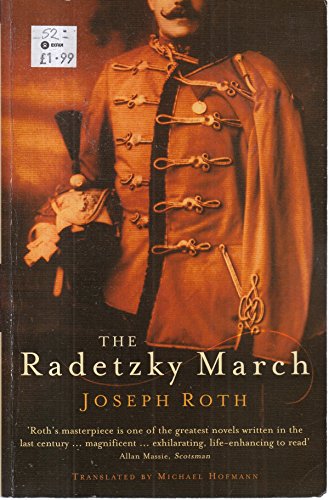
The Radetzky March charts the history of the Trotta family through three generations spanning the rise and fall of the Austro-Hungarian Empire. Through the Battle of Solferino to the entombment of the last Hapsburg emperor, Roth's intelligent compassion illuminates the crumbling of a way of life.
"synopsis" may belong to another edition of this title.
Review
Joseph Roth's 1932 novel, The Radetzky March, starts with an accident that creates a dynasty. When an infantry lieutenant steps in front of a bullet intended for the young Franz Joseph, the Austro-Hungarian emperor rewards him with wealth, promotion, and a knighthood. Almost overnight, Joseph Trotta is "severed" from his ancestors, and his family is transformed from unremarkable soldiers and peasants living in the outer reaches of the empire to barons and high-ranking officials living near the imperial palace. As long as Franz Joseph is the Kaiser, their status is secure. But when Trotta happens upon a schoolbook account of the event that exaggerates his heroism, he is shaken: He had been driven from the paradise of simple faith in Emperor and Virtue, Truth, and Justice, and, now fettered in silence and endurance, he may have realized that the stability of the world, the power of laws, and the glory of majesties were all based on deviousness. As World War I approaches and the monarchy's limitations become apparent, Trotta's son and grandson become even further removed from this paradise. They continue to follow the codes of honor and duty, though such behavioral guides become pointless, even burdensome, in a world shorn of simple faith in an emperor. Trotta's grandson Carl Joseph finds his military career overwhelmed by bad horsemanship, alcohol dependency, frivolous roulette and baccarat debts, and misguided love affairs--the kinds of flaws, he thinks, that are inevitable without the self-assurance and practical knowledge that he would have gained had he earned (rather than inherited) his position. Not long ago, he thinks wistfully, his family lived as peasants "in dwarfed huts, making their wives fertile by night and their fields by day." It is here that the Trottas' demise is at its most poignant, as the focus of the narrative shifts from the loss of status to the far more devastating loss of purpose.
In both style and temperament, Roth's novel stands between the 19th and 20th centuries, and the three Trottas could be seen as part of a progression that stretches back to Tolstoy's Prince Andrei and looks ahead to the Mathieu of Sartre's Les Chemins de la Liberté trilogy. Although The Radetzky March illustrates why the monarchy was doomed, and isn't blind to the new nations and ideologies on the horizon, Roth is more interested in his characters' psychology than their politics. And their central difficulty--the bewildering meaninglessness that follows the dissolution of an ideal--has been a fundamental 20th-century dilemma. The Trottas are, in Roth's stunning phrase, "homesick for the Kaiser." One need only substitute "the Chairman" or "Marxism" or "God" to understand the novel's lasting resonance. --John Ponyicsanyi
From the Back Cover
"A masterpiece.... The totality of Joseph Roth's work is no less than a tragédie humaine achieved in the techniques of modern fiction. No other contemporary writer, not excepting Thomas Mann, has come so close to achieving the wholeness--lying atop a slippery pole we never stop trying to climb--that Lukács cites as our impossible aim." --Nadine Gordimer
The Radetzky March, first published in 1932, is Joseph Roth's greatest literary achievement, a novel of world literary rank. Spanning three generations of the Trotta family and set in the waning days of the Hapsburg Empire, the novel unfolds with marvelous subtlety to reveal its splendidly modern ironies. In this new translation, Joachim Neugroschel captures the uniquely Rothian tone of the original--profound and elegant seriousness meshed with a tender sense of irony. One of the greatest novels of the twentieth century and an essential novel for our time, The Radetzky March is still breathtaking and still brilliant.
Joseph Roth was born in 1894, in a small Galician town on the eastern border of the Hapsburg Empire. He served briefly in the Austro-Hungarian Army and later worked as a journalist in Vienna, Berlin and Frankfurt. In 1933, he moved to Paris, where, upset by events in Europe and by his personal problems, he drank excessively, dying in Paris in 1939 from pneumonia and heart failure brought on by the withdrawal symptoms during a delerium tremens spell. One of the central figures in the émigré intellectual opposition to the Nazis, Joseph Roth is the author of fifteen novels and novellas and a large body of journalism. He is, along with Robert Musil and Thomas Mann, among the greatest of the early twentieth century Central European writers.
"About this title" may belong to another edition of this title.
Search results for The Radetzky March

Seller Image
The Radetzky March
Seller: Blue Vase Books, Interlochen, MI, U.S.A.
Seller rating 5 out of 5 stars

Condition: acceptable. The item is very worn but is perfectly usable. Signs of wear can include aesthetic issues such as scratches, dents, worn and creased covers, folded page corners and minor liquid stains. All pages and the cover are intact, but the dust cover may be missing. Pages may include moderate to heavy amount of notes and highlighting, but the text is not obscured or unreadable. Page edges may have foxing age related spots and browning . May NOT include discs, access code or other supplemental materials. Seller Inventory # BVV.1862076057.A
Stock Image
The Radetzky March
Seller: Better World Books, Mishawaka, IN, U.S.A.
Seller rating 5 out of 5 stars
Condition: Good. Pages intact with minimal writing/highlighting. The binding may be loose and creased. Dust jackets/supplements are not included. Stock photo provided. Product includes identifying sticker. Better World Books: Buy Books. Do Good. Seller Inventory # 4270483-6
Seller Image
Radetzky March
Seller: WeBuyBooks, Rossendale, LANCS, United Kingdom
Seller rating 5 out of 5 stars
paperback. Condition: Good. Most items will be dispatched the same or the next working day. A copy that has been read but remains in clean condition. All of the pages are intact and the cover is intact and the spine may show signs of wear. The book may have minor markings which are not specifically mentioned. Seller Inventory # rev4250261433
Buy Used
US$ 3.49
US$ 7.24 shipping
Ships from United Kingdom to U.S.A.
Ships from United Kingdom to U.S.A.
Quantity: 1 available
Stock Image
Radetzky March (Revised)
Published by
Granta Books (Uk) March 2012, 2012
ISBN 10: 1862076057
ISBN 13: 9781862076051
Used
Trade Paperback
Seller: R Bookmark, Youngtown, AZ, U.S.A.
Seller rating 5 out of 5 stars
Trade Paperback. Condition: Used - Acceptable. Shelf wear on cover. Seller Inventory # 296095
Stock Image
Radetzky March
Published by
Granta Books, United Kingdom, London, 2003
ISBN 10: 1862076057
ISBN 13: 9781862076051
Used
Paperback
Seller: WorldofBooks, Goring-By-Sea, WS, United Kingdom
Seller rating 5 out of 5 stars
Paperback. Condition: Very Good. The Radetzky March charts the history of the Trotta family through three generations from 1859 to 1916. The decadence and impending collapse of the Austro-Hungarian Empire are described in beautifully crafted and vivid language. Through the Battle of Solferino to the entombment of the last Hapsburg emperor, Roth's intelligent compassion illuminates the crumbling of an empire. The book has been read, but is in excellent condition. Pages are intact and not marred by notes or highlighting. The spine remains undamaged. Seller Inventory # GOR001240828
Buy Used
US$ 4.12
US$ 7.46 shipping
Ships from United Kingdom to U.S.A.
Ships from United Kingdom to U.S.A.
Quantity: 1 available
Stock Image
The Radetzky March
Seller: Better World Books Ltd, Dunfermline, United Kingdom
Seller rating 5 out of 5 stars
Condition: Good. Former library copy. Pages intact with minimal writing/highlighting. The binding may be loose and creased. Dust jackets/supplements are not included. Includes library markings. Stock photo provided. Product includes identifying sticker. Better World Books: Buy Books. Do Good. Seller Inventory # 7554903-6
Buy Used
US$ 6.43
US$ 6.66 shipping
Ships from United Kingdom to U.S.A.
Ships from United Kingdom to U.S.A.
Quantity: 1 available
Seller Image
The Radetzky March
Seller: Shakespeare Book House, Rockford, IL, U.S.A.
Seller rating 5 out of 5 stars
Condition: very_good. The book is clean and shows minor shelf ware, Seller Inventory # EBBV.1862076057.VG
Seller Image
The Radetzky March
Seller: Solr Books, Lincolnwood, IL, U.S.A.
Seller rating 5 out of 5 stars
Condition: very_good. This book is in Very good condition. There may be a few flaws like shelf wear and some light wear. Seller Inventory # BCV.1862076057.VG
Seller Image
Radetzky March
Seller: M Godding Books Ltd, Devizes, WILTS, United Kingdom
Seller rating 5 out of 5 stars
paperback. Condition: Good. . Posted within 1 working day. 1st class tracked post to the UK, Airmail with tracking worldwide. Robust recyclable packaging. Picture is the actual item. Seller Inventory # 276361
Buy Used
US$ 7.53
US$ 16.63 shipping
Ships from United Kingdom to U.S.A.
Ships from United Kingdom to U.S.A.
Quantity: 1 available
Seller Image
The Radetzky March
Seller: Hamelyn, Madrid, M, Spain
Seller rating 5 out of 5 stars
Condition: Fair. : Sumérgete en la Austria-Hungría de antes de la Primera Guerra Mundial con 'La Marcha Radetzky' de Joseph Roth. Esta edición de Granta Books, traducida por Michael Hofmann, te transporta a un mundo de cambios sociales y decadencia imperial a través de la historia de la familia Trotta. Con 384 páginas, esta novela en tapa blanda es una exploración profunda de la identidad, el honor y el declive de una era. EAN: 9781862076051 Tipo: Libros Categoría: Historia|Literatura y Ficción Título: The Radetzky March Autor: Joseph Roth Idioma: en Páginas: 384 Formato: tapa blanda. Seller Inventory # Happ-2026-10-07-fac51923
Buy Used
US$ 13.82
US$ 13.48 shipping
Ships from Spain to U.S.A.
Ships from Spain to U.S.A.
Quantity: 1 available