
Items related to River Rescue: A Manual for Whitewater Safety
Synopsis
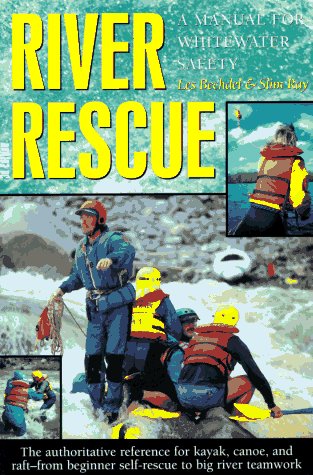
Whitewater paddling is exciting, adventurous_and sometimes risky. That's why every fast-water paddler needs the skills so clearly defined in River Rescue. This completely revised third edition of the AMC classic manual gives expert advice, with clear, concise instructions and hundreds of vital illustrations and photographs that cover all aspects of river safety. Features:
_ expanded material on big-water rescue
_ self-rescue and rescue of others_by hand, boat, rope, and other ways;
_ tools and techniques_rope work, throw bags, boat handling, high and
low-tech gear to use when seconds count;
_ rescue organization: leadership, teamwork, patient care, evacuation, and more
"synopsis" may belong to another edition of this title.
About the Author
Slim Ray is an internationally-recognized authority on flood, swiftwater and whitewater safety and rescue with over fifteen years experience in swiftwater rescue, including course development and instruction with Rescue 3, Canyonlands Field Institute, and the Nantahala Outdoor Center. He is also the author of Swiftwater Rescue and has written numerous articles on the subject. He is an active recreational kayaker and has worked as a raft guide and canoe and kayak instructor both in the US and abroad. He has been the American representative in several international river safety conferences and organized the International Safety Symposium (ISS '90) in the US.
From the Back Cover
Okay, your boat flipped. Now what? Whitewater paddling is exciting, adventurous - and sometimes risky. That's why every whitewater paddler needs the skills so clearly defined in River Rescue. With even more illustrations and photographs, this completely revised new edition will help prepare you for a great river adventure. You'll find expanded material on big-water rescue, including new gear and methods; on self-rescue and rescue of others, by hand, boat, rope and other methods; on tools and techniques, including rope work, throw bags, boat handling, and high- and low-tech gear to use when seconds count; and on rescue organization, including leadership, teamwork, patient care, evacuation and more.
Reviews
Without the knowledge imparted in these pages, the white magic of wild waters can turn black in a split-splash; with this knowledge rescue_with participants emerged washed and unscathed_can make an ordinary trip into a grand and epic experience." Richard Bangs, author of River Gods, Managing Editor, Microsoft Travel Products Group.
Excerpt. © Reprinted by permission. All rights reserved.
Characteristics of Whitewater Rivers
Four factors should be considered in assessing the difficulty of a whitewater river: elevation loss, volume of flow, geomorphic makeup of the river bed, and hazards. Other factors, like weather and accessibility, must also be considered, but they do not, strictly speaking, define the difficulty of the river.
Elevation loss in the United States is normally expressed in vertical feet per mile, usually as an average figure over the section normally run: the net vertical drop between two points 1 mile apart. Outside the U.S. this average is normally expressed as a percentage; e.g. 5%, equal to about 250 feet per mile. Averages can be deceptive, however, since some rivers concentrate their elevation loss in one steep section, thus hiding a difficult section with easy water before and after. For example, Section IV of the Chattooga has an average drop of about 50 feet per mile, but in the quarter-mile of the Five Falls it averages well over 200 feet per mile. Rivers like this are called pool-and-drop rivers. Other rivers, like the Arkansas River in Colorado, have a more consistent elevation loss. These rivers are often more dangerous, since they may have no calm pools in which to recover after a difficult section. Furthermore, there may be the risk of a long swim in cold water if things go wrong. Thus continuous Class III water may be more dangerous than pool-and-drop Class IV.
"About this title" may belong to another edition of this title.
Search results for River Rescue: A Manual for Whitewater Safety

Stock Image
River Rescue: Manual for Whitewater Safety
Seller: World of Books (was SecondSale), Montgomery, IL, U.S.A.
Seller rating 5 out of 5 stars

Paperback. Condition: Fair. Seller Inventory # 00110093401
Stock Image
River Rescue: Manual for Whitewater Safety
Seller: World of Books (was SecondSale), Montgomery, IL, U.S.A.
Seller rating 5 out of 5 stars
Paperback. Condition: Good. Seller Inventory # CIN1878239554G
Stock Image
River Rescue: A Manual for Whitewater Safety
Seller: Evergreen Goodwill, Seattle, WA, U.S.A.
Seller rating 5 out of 5 stars
paperback. Condition: Good. Seller Inventory # mon0000767775
Stock Image
River Rescue: A Manual for Whitewater Safety
Seller: ThriftBooks-Dallas, Dallas, TX, U.S.A.
Seller rating 5 out of 5 stars
Paperback. Condition: Good. No Jacket. Pages can have notes/highlighting. Spine may show signs of wear. ~ ThriftBooks: Read More, Spend Less. Seller Inventory # G1878239554I3N00
Stock Image
River Rescue: A Manual for Whitewater Safety
Seller: ThriftBooks-Atlanta, AUSTELL, GA, U.S.A.
Seller rating 5 out of 5 stars
Paperback. Condition: Good. No Jacket. Pages can have notes/highlighting. Spine may show signs of wear. ~ ThriftBooks: Read More, Spend Less. Seller Inventory # G1878239554I3N00
Stock Image
River Rescue: A Manual for Whitewater Safety
Seller: BooksRun, Philadelphia, PA, U.S.A.
Seller rating 5 out of 5 stars
Paperback. Condition: Very Good. 3rd. It's a well-cared-for item that has seen limited use. The item may show minor signs of wear. All the text is legible, with all pages included. It may have slight markings and/or highlighting. Seller Inventory # 1878239554-8-1
Stock Image
River Rescue : A Manual for Whitewater Safety
Published by
The Globe Pequot Publishing Group, Inc., 1998
ISBN 10: 1878239554
ISBN 13: 9781878239556
Used
Softcover
Seller: Better World Books, Mishawaka, IN, U.S.A.
Seller rating 5 out of 5 stars
Condition: Good. 3rd. Pages intact with minimal writing/highlighting. The binding may be loose and creased. Dust jackets/supplements are not included. Stock photo provided. Product includes identifying sticker. Better World Books: Buy Books. Do Good. Seller Inventory # 1605072-6
Stock Image
River Rescue : A Manual for Whitewater Safety
Published by
The Globe Pequot Publishing Group, Inc., 1998
ISBN 10: 1878239554
ISBN 13: 9781878239556
Used
Softcover
Seller: Better World Books, Mishawaka, IN, U.S.A.
Seller rating 5 out of 5 stars
Condition: Good. 3rd. Former library copy. Pages intact with minimal writing/highlighting. The binding may be loose and creased. Dust jackets/supplements are not included. Includes library markings. Stock photo provided. Product includes identifying sticker. Better World Books: Buy Books. Do Good. Seller Inventory # 10887587-6
Stock Image
River Rescue: A Manual for Whitewater Safety, 3rd (AMC Paddlesports)
Seller: Wonder Book, Frederick, MD, U.S.A.
Seller rating 5 out of 5 stars
Condition: Good. Good condition. A copy that has been read but remains intact. May contain markings such as bookplates, stamps, limited notes and highlighting, or a few light stains. Seller Inventory # E03L-00878
Stock Image
River Rescue: A Manual for Whitewater Safety, 3rd (AMC Paddlesports)
Seller: Wonder Book, Frederick, MD, U.S.A.
Seller rating 5 out of 5 stars
Condition: Very Good. Very Good condition. 3rd edition. A copy that may have a few cosmetic defects. May also contain light spine creasing or a few markings such as an owner's name, short gifter's inscription or light stamp. Seller Inventory # Q03P-01130