
Items related to How to Be a Perfect Stranger: A Guide to Etiquette...
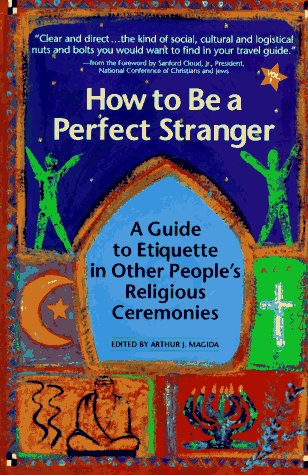
How to Be a Perfect Stranger: A Guide to Etiquette in Other People's Religious Ceremonies - Hardcover
Synopsis
Helps the guest of any other faith to feel comfortable, participate to the fullest extent possible, and avoid violating anyone's religious principles
"synopsis" may belong to another edition of this title.
From the Back Cover
"We encourage all people of faith to read it, refer to it often, and use it as their guide when visiting other communities of faith." -Rev. Ken Brooker Langston, Director of Education, The Interfaith Alliance"You'll never again feel uncomfortable attending services of a religion not your own, after reading this wonderful book." -Rabbi Jack Bemporad, Director of the Center for Christian-Jewish Understanding, Sacred Heart University
Reviews
At last: Help has arrived for the religiously challenged.
Guests at religious celebrations of faiths other than their own are often unaware of customs and rituals, appropriate dress, or gift-giving practices. The guidelines to religious etiquette in this book were developed to answer common questions asked by guests seeking to participate in the event yet attempting to avoid violating religious principles. Topics are addressed in a straightforward and nonjudgmental manner. The foreword was written by Sanford Cloud, president of the National Conference of Christians and Jews, who describes the effort as "a conscientious labor in the service of intergroup understanding."
Each of the 20 chapters is devoted to a particular religion, including Baptist, Buddhist, Christian Science, Episcopalian, Greek Orthodox, Hindu, Islam, Jehovah's Witnesses, Jewish, Mormon, Quaker, and Roman Catholic. Extensive questionnaires seeking information about customs, rituals, and language of the faith were completed by the national office of each religion, or by a member of the clergy of that faith. The respondents are listed in the front of the book.
Each chapter begins with a brief introduction to the history and beliefs of the faith, followed by a series of standard questions that detail the basic service (appropriate dress, behavior during the service); holy days and festivals; life cycle events (birth, initiation, marriage, and funerals); and home celebrations. They answer such questions as Where do I sit? Are there any parts of the service in which a guest should participate? Is there a reception after the service? What does the ritual mean? Is it OK to leave early? Is flash photography or videotaping permitted? Will contributions be collected at the ceremony? Will the casket be open?
Representing a diversity of faiths, these guidelines to correct social behavior at religious ceremonies belong on public library shelves everywhere.
Many of us feel nervous when we receive an invitation to attend a wedding, bar mitzvah, funeral, or other religious ceremony in a denomination or religion with which we are unfamiliar. What will the ceremony be like? What should I wear? When do I kneel? When do I stand? In what should I not participate? What sort of gift is expected and when do I present it? After questioning religious centers and experts across the country, Magida and other staff of Jewish Lights have compiled this helpful and informative guide to the basic beliefs and ceremonial practices of the major Jewish and Protestant denominations, Roman Catholic, Greek Orthodox, Mormon, Christian Scientist, Muslim, Hindu, and Buddhist religions. While general etiquette books usually cover some religious etiquette, none covers it as extensively or in as much detail as this. A welcome addition to public library collections. Highly recommended.?Marcia Welsh, Guilford Free Lib., Ct.
Copyright 1996 Reed Business Information, Inc.
"About this title" may belong to another edition of this title.
Search results for How to Be a Perfect Stranger: A Guide to Etiquette...

Stock Image
How to Be a Perfect Stranger: A Guide to Etiquette in Other People's Religious Ceremonies
Seller: World of Books (was SecondSale), Montgomery, IL, U.S.A.
Seller rating 5 out of 5 stars

Condition: Good. Item in very good condition! Textbooks may not include supplemental items i.e. CDs, access codes etc. Seller Inventory # 00073997932
Seller Image
How to Be a Perfect Stranger: A Guide to Etiquette in Other People's Religious Ceremonies
Seller: Greenworld Books, Arlington, TX, U.S.A.
Seller rating 5 out of 5 stars
Condition: very_good. Fast Free Shipping â" Very Good condition book with a firm cover and clean pages. Shows normal use and some light wear or limited notes markings. A solid, nice copy to enjoy. Seller Inventory # GWV.1879045397.VG
Stock Image
How to Be a Perfect Stranger: A Guide to Etiquette in Other People's Religious Ceremonies
Published by
Jewish Lights Pub (edition First Edition), 1995
ISBN 10: 1879045397
ISBN 13: 9781879045392
Used
Hardcover
First Edition
Seller: BooksRun, Philadelphia, PA, U.S.A.
Seller rating 5 out of 5 stars
Hardcover. Condition: Very Good. First Edition. With dust jacket. It's a well-cared-for item that has seen limited use. The item may show minor signs of wear. All the text is legible, with all pages included. It may have slight markings and/or highlighting. Seller Inventory # 1879045397-11-1-29
Stock Image
How to Be a Perfect Stranger Vol. 1 : A Guide to Etiquette in Other People's Religious Ceremonies
Published by
LongHill Partners, Incorporated, 1995
ISBN 10: 1879045397
ISBN 13: 9781879045392
Used
Hardcover
First Edition
Seller: Better World Books, Mishawaka, IN, U.S.A.
Seller rating 5 out of 5 stars
Condition: Good. 1st. Pages intact with minimal writing/highlighting. The binding may be loose and creased. Dust jackets/supplements are not included. Stock photo provided. Product includes identifying sticker. Better World Books: Buy Books. Do Good. Seller Inventory # 1607193-6
Stock Image
How to Be a Perfect Stranger Vol. 1 : A Guide to Etiquette in Other People's Religious Ceremonies
Published by
LongHill Partners, Incorporated, 1995
ISBN 10: 1879045397
ISBN 13: 9781879045392
Used
Hardcover
First Edition
Seller: Better World Books, Mishawaka, IN, U.S.A.
Seller rating 5 out of 5 stars
Condition: Good. 1st. Former library copy. Pages intact with minimal writing/highlighting. The binding may be loose and creased. Dust jackets/supplements are not included. Includes library markings. Stock photo provided. Product includes identifying sticker. Better World Books: Buy Books. Do Good. Seller Inventory # GRP36638536
Stock Image
How to Be a Perfect Stranger: A Guide to Etiquette in Other People's Religious Ceremonies
Seller: ThriftBooks-Atlanta, AUSTELL, GA, U.S.A.
Seller rating 5 out of 5 stars
Hardcover. Condition: Very Good. No Jacket. Former library book; May have limited writing in cover pages. Pages are unmarked. ~ ThriftBooks: Read More, Spend Less. Seller Inventory # G1879045397I4N10
Stock Image
How to Be a Perfect Stranger: A Guide to Etiquette in Other People's Religious Ceremonies
Seller: ThriftBooks-Reno, Reno, NV, U.S.A.
Seller rating 5 out of 5 stars
Hardcover. Condition: Very Good. No Jacket. May have limited writing in cover pages. Pages are unmarked. ~ ThriftBooks: Read More, Spend Less. Seller Inventory # G1879045397I4N00
Stock Image
How to Be a Perfect Stranger: A Guide to Etiquette in Other People's Religious Ceremonies
Seller: ThriftBooks-Atlanta, AUSTELL, GA, U.S.A.
Seller rating 5 out of 5 stars
Hardcover. Condition: Very Good. No Jacket. May have limited writing in cover pages. Pages are unmarked. ~ ThriftBooks: Read More, Spend Less. Seller Inventory # G1879045397I4N00
Stock Image
How to Be a Perfect Stranger: A Guide to Etiquette in Other People's Religious Ceremonies
Seller: HPB-Diamond, Dallas, TX, U.S.A.
Seller rating 5 out of 5 stars
hardcover. Condition: Very Good. Connecting readers with great books since 1972! Used books may not include companion materials, and may have some shelf wear or limited writing. We ship orders daily and Customer Service is our top priority! Seller Inventory # S_467157293
Stock Image
How to Be a Perfect Stranger: A Guide to Etiquette in Other People's Religious Ceremonies
Seller: HPB-Ruby, Dallas, TX, U.S.A.
Seller rating 5 out of 5 stars
hardcover. Condition: Very Good. Connecting readers with great books since 1972! Used books may not include companion materials, and may have some shelf wear or limited writing. We ship orders daily and Customer Service is our top priority! Seller Inventory # S_457837691