
Items related to The Bus Ride
Synopsis
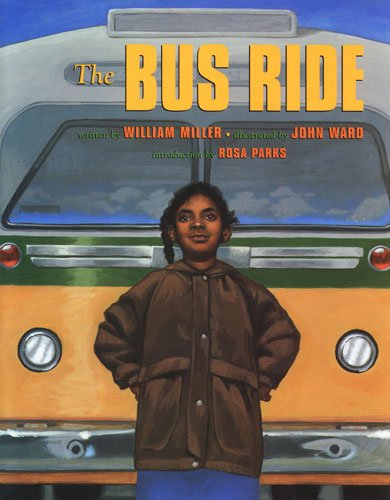
With its inspiring introduction by Rosa Parks, The Bus Ride is a timely reminder for readers of all ages that no act is too small when it comes to confronting injustice.
Sarah and her mother ride the bus every day. There are lots of other people on the bus, but some passengers aren't allowed to sit in certain areas.
One day, Sarah decides to see what she's missing by sitting at the back of the bus. The moment she moves up front she sets off a commotion that reverberates furiously throughout the city.
The award-winning author and artist, William Miller and John Ward, poignantly portray a child who discovers the courage of her convictions. With its inspiring introduction by Rosa Parks, The Bus Ride is a timely reminder for readers of all ages that no act is too small when it comes to confronting injustice.
"synopsis" may belong to another edition of this title.
About the Authors
William Miller is the award-winning author of numerous books for children for Lee & Low. Mr. Miller lives in York, Pennsylvania, where he teaches African American literature and creative writing at York College.
John Ward has illustrated many acclaimed children's books, including Kente Colors, The Freedom Riddle, and Poppa's New Pants, winner of the Parents' Choice Award. He lives with his wife in Freeport, NY.
Reviews
Kindergarten-Grade 3-A well-intentioned, fictional attempt to present some information about the issues at play during the 1955-56 bus boycott in Montgomery, AL, and to show the impact that can be made by one person taking a stand for what is right. Sara, an African-American girl, rides the bus each day with her mother. One morning, after her mother has gotten off, the child decides to see what is so special about the front of the bus. When she sits in one of the front seats and refuses to move, the driver calls a policeman, who carries her to the police station, where her mother is called. The next morning the two of them walk instead of taking the bus. Along the way they discover that Sara's picture is in the paper and that black and white people alike hail her as a hero. While this story follows the outline of the incidents that made Rosa Parks justifiably famous, it all happens too easily here. There is no sense of the bravery of Sara's action. When the policeman first talks to Sara, he is smiling. At the station, the sergeant pats her on the back. She is instantly a hero. It appears that a few days of boycotting is all it took to get the laws changed. The story, in fact, trivializes the entire incident rather than bringing it to life. Even the beautiful paintings portray little more than mild annoyance on the part of some of the onlookers. Rosa Parks's I Am Rosa Parks (Dial, 1997), Eloise Greenfield's Rosa Parks (HarperCollins, 1995), and David A. Adler's A Picture Book of Rosa Parks (Holiday, 1993) are all better choices.
Linda Greengrass, Bank Street College Library, New York City
Copyright 1998 Reed Business Information, Inc.
Miller (Richard Wright and the Library Card) offers a streamlined, fictional account of the Montgomery, Ala., bus strike?inspired by Rosa Parks's pivotal act of courage. Each morning, young Sara and her mother sit at the back of the bus, on their respective ways to school and work, while the whites sit in front. The girl's ride is longer than her mother's, and one morning after her mother exits, Sara makes her way to the front of the bus ("I just wanted to see what was so special"). Sara's ordeal is understandably less harrowing than Parks's was, given her age: after she refuses to either move to the back or get off the bus, a police officer takes her to the station, where he calls her mother rather than arrest her. The following day, Sara becomes an instant celebrity when her photo appears on the front page of the newspaper, and a crowd falls in step behind mother and daughter as they boycott the bus. The author somewhat oversimplifies the results of the youngster's actions ("The bus company got mad. The mayor got mad. People got so mad they finally changed the law"), but the language is easily accessible to picture-book readers. Ward's (Kente Colors) closely focused, acrylic paintings (most of which show similar scenes of the bus interior) are as straightforward and unadorned as Miller's text. Perhaps most inspiring to readers will be Parks's brief introduction, in which she frankly states that she had no intention of making history on that day in 1955: "I chose not to move because I was tired of laws that did not treat me like a first-class citizen in my own country." Ages 4-up.
Copyright 1998 Reed Business Information, Inc.
Ages 4^-6. Apparently set in the 1950s, this picture book, inspired by the story of Rosa Parks, places a child at the center of a civil rights triumph. Little Sara, who rides the bus every day, wants to know what's so special about the front of the bus, where she is not legally allowed to sit. One day she breaks the rules and plants herself in the front seat, causing a commotion that lands her at the police station. But reporters and supporters of all kinds await Sara outside, and her publicized bravery sparks a protest that finally causes the law to be amended. Rosa Parks' introduction places the story in the historical context that the story seems to lack: only a few details in the illustrations give clues to the time period. But even without a firm historical setting, the story is a fine example of a child taking a stand and making a difference. Kathleen Squires
"About this title" may belong to another edition of this title.
Search results for The Bus Ride

Stock Image
The Bus Ride
Published by
Lee & Low Books, Incorporated, 1998
ISBN 10: 1880000601
ISBN 13: 9781880000601
Used
Hardcover
First Edition
Seller: Better World Books: West, Reno, NV, U.S.A.
Seller rating 5 out of 5 stars

Condition: Very Good. John Ward (illustrator). 1st. Former library copy. Pages intact with possible writing/highlighting. Binding strong with minor wear. Dust jackets/supplements may not be included. Includes library markings. Stock photo provided. Product includes identifying sticker. Better World Books: Buy Books. Do Good. Seller Inventory # GRP58630433
Stock Image
The Bus Ride
Published by
Lee & Low Books, Incorporated, 1998
ISBN 10: 1880000601
ISBN 13: 9781880000601
Used
Hardcover
First Edition
Seller: Better World Books, Mishawaka, IN, U.S.A.
Seller rating 5 out of 5 stars
Condition: Good. John Ward (illustrator). 1st. Former library copy. Pages intact with minimal writing/highlighting. The binding may be loose and creased. Dust jackets/supplements are not included. Includes library markings. Stock photo provided. Product includes identifying sticker. Better World Books: Buy Books. Do Good. Seller Inventory # 42585486-6
Stock Image
The Bus Ride
Seller: World of Books (was SecondSale), Montgomery, IL, U.S.A.
Seller rating 5 out of 5 stars
Condition: Good. John Ward (illustrator). Item in very good condition! Textbooks may not include supplemental items i.e. CDs, access codes etc. Seller Inventory # 00076719592
Stock Image
The Bus Ride
Seller: World of Books Inc, Montgomery, IL, U.S.A.
Seller rating 4 out of 5 stars

Hardback. Condition: Good. John Ward (illustrator). Reading Program, United Methodist WomenWith its inspiring introduction by Rosa Parks, The Bus Ride is a timely reminder for readers of all ages that no act is too small when it comes to confronting injustice.Sarah and her mother ride the bus every day. There are lots of other people on the bus, but some passengers aren't allowed to sit in certain areas. One day, Sarah decides to see what she's missing by sitting at the back of the bus. The moment she moves up front she sets off a commotion that reverberates furiously throughout the city. The award-winning author and artist, William Miller and John Ward, poignantly portray a child who discovers the courage of her convictions. With its inspiring introduction by Rosa Parks, The Bus Ride is a timely reminder for readers of all ages that no act is too small when it comes to confronting injustice. Seller Inventory # CIN1880000601G
Seller Image
The Bus Ride
Published by
Lee & Low Books, New York, NY, U.S.A., 1998
ISBN 10: 1880000601
ISBN 13: 9781880000601
Used
Hardcover
First Edition
Seller: Betty Mittendorf /Tiffany Power BKSLINEN, Ralston, NE, U.S.A.
Seller rating 5 out of 5 stars
Pictorial Cover. Condition: Fair. No Jacket. John Ward (illustrator). 1st Edition. Color illustration on cover. Color illustrations. Int. good. Usual library markings and flaws. Ends of spine worn and chipped. Seller Inventory # 139499B
Stock Image
The Bus Ride
Published by
Lee & Low Books, New York, New York, U.S.A., 1998
ISBN 10: 1880000601
ISBN 13: 9781880000601
Used
Hardcover
First Edition
Seller: Indian Hills Books, Blountville, TN, U.S.A.
Seller rating 5 out of 5 stars
Hardcover. Condition: Fine. Dust Jacket Condition: Very Good. John Ward (illustrator). Stated First. No marks but for a small penciled number at upper corner of first blank page. Jacket has original $15.95 price intact on the flap. 3/4" tear at bottom edge of rear panel of jacket near the spine. No chipping. No fading. Top and bottom edges of jacket have curled a bit outward. Seller Inventory # 17747
Stock Image
The Bus Ride
Seller: BennettBooksLtd, Los Angeles, CA, U.S.A.
Seller rating 5 out of 5 stars
Hardcover. Condition: New. John Ward (illustrator). In shrink wrap. Looks like an interesting title! Seller Inventory # Q-1880000601