
Items related to British Enfield Rifles, Lee-Enfield No. 4 and No. 5...
British Enfield Rifles, Lee-Enfield No. 4 and No. 5 Rifles, Vol. 2 (For Collectors Only) - Softcover
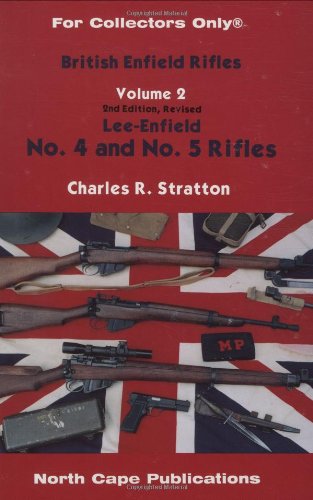
Synopsis
At the start of World War II, Great Britain was badly under armed. The disastrous campaigns in France in 1940 which resulted in the massive evacuation under fire of British and Allied troops from the beaches of Dunkirk and Calais further depleted her inventory of arms. Massive shipments of military arms from the U.S. Government and sporting arms from private American citizens helped to ease the situation somewhat, but it was the amazing production program that the British had put into effect as early as September 1939 that saved the British Army. In the first few years of the war, the tired old Lee-Enfield Mk I and Mk III carried the brunt of infantry fighting. Most of these rifles had been built before 1918 and were wearing out quickly. In the 1920s, the British army had begun development of a new, easier-to-manufacture version of the bolt action Lee-Enfield. The result was the Mk V with its receiver sight and stiffer barrel. Some 20,000 were produced for trials but then the labor governments of the late 1920s and early 1930s saw no reason to continue the development of armaments. Hadn't the League of Nations promised to settle all future international disputes? But in 1939, as Hitler's Germany was crushing Poland, a crash development program was instituted to put the Mk V Enfield into production was begun to make up for lost years. By 1941, the new rifle by now rechristened the No. 4 Enfield was pouring out of factories around the country. Production was begun also in Canada and in the United States. The new rifle was equipped with an improved receiver rear sight that brought the aperture nearer the eye and improved the solider's marksmanship. The heavy nose cap was gone, replaced by a lighter band with protective ears to guard the front sight. The long Pattern 1914 bayonet had been replaced by a short spike useful for guarding prisoners and little else an implicit recognition that the static, trench-oriented warfare was gone forever, replaced by maneuver warfare spearheaded by mobile columns of armor and infantry. A new, stiffer barrel was installed to improve the rifle's accuracy. Otherwise, it remained remarkably similar to its earlier incarnations. The No. 4 Enfield was produced in a wide number of variations, most having to do with ways to cut production costs and time. The rifles poured out of the factories and were shipped to the soldiers in the front lines and training camps as fast they could be made. The No. 4 provided excellent service in the British tommy's hands from the Arctic Circle to the North African Desert to the steamy jungles of Burma. As the rifle production program began, the British Army, impressed by the havoc wrought against the Red army by Finnish snipers in the Winter War of 1939-40, also began development of a new sniper rifle. The private firearms firm of Holland and Holland, famous for the sporting rifles and shotguns, developed a sturdy mounting system for the 32 Telescopic Sight and the No. 4 Mk I (T) was born. This rifle in the hands of British snipers in the regular Army and in such special warfare units as the Secret Air Service and the Commandos, inflicted casualties and havoc on Axis troops far beyond their number. In 1944, it became clear that a smaller, lighter rifle was needed for combat in the heavy jungles of Southeast Asia. A team of Enfield engineers stripped the No. 4 rifle to its essentials, shortened the barrel and developed a flash-hider to shield the soldier from the heavy muzzle concussion and flash, and added a padded butt plate. The No. 5 rifle popularly known as the British Enfield Jungle Carbine served well during the remainder of World War II and through the communist insurgencies that plagued Southeast Asia during the early Cold War years. "The British Enfield, Vol 2., The No. 4 and 5 Rifles," continues Charles R. Stratton's excellent series on British rifles of the 20th Century. The No. 4 and No. 5 rifles are dissected wit
"synopsis" may belong to another edition of this title.
From the Publisher
Charles Stratton has done his usual admirable job of organizing a vast body of information and make it clear and concise for the experienced historian and collector as well as the novice. This is the second in a projected four volume series with each book appearing at approximately 18 month intervals.
"About this title" may belong to another edition of this title.
Search results for British Enfield Rifles, Lee-Enfield No. 4 and No. 5...

Stock Image
British Enfield Rifles, Lee-Enfield No. 4 and No. 5 Rifles, Vol. 2 (For Collectors Only)
Published by
North Cape Publications Inc, 1999
ISBN 10: 1882391241
ISBN 13: 9781882391240
Used
Softcover
Seller: World of Books (was SecondSale), Montgomery, IL, U.S.A.
Seller rating 5 out of 5 stars

Condition: Very Good. Item in very good condition! Textbooks may not include supplemental items i.e. CDs, access codes etc. Seller Inventory # 00107406374
Seller Image
British Enfield Rifles Volume 2 (2nd Edition Revised): Lee-Enfield No. 4 and No. 5 Rifles
Published by
North Cape Publications, Tustin, CA, 2003
ISBN 10: 1882391241
ISBN 13: 9781882391240
Used
Paperback
Seller: JW Barker Books & Antiques, Natchez, MS, U.S.A.
Seller rating 5 out of 5 stars
Paperback. Condition: Near fine. Second. 2nd edition, revised, near fine trade paperback shows just a hint of wear. 193 pages with black & white drawings and photos. Still a pleasing copy of this informative work in the For Collectors Only line of titles. Seller Inventory # 35063
Seller Image
British Enfield Rifles Volume 2: Lee- Enfield No.4 and No. 5 Rifles
Published by
North Cape Publications Inc, 2003
ISBN 10: 1882391241
ISBN 13: 9781882391240
Used
Paperback
Seller: Midway Book Store (ABAA), St. Paul, MN, U.S.A.
Seller rating 5 out of 5 stars
Paperback. Condition: Fine. 2nd Edition Revised. Trade paperback, 193 pp. This copy has some shelf wear on the top and bottom of the cover and a little bit of the bottom of the spine. This is the second edition of the originally published work from 1999. This is part of the larger series and is for volume 2 only. Seller Inventory # 91293
Stock Image
British Enfield Rifles Vol. 2 Lee-Enfield No. 4 and No. 5 Rifles
Published by
North Cape Publications, Inc., Tustin, CA, 1999
ISBN 10: 1882391241
ISBN 13: 9781882391240
Used
Soft cover
First Edition
Seller: Prairie Creek Books LLC., Torrington, WY, U.S.A.
Seller rating 4 out of 5 stars

Soft cover. Condition: Very Good. Dust Jacket Condition: None. 1st Edition. Very good/none, used, 1st printing, perfect bound color illustrated stiff paper wraps, ii-xii, 192 pages. Interior clean and bright, binding tight. Slight rubbing to wraps, no chips or tears, corners lightly rubbed. Seller Inventory # 033405
Stock Image
British Enfield Rifles. Volume 2: Lee-Enfield No. 4 and No. 5 Rifles
Published by
North Cape Publications Inc, 1999
ISBN 10: 1882391241
ISBN 13: 9781882391240
Used
Soft cover
First Edition
Seller: Kisselburg Military Books, Potomac, MD, U.S.A.
Seller rating 4 out of 5 stars
Soft cover. Condition: Fine. 1st Edition. very nice copy. Seller Inventory # 048527
Stock Image
BRITISH ENFIELD RIFLES, VOLUME 2, 3RD EDITION, REVISED: LEE-ENFIELD NO. 4 AND NO. 5 RIFLES
Published by
North Cape Publications, 2024
ISBN 10: 1882391241
ISBN 13: 9781882391240
New
Soft cover
Seller: BSG BOOKS, Covington, LA, U.S.A.
Seller rating 5 out of 5 stars
Soft cover. Condition: New. 3rd Edition. 2024 Reprint of the 2008 Revised 3rd Edition, 191 pages. Soft covers. The second book in the Enfield series discusses the famed Enfield No. 4 rifle and No. 5 carbines. A part-by-part analysis includes all codes and manufacturers; history of development and use; serial number ranges and assembly/disassembly. The information is organized by part, manufacturer, and serial number to make it easy to find. A very detailed and comprehensive study. Available once again after being out of print for a while. Seller Inventory # 5575
Seller Image
British Enfield Rifles, Volume 2, 3rd Edition, Revised: Lee-Enfield No. 4 ad No. 5 Rifles
Published by
North Cape Publications, 2008
ISBN 10: 1882391241
ISBN 13: 9781882391240
New
Soft Cover
Seller: Collector Bookstore, Leavenworth, KS, U.S.A.
Seller rating 5 out of 5 stars
Soft Cover. Condition: New. Collector Bookstore Notes Covers British Enfield rifles & Lee-Enfield No. 4, No. 5 rifles, including sniper, target, training, etc. Includes production from U.K, U.S., South Africa, Pakistan. Publishers Description Charles (Skip) Stratton, has done an outstanding job - again. He presents the No. 4 and No. 5 rifle part-by-part. Every single model, including the sniper rifles, target and match rifles and training rifles, manufactured in the U.K., Canada, the U.S., Republic of South Africa and Pakistan, is thoroughly described. He begins by presenting the historical background for the development of both rifles, the No. 4 in the dark, early days of World War II and the No. 5 (better known as the Jungle Carbine) prompted by the ferocious fighting in Malaya and Burma. He describes each variation of both rifles and explains what all the "marks," "numbers," and codes found on most parts mean and shows how to relate them to the various manufacturing factories in England, Canada, the United States, South Africa and Pakistan. He also provides a breakdown of serial numbers by year, factory and country. Stratton then literally dissects both rifles, describing every single part and explaining the reasons behind any changes and points out how to identify those changes. For instance, there are eight different receivers - action bodies- used on the eleven variations of both rifles, five variations of breech bolts, nine variations of rear sights, thirteen variations of barrels and two variations of stocks. Stratton also discusses every single part of the rifle in the same detail so that the reader and collector knows that there are three variations of the humble stock bolt, seven variations of the forend, three variations of the buttplate, and so on, as well as how to identify each and relate it to a specific range of serial numbers produced by a specific factory. The book also translates the codes and markings that often pinpoint its original and subsequent military units. Collectors are thrilled when the discover that their rifle served at El Alamein or during the Invasion of Sicily, at Monte Cassino, Normandy or in the Far East in Malaya, or in Korea or Aden or anywhere else British forces were to be found between 1941 and the mid-1950s. As with his first volume covering the Mk I and Mk III (No. 1) Rifles, this is a thorough and well-organized book that will aid the collector in determining originality and restoring these historical battle rifles to authenticity. Seller Inventory # NCP-2008-9781882391240-WH1
Stock Image
British Enfield Rifles, Vol. 2, Lee-Enfield No. 4 and No. 5 Rifles (For Collectors Only)
Published by
North Cape Publications Inc, 1999
ISBN 10: 1882391241
ISBN 13: 9781882391240
New
Paperback
Seller: Revaluation Books, Exeter, United Kingdom
Seller rating 5 out of 5 stars
Paperback. Condition: Brand New. 1st edition. 192 pages. 8.40x5.50x0.60 inches. In Stock. Seller Inventory # __1882391241
Buy New
US$ 37.61
US$ 13.53 shipping
Ships from United Kingdom to U.S.A.
Ships from United Kingdom to U.S.A.
Quantity: 18 available
Stock Image
British Enfield Rifles, Vol. 2, Lee-Enfield No. 4 and No. 5 Rifles. (For collectors only)
Published by
North Cape, 1999., 1999
ISBN 10: 1882391241
ISBN 13: 9781882391240
Used
Paperback
First Edition
Seller: Military Books, Washington, DC, U.S.A.
Seller rating 5 out of 5 stars
Paperback. Condition: As New. 1st. 192p. Photos. Line drawings. Wraps. As New copy. Seller Inventory # 74-884C
Seller Image
The British Enfield Rifles: Vol 2: The No.4 and No.5 Rifles (The British Enfield Rifles: The No.4 and No.5 Rifles)
Published by
North Cape Publications Inc, 2003
ISBN 10: 1882391241
ISBN 13: 9781882391240
Used
Soft cover
Seller: Dyfi Valley Bookshop, Machynlleth, POWYS, United Kingdom
Seller rating 5 out of 5 stars
Soft cover. Condition: Very Good. 3rd Edition. Revised. Seller Inventory # 021751
Buy Used
US$ 27.87
US$ 29.76 shipping
Ships from United Kingdom to U.S.A.
Ships from United Kingdom to U.S.A.
Quantity: 1 available