
Items related to Bonfire of the Humanities: Rescuing the Classics in...
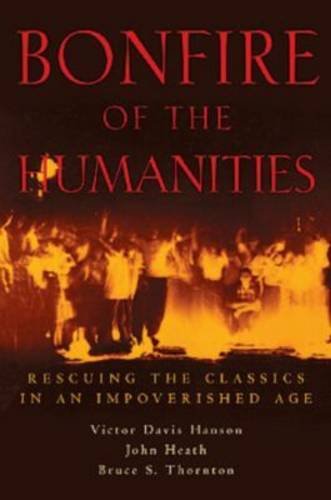
Synopsis
With humor, lucidity, and unflinching rigor, the acclaimed authors of Who Killed Homer? and Plagues of the Mind unsparingly document the degeneration of a central, if beleagured, disciplineclassicsand reveal the root causes of its decline. Hanson, Heath, and Thornton point to academics themselvestheir careerist ambitions, incessant self-promotion, and overspecialized scholarship, among other thingsas the progenitors of the crisis, and call for a return to academic populism, an approach characterized by accessible, unspecialized writing, selfless commitment to students and teaching, and respect for the legacy of freedom and democracy that the ancients bequeathed to the West.
"synopsis" may belong to another edition of this title.
About the Author
Victor Davis Hanson is Professor of Greek and Director of the Classics Program at California State University, Fresno. He is the author or editor of many books, including Who Killed Homer? The Demise of Classical Education and the Recovery of Greek Wisdom (with John Heath, Free Press, 1998), and The Soul of Battle (Free Press, 1999). In 1992 he was named the most outstanding undergraduate teacher of classics in the nation. John Heath is Associate Professor of Classics at Santa Clara University. His books include Actaeon, the Unmannerly Intruder (Peter Lang 1992) and Who Killed Homer? The Demise of Classical Education and the Recovery of Greek Wisdom (with Victor Davis Hanson, Free Press 1998).
Bruce S. Thornton is Professor of Classics and Humanities and in the Department of Foreign Languages at California State University in Fresno. Thorntons books include Eros: The Myth of Ancient Greek Sexuality (Westview, 1997), Plagues of the Mind: The New Epidemic of False Knowledge(ISI Books, 1999), The Humanities Handbook (Prentice Hall, 2000), and Greek Ways: How the Greeks Created Western Civilization (Encounter, 2000).
From the Inside Flap
“Professors Hanson, Heath and Thornton have written a set of powerful essays that combine scholarship, passion and wit in a devastating critique of the errors and sins that have brought the condition of the humanities low in America’s colleges and universities. They take on the elite rulers of what has become a shrinking and increasingly embattled kingdom with a vigor and zeal that embody the power latent in studies that are truly humanistic. Their assaults resemble the attacks made by the humanists of the Renaissance against the scholastic pettifoggers of their day and, in time, are bound to win a similar victory.”—Donald Kagan, Hillhouse Professor of History and Classics, Yale University “The true enemies of the Humanities are an unholy alliance between the tenured ideological dictatorship of deconstructive Leftists and the corporate-managerial mentality of fat overpaid administrators. Hanson, Heath, and Thornton are resolved to give these nefarious forces a run for their money. What makes this book genuinely splendid is that its authors know where to start: in Classical Antiquity, the indispensable foundation for any education that wants to see young minds growing into their full human potential.”—Virgil Nemoianu, William J Byron Distinguished Professor of Literature and Ordinary Professor of Philosophy, Catholic University of America Classical studies, once considered the foundation of all higher learning, is today nearly moribund. Students—and the general public—seem no longer interested in what the Greeks and Romans did or what they had to say. They certainly have no expectation of discovering wisdom in our classical past. The rejection of the relevance of the past, moreover, has increasingly spread throughout the humanities. Why is this occurring? And does it matter? Though many have sought to explain, or explain away, the problems of contemporary higher education, and the humanities in particular, few authors have examined the problem as deeply or as thoroughly as have Victor Davis Hanson, John Heath, and Bruce S. Thornton, well-known classicists and the acclaimed authors of such books as Who Killed Homer? and Plagues of the Mind. No one has explained so well, as these authors, the crucial linkages between the discipline of classics and modern Western civilization. They demonstrate here that no one can understand, much less hope to defend, the modern West without a thorough grounding in the classical authors and ideas that were its progenitors. In Bonfire of the Humanities: Rescuing the Classics in an Impoverished Age, Hanson, Heath, and Thornton begin by unsparingly documenting the degeneration of classics. They also reveal the root causes of this decline. They point to the academics themselves—their careerist ambitions, incessant self-promotion, and overspecialized, inaccessible work, among other things—as the source of the crisis, and call for a return to “academic populism,” an approach characterized by accessible, graceful writing, selfless commitment to students and teaching, and respect for the legacy of freedom and democracy that the ancients bequeathed to the West. Subsequent chapters detail the betrayal of classics by classicists, including chapters discussing the hypocrisy of Professor Martha Nussbaum’s attempt to justify the radicalization of classical studies, the self-indulgent careerism of humanities professors, the solipsistic narcissism of recent academic work in classics, the postmodernist contradictions and inanities now plaguing classical studies, and the disappearance of the disinterested humanities professor. An epilogue reviews the hilariously bizarre (but disturbing) “Unabomber episode,” in which authors Hanson and Heath were turned in as potential Unabomber suspects by one of their feminist colleagues. Hanson, Heath, and Thornton write in a style that is as illuminating as it is engaging. No one who reads this book will be able to deny the seriousness of the crisis in classics and the humanities at large; it will be equally impossible to deny the cultural significance of this crisis. Fortunately, the authors lay out detailed proposals to arrest the decline in humane learning. These proposals, and especially their call for professors to embrace academic populism, merit a fair and widespread hearing. Bonfire of the Humanities should be read by anyone interested in a sophisticated yet accessible analysis of the root problems affecting academia and the necessary measures to effect recovery.
Reviews
It has become quite common over the past 20 years for various groups of humanists to cry like prophets in the wilderness over the demise of the classics both in small liberal arts colleges and large state universities. Hanson and Heath (coauthors of Who Killed Homer? and professors of classics at, respectively, Cal State, Fresno, and Santa Clara University), along with Cal State classicist Thornton, contend that these arguments generally fail to strike at the heart of the problem which is, they say, that contemporary academics are hypocrites who decry racial discrimination, sexism and democratic capitalism from the vantage point of well-paid, tenured positions. These professors whom they deride as "Savonarolas... ideologues of the multicultural and postmodern Left" also purportedly contribute to the death of the classics by writing jargon-filled articles and books about ancient Greece and Rome that are inaccessible to a broader audience. In addition, such academics refuse to teach undergraduates, exploiting instead graduate teaching assistants who do not have the wealth of research to share with these younger students. The authors, who define their own enterprise as "academic populism," address this elitism and hypocrisy in a series of scathing essays and book reviews, which, unfortunately, suffer from many of the same problems of which they accuse their opponents (for instance, those they criticize, such as philosopher Martha Nussbaum and classicist Judith Hallett and thus these critiques themselves are more likely to be read by scholars than by a general audience). At best, the authors engage in defensive, whining, self-righteous diatribes in an effort to show how misguided their opponents are. At worst, Hanson, Heath and Thornton use this book to vilify those whom they perceive to have wronged them.
Copyright 2001 Cahners Business Information, Inc.
In this collection of new and previously published essays, classicists Hanson (California State Univ., Fresno), John Heath (Santa Clara Univ.), and Bruce S. Thornton (California State Univ., Fresno) prove that the old saying "academic politics are so poisonous only because there is so little at stake" is true. Railing against what they perceive as rampant careerism among modern-day exponents of "fashionable" theories such as postmodernism, feminism, and multiculturalism, Hanson and Heath return to the question that they posed in their earlier work, Who Killed Homer?: The Demise of Classical Education and the Recovery of Greek Wisdom, and provide the same answer, i.e., "They did." While the authors might compare their work to broader criticisms of the academy such as Allan Bloom's The Closing of the American Mind (LJ 5/1/87) and Dinesh D'Souza's Illiberal Education (LJ 3/15/91), this work is so steeped in the academic infighting specific to the field of classical studies that it is unlikely to find much of an audience beyond those already involved in the conflict. Recommended only for academic collections supporting advanced teaching and research in classics. Scott Walter, Washington State Univ., Pullman
Copyright 2001 Reed Business Information, Inc.
"About this title" may belong to another edition of this title.
Search results for Bonfire of the Humanities: Rescuing the Classics in...

Stock Image
Bonfire of the Humanities Resc
Seller: World of Books (was SecondSale), Montgomery, IL, U.S.A.
Seller rating 5 out of 5 stars

Condition: Very Good. Item in very good condition! Textbooks may not include supplemental items i.e. CDs, access codes etc. Seller Inventory # 00109237942
Seller Image
Bonfire of the Humanities: Rescuing the Classics in an Impoverished Age
Seller: Gate City Books, GREENSBORO, NC, U.S.A.
Seller rating 5 out of 5 stars
Condition: acceptable. USED book in ACCEPTABLE condition. Cover and pages are in tact but may show creases, tears, water damage, handwriting, underlining, or highlighting. May be missing dust jacket. Supplemental items such as access codes and CDs not guaranteed. Seller Inventory # GCM.3CGK
Stock Image
Bonfire of the Humanities: Rescuing the Classics in an Impoverished Age
Seller: HPB-Emerald, Dallas, TX, U.S.A.
Seller rating 5 out of 5 stars
Hardcover. Condition: Very Good. Connecting readers with great books since 1972! Used books may not include companion materials, and may have some shelf wear or limited writing. We ship orders daily and Customer Service is our top priority! Seller Inventory # S_464015672
Stock Image
Bonfire of the Humanities: Rescuing the Classics in an Impoverished Age
Seller: World of Books Inc, Montgomery, IL, U.S.A.
Seller rating 2 out of 5 stars

Hardback. Condition: Very Good. With humor, lucidity, and unflinching rigor, the acclaimed authors of Who Killed Homer? and Plagues of the Mind unsparingly document the degeneration of a central if beleagured discipline -- classics -- and reveal the root causes of its decline. Hanson, Heath, and Thornton point to academics themselves -- their careerist ambitions, incessant self-promotion, and overspecialized scholarship, among other things -- as the progenitors of the crisis. They call for a return to academic populism, an approach characterized by accessible, unspecialized writing, selfless commitment to students and teaching, and respect for the legacy of freedom and democracy that the ancients bequeathed to the West. Seller Inventory # CIN1882926544VG
Stock Image
Bonfire of the Humanities: Rescuing the Classics in an Impoverished Age
Published by
Intercollegiate Studies Institute, 2001
ISBN 10: 1882926544
ISBN 13: 9781882926541
Used
Hardcover
Seller: ThriftBooks-Dallas, Dallas, TX, U.S.A.
Seller rating 5 out of 5 stars
Hardcover. Condition: Very Good. No Jacket. Former library book; May have limited writing in cover pages. Pages are unmarked. ~ ThriftBooks: Read More, Spend Less. Seller Inventory # G1882926544I4N10
Stock Image
Bonfire of the Humanities: Rescuing the Classics in an Impoverished Age
Published by
Intercollegiate Studies Institute, 2001
ISBN 10: 1882926544
ISBN 13: 9781882926541
Used
Hardcover
Seller: ThriftBooks-Atlanta, AUSTELL, GA, U.S.A.
Seller rating 5 out of 5 stars
Hardcover. Condition: Good. No Jacket. Missing dust jacket; Pages can have notes/highlighting. Spine may show signs of wear. ~ ThriftBooks: Read More, Spend Less. Seller Inventory # G1882926544I3N01
Stock Image
Bonfire of the Humanities: Rescuing the Classics in an Impoverished Age
Published by
Intercollegiate Studies Institute, 2001
ISBN 10: 1882926544
ISBN 13: 9781882926541
Used
Hardcover
Seller: ThriftBooks-Dallas, Dallas, TX, U.S.A.
Seller rating 5 out of 5 stars
Hardcover. Condition: Good. No Jacket. Former library book; Pages can have notes/highlighting. Spine may show signs of wear. ~ ThriftBooks: Read More, Spend Less. Seller Inventory # G1882926544I3N10
Stock Image
Bonfire of the Humanities: Rescuing the Classics in an Impoverished Age
Published by
Intercollegiate Studies Institute, 2001
ISBN 10: 1882926544
ISBN 13: 9781882926541
Used
Hardcover
Seller: ThriftBooks-Atlanta, AUSTELL, GA, U.S.A.
Seller rating 5 out of 5 stars
Hardcover. Condition: Good. No Jacket. Pages can have notes/highlighting. Spine may show signs of wear. ~ ThriftBooks: Read More, Spend Less. Seller Inventory # G1882926544I3N00
Stock Image
Bonfire of the Humanities: Rescuing the Classics in an Impoverished Age
Published by
Intercollegiate Studies Institute, 2001
ISBN 10: 1882926544
ISBN 13: 9781882926541
Used
Hardcover
Seller: ThriftBooks-Dallas, Dallas, TX, U.S.A.
Seller rating 5 out of 5 stars
Hardcover. Condition: Fair. No Jacket. Readable copy. Pages may have considerable notes/highlighting. ~ ThriftBooks: Read More, Spend Less. Seller Inventory # G1882926544I5N00
Stock Image
Bonfire of the Humanities: Rescuing the Classics in an Impoverished Age
Published by
Intercollegiate Studies Institute, 2001
ISBN 10: 1882926544
ISBN 13: 9781882926541
Used
Hardcover
Seller: ThriftBooks-Atlanta, AUSTELL, GA, U.S.A.
Seller rating 5 out of 5 stars
Hardcover. Condition: Very Good. No Jacket. Former library book; May have limited writing in cover pages. Pages are unmarked. ~ ThriftBooks: Read More, Spend Less. Seller Inventory # G1882926544I4N10