
Items related to I Used to Be Perfect: A Study of Sin and Salvation
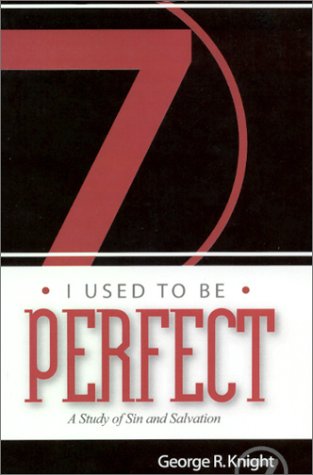
Synopsis
Writing in a highly engaging oral style from his own early struggles with legalism, Knight examines some of the most basic questions about salvation: What does it mean to sin? What is temptation? What is the law? What does it mean to be saved? What does it mean to be perfect? Special features include study questions at the end of each chapter, reference notes to sources, a topical and scripture index, and a bibliography.
"synopsis" may belong to another edition of this title.
About the Author
George R. Knight is professor of church history at the Seventh-day Adventist Theological Seminary at Andrews University. A prolific writer, he is the author of A Brief History of Seventh-day Adventists, Walking with Jesus on the Mount of Blessing, and Philosophy and Education: An Introduction in Christian Perspective, among many other works.
Excerpt. © Reprinted by permission. All rights reserved.
Eating cheese is not SIN!
I figured most of you would agree with me on that point. So I ll see if I can antagonize the rest of you.
Eating rats, snakes, snails, or even hogs is not SIN.
Sabbath breaking is not SIN.
Murder is not SIN.
Theft is not SIN.
SIN is prior to all these things. They may be sins maybe but they are not SIN.
SIN is love.
Earth s first SIN
Perhaps we can best understand the nature of SIN by looking at the first sin in Genesis 3, the original sin by Eve. The essential question is, "Did Eve sin when she took the fruit or before she took the fruit?" The answer will help us come to grips with the nature of both SIN and sins. Now, let s go to the biblical record.
The first part of Genesis 3 centers around the dynamics of temptation. "The serpent," we read, "was more subtle than any other wild creature that the Lord God had made. He said to the woman, Did God say...? " (Gen. 3:1). When Satan comes to me, when he comes to you, his first point of attack is to get us to question the Word of God to get us to doubt whether God said it. If the devil can win the battle at that point, he has won the war.
However, that s not usually the end, because often Satan doesn t win there. And so the passage goes on in verse 2: "And the woman said to the serpent, We may eat of the fruit of the trees of the garden; but God said, "You shall not eat of the fruit of the tree which is in the midst of the garden, neither shall you touch it, lest you die." " But the serpent replied to the woman, "You certainly don t believe that, do you? You won t die" (see verse 4). So if the first point in Satan s strategy is to get us to doubt God s Word (to tempt us to doubt that God said it), the second point is to get us to doubt that God means what He says.
And the passage goes on, " For God knows that when you eat of it your eyes will be opened, and you will be like God, knowing good and evil. So...the woman saw that the tree was good for food, and that it was a delight to the eyes, and that the tree was to be desired to make one wise" (Gen. 3:5, 6). The third step in temptation is to get us to doubt God s good intentions toward us. Underlying this step is the idea that God wants to keep us from the good things of life that He doesn t want us to be happy.
Thus He can t be trusted.
Even though God made us to enjoy life to the fullest, Satan comes and says:
"God can t be trusted."
"Doubt God s Word."
"Doubt whether God means it."
"Doubt the goodness of His intentions."
If one listens to the tempter, the natural conclusion is that God can t be trusted. Therefore, do your own thing. And that is exactly what Eve did in verse 6. The Bible says she took of the fruit and she ate it. She took. But note. Something happened in Eve s head or in her heart before she took the fruit. By the time she had taken the fruit, she had already sinned. In essence, she had told God to leave her alone, that she knew better than He did what was good for her. She had rejected His Word and will and replaced it with her own wisdom and will. In short, before reaching for the fruit, Eve had chosen her own will over the will of God. She had put her self on the throne of her life, at the center of her universe, thus displacing God. In actuality, she had focused her love on her self rather than on God. And that is the core of SIN.
Eve committed SIN when she loved herself and her desire more than she loved God and His will. She committed SIN in her heart. And that SIN in her heart led to the taking and the eating of the fruit. SIN in the heart leads to sins in terms of action. Something happens in the heart first. First, there is SIN in the heart. That SIN in the heart then gives birth to sinful actions.
"About this title" may belong to another edition of this title.
Search results for I Used to Be Perfect: A Study of Sin and Salvation

Stock Image
I Used to Be Perfect: A Study of Sin and Salvation
Published by
Andrews University Press, 2001
ISBN 10: 1883925312
ISBN 13: 9781883925314
Used
Softcover
Seller: World of Books (was SecondSale), Montgomery, IL, U.S.A.
Seller rating 5 out of 5 stars

Condition: Good. Item in good condition. Textbooks may not include supplemental items i.e. CDs, access codes etc. Seller Inventory # 00097349628
Stock Image
I Used to Be Perfect
Published by
Andrews University Press, 2001
ISBN 10: 1883925312
ISBN 13: 9781883925314
Used
Paperback
Seller: World of Books (was SecondSale), Montgomery, IL, U.S.A.
Seller rating 5 out of 5 stars
Paperback. Condition: Very Good. Seller Inventory # 00110478457
Seller Image
I Used to Be Perfect: A Study of Sin and Salvation
Published by
Andrews University Press, 2001
ISBN 10: 1883925312
ISBN 13: 9781883925314
Used
Softcover
Seller: Zoom Books East, Glendale Heights, IL, U.S.A.
Seller rating 5 out of 5 stars
Condition: very_good. Book is in very good condition and may include minimal underlining highlighting. The book can also include "From the library of" labels. May not contain miscellaneous items toys, dvds, etc. . We offer 100% money back guarantee and 24 7 customer service. Seller Inventory # ZEV.1883925312.VG
Seller Image
I Used to Be Perfect: A Study of Sin and Salvation
Published by
Andrews University Press, 2001
ISBN 10: 1883925312
ISBN 13: 9781883925314
Used
Softcover
Seller: Zoom Books Company, Lynden, WA, U.S.A.
Seller rating 5 out of 5 stars
Condition: very_good. Book is in very good condition and may include minimal underlining highlighting. The book can also include "From the library of" labels. May not contain miscellaneous items toys, dvds, etc. . We offer 100% money back guarantee and 24 7 customer service. Seller Inventory # ZBV.1883925312.VG
Seller Image
I Used to Be Perfect: A Study of Sin and Salvation
Published by
Andrews University Press, 2001
ISBN 10: 1883925312
ISBN 13: 9781883925314
Used
Softcover
Seller: Greenworld Books, Arlington, TX, U.S.A.
Seller rating 5 out of 5 stars
Condition: good. Fast Free Shipping â" Good condition. It may show normal signs of use, such as light writing, highlighting, or library markings, but all pages are intact and the book is fully readable. A solid, complete copy that's ready to enjoy. Seller Inventory # GWV.1883925312.G
Stock Image
I Used to Be Perfect
Published by
Andrews University Press, 2001
ISBN 10: 1883925312
ISBN 13: 9781883925314
Used
Paperback
Seller: World of Books Inc, Montgomery, IL, U.S.A.
Seller rating 4 out of 5 stars

Paperback. Condition: Very Good. Seller Inventory # CIN1883925312VG
Stock Image
I Used to Be Perfect
Published by
Andrews University Press, 2001
ISBN 10: 1883925312
ISBN 13: 9781883925314
Used
Paperback
Seller: World of Books Inc, Montgomery, IL, U.S.A.
Seller rating 4 out of 5 stars
Paperback. Condition: Good. Seller Inventory # CIN1883925312G
Stock Image
I Used to Be Perfect : A Study of Sin and Salvation
Published by
Andrews University Press, 2001
ISBN 10: 1883925312
ISBN 13: 9781883925314
Used
Softcover
Seller: Better World Books, Mishawaka, IN, U.S.A.
Seller rating 5 out of 5 stars
Condition: Very Good. Pages intact with possible writing/highlighting. Binding strong with minor wear. Dust jackets/supplements may not be included. Stock photo provided. Product includes identifying sticker. Better World Books: Buy Books. Do Good. Seller Inventory # 14374143-6
Stock Image
I Used to Be Perfect : A Study of Sin and Salvation
Published by
Andrews University Press, 2001
ISBN 10: 1883925312
ISBN 13: 9781883925314
Used
Softcover
Seller: Better World Books, Mishawaka, IN, U.S.A.
Seller rating 5 out of 5 stars
Condition: Good. Pages intact with minimal writing/highlighting. The binding may be loose and creased. Dust jackets/supplements are not included. Stock photo provided. Product includes identifying sticker. Better World Books: Buy Books. Do Good. Seller Inventory # 8907180-6
Stock Image
I Used to Be Perfect: A Study of Sin and Salvation
Published by
Andrews University Press, 2001
ISBN 10: 1883925312
ISBN 13: 9781883925314
Used
Softcover
Seller: Wonder Book, Frederick, MD, U.S.A.
Seller rating 5 out of 5 stars
Condition: Good. Good condition. 2nd edition. A copy that has been read but remains intact. May contain markings such as bookplates, stamps, limited notes and highlighting, or a few light stains. Seller Inventory # L13I-04611